Probability — OCR GCSE Study Guide
Exam Board: OCR | Level: GCSE
Master OCR Further Maths Probability by tackling conditional events, algebraic tree diagrams, and quadratic equation formation. This guide provides examiner insights, worked examples, and memory hooks to help you secure top marks on this high-stakes topic.
## Overview
Welcome to the definitive guide for Probability (5.4) in the OCR GCSE Further Mathematics specification. This topic is a cornerstone of the exam, blending pure probability theory with advanced algebraic manipulation. Unlike standard GCSE, you will be required to move beyond simple probability trees and engage with conditional probability in 'without replacement' scenarios, which often leads to forming and solving quadratic equations. Examiners frequently use this topic to test multiple Assessment Objectives simultaneously, particularly AO2 (Reasoning) and AO3 (Problem Solving), which together account for 70% of the marks. A strong command of this area is not just about earning marks; it's about developing a sophisticated mathematical mindset that connects different areas of the curriculum. This guide will equip you with the core concepts, examiner-approved techniques, and multi-modal resources to achieve excellence.

## Key Concepts
### Concept 1: Conditional Probability and 'Without Replacement'
This is the single most important concept to master. When an event occurs 'without replacement', the outcome of the second event is dependent on the outcome of the first. This is the essence of **conditional probability**. The total number of possible outcomes decreases for the second event, which is a common source of error for candidates.
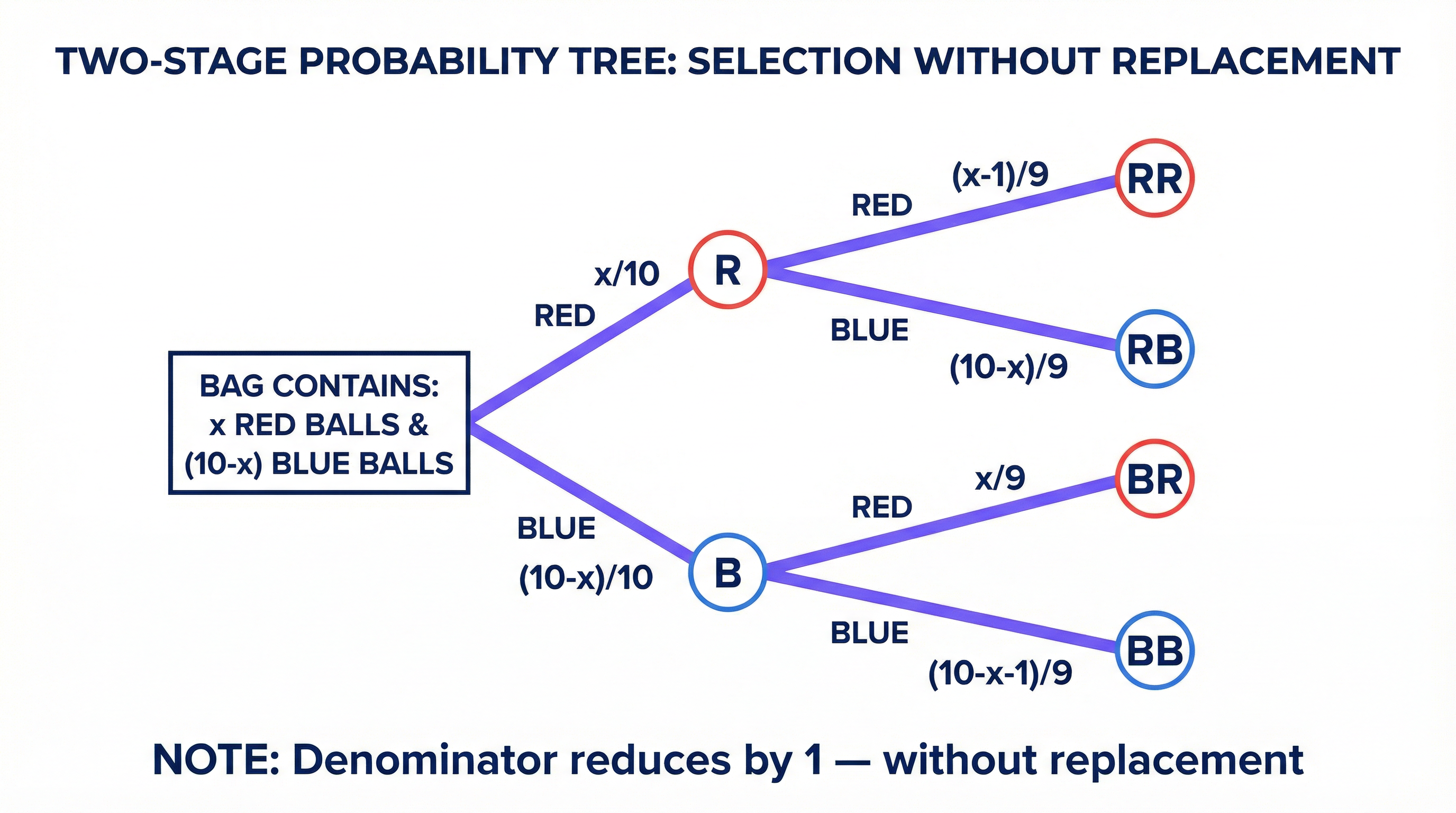
**The Golden Rule**: In any 'without replacement' problem, the denominator of the probabilities for the second event MUST be one less than the denominator for the first event. Forgetting this is the most frequent mistake and will lose you the initial method marks.
**Example**: A bag contains 5 red and 3 blue balls (8 total). A ball is picked and not replaced. A second ball is picked.
- P(First is Red) = 5/8
- P(Second is Red, GIVEN the first was Red) = 4/7 (There are now only 4 red balls and 7 total balls left).
### Concept 2: The Core Probability Rules
The entire topic rests on two fundamental rules for combining probabilities, which are best visualised using a tree diagram.
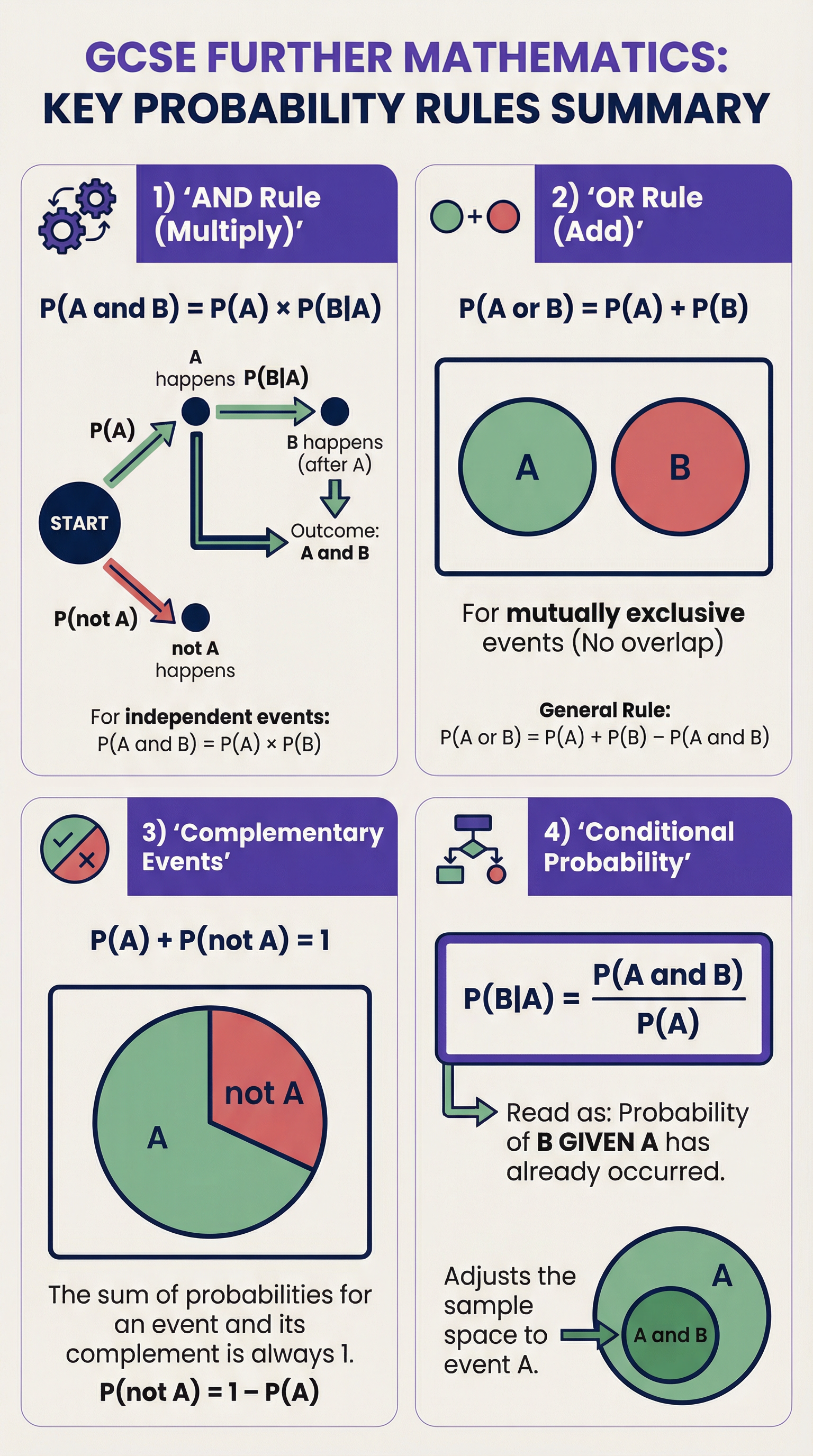
1. **The AND Rule (Multiplication)**: To find the probability of a sequence of events occurring one after another (e.g., picking a red ball AND then a blue ball), you **multiply** the probabilities along the corresponding branches of the tree diagram. Think of it as travelling along a single path from start to finish.
- *P(A and B) = P(A) * P(B|A)*
2. **The OR Rule (Addition)**: To find the probability of an overall outcome that can be achieved in more than one way (e.g., picking one ball of each colour), you **add** the probabilities of the individual, mutually exclusive paths. First, calculate the probability of each complete path (using the AND rule), then sum the results.
- *P(one of each) = P(Red then Blue) + P(Blue then Red)*
### Concept 3: Algebraic Probability
This is the hallmark of Further Mathematics. Questions will introduce an unknown, 'x', representing the number of items of a certain type. Your task is to build a probability tree using algebraic fractions and then form an equation using information given in the question. This almost always results in a quadratic equation that you must solve.
**Process**:
1. Define your probabilities algebraically on the tree diagram (e.g., P(Red) = x/N).
2. Identify the outcome path(s) described in the question.
3. Multiply along the branches to form an algebraic expression for the probability of that outcome.
4. Set this expression equal to the probability value given in the question.
5. Solve the resulting equation (usually quadratic). Remember to discard any solutions that are not valid in the context (e.g., negative numbers of balls, or a number greater than the total).
## Mathematical Relationships
- **Conditional Probability Formula**: *P(B|A) = P(A and B) / P(A)*. This states the probability of B happening given A has already happened. It is the foundation of the 'without replacement' logic. (Must memorise)
- **The Complement Rule**: *P(At least one) = 1 - P(None)*. This is a crucial time-saving technique. For example, the probability of picking at least one red ball is 1 minus the probability of picking no red balls (i.e., all blue balls). (Must memorise)
- **Sum of Probabilities**: For any event, *P(A) + P(not A) = 1*. On a tree diagram, the sum of probabilities on branches originating from a single point must always equal 1. (Given on formula sheet)
## Practical Applications
While the exam questions focus on abstract scenarios like coloured balls or counters, the principles of conditional probability are fundamental to many real-world fields. Actuaries in the insurance industry use it to calculate risk based on a series of events. In medical testing, it's used to determine the accuracy of a diagnosis given a particular test result (the probability of having a disease given a positive test). It is also the mathematical basis for machine learning algorithms used in spam filtering and recommendation systems.