OCR · GCSE · Further Mathematics
Set Notation
Master OCR GCSE Further Maths Set Notation (5.5) with this comprehensive guide. Learn to fluently use symbols, interpret Venn diagrams, and tackle exam questions on intersection, union, and complements to secure top marks."
- 5 min read
- 3 worked examples
- 6 practice questions
Study Notes

Overview
Set notation is the language of mathematical logic, providing a precise and universal shorthand to describe and manipulate collections of objects, known as sets. For OCR GCSE Further Mathematics candidates, mastering this topic (5.5) is crucial as it forms a vital bridge between algebra, probability, and logic. Examiners frequently use set notation to test a candidate's symbolic literacy and their ability to translate between abstract symbols, descriptive language, and visual representations like Venn diagrams. A typical exam question might ask you to populate a Venn diagram from given information, describe a shaded region using correct notation, or calculate probabilities based on the number of elements in specific sets. Strong performance in this area demonstrates a deeper level of mathematical maturity and is essential for achieving higher grades.
Key Concepts
Concept 1: The Universal Set and Elements
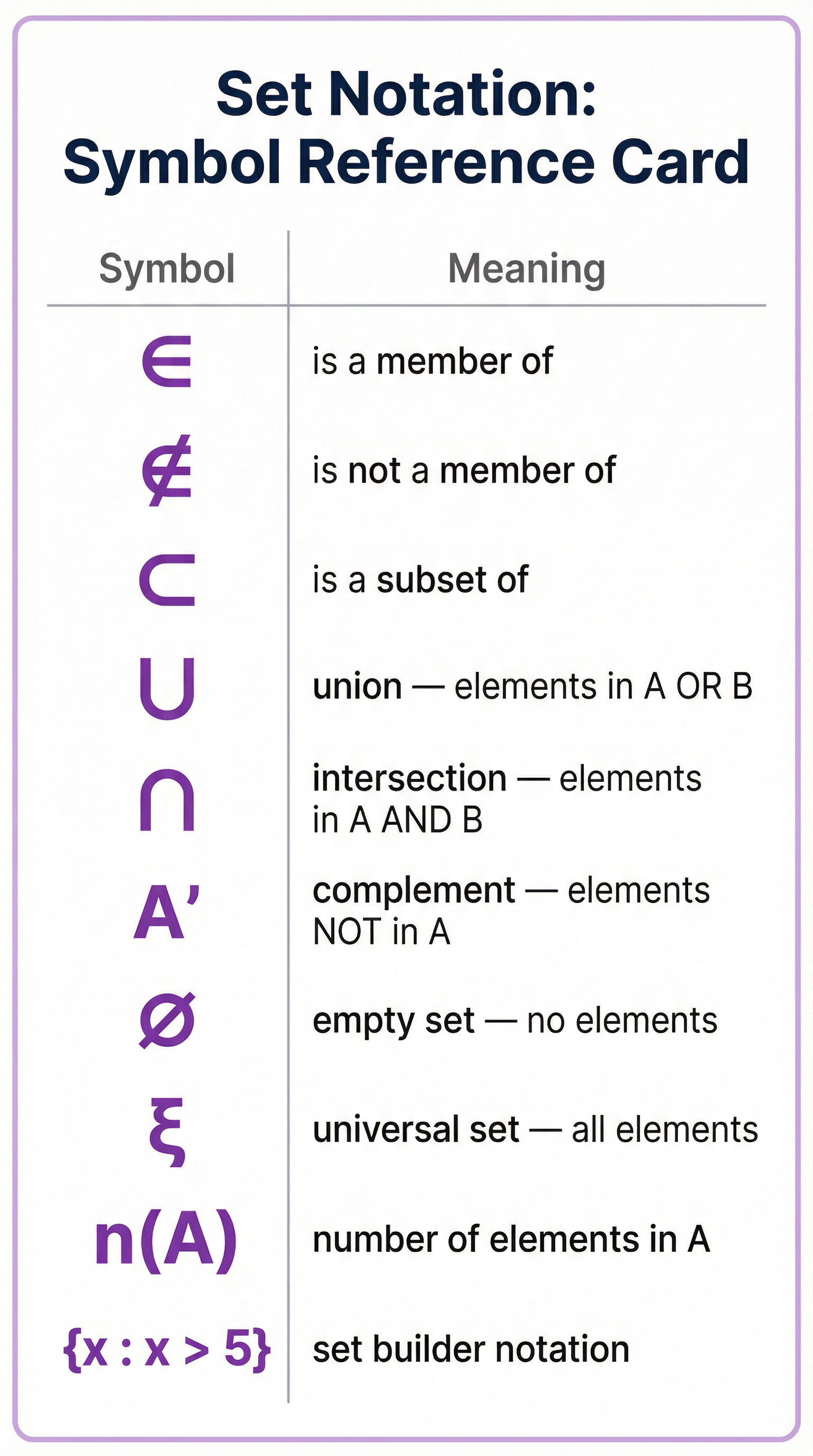
The Universal Set, denoted by the symbol ξ (the Greek letter xi), encompasses every element relevant to a particular problem. It is the 'universe' of our question. On a Venn diagram, this is represented by the outer rectangle. An element is a single item within a set. We use the symbol ∈ to show that an item is an element of a set (e.g., 3 ∈ A means '3 is an element of set A') and ∉ to show it is not (e.g., 4 ∉ A).
Example: If ξ = {1, 2, 3, 4, 5, 6} and Set A = {2, 4, 6}, then 2 ∈ A but 5 ∉ A.
Concept 2: Intersection (∩) and Union (∪)
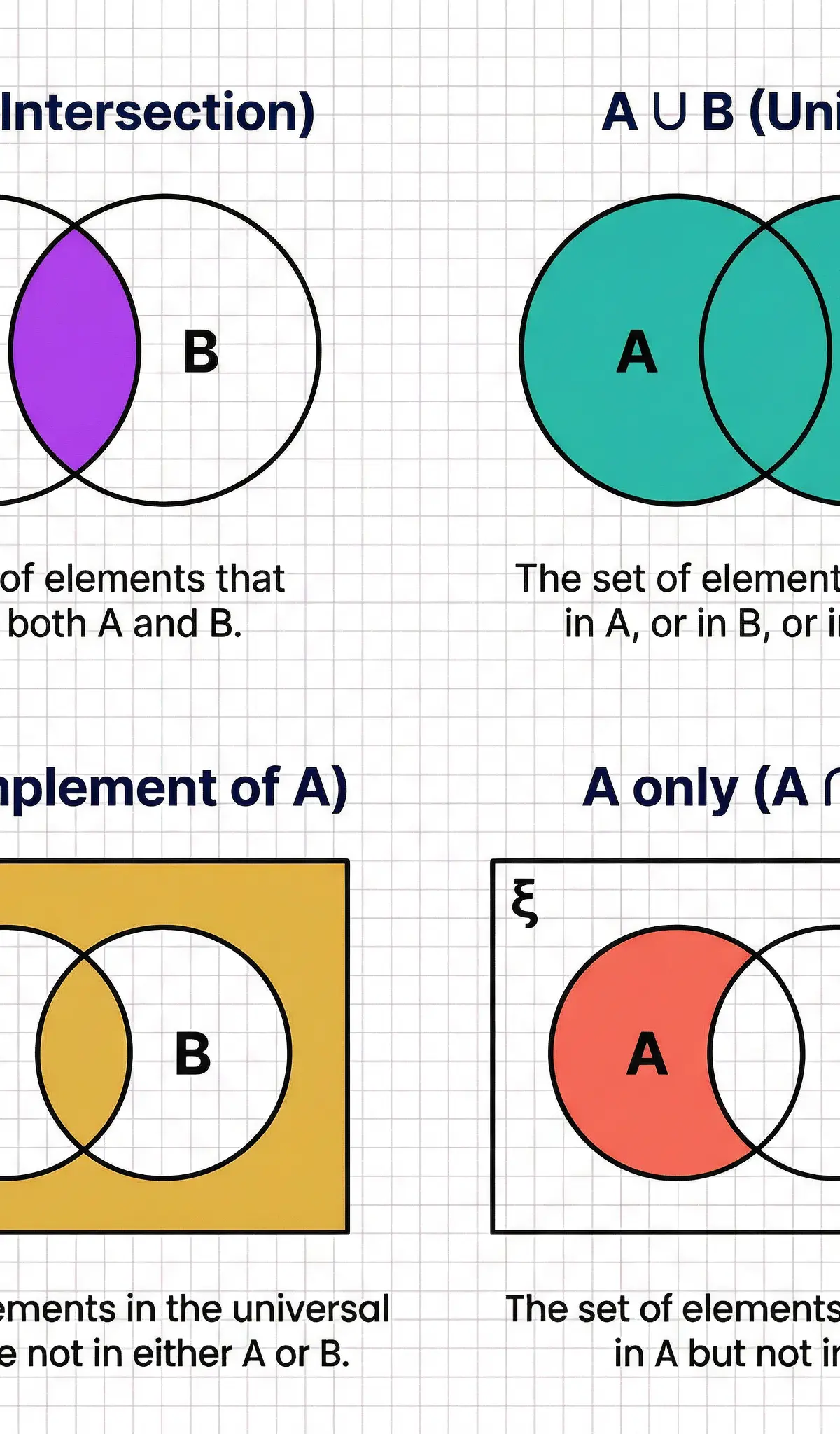
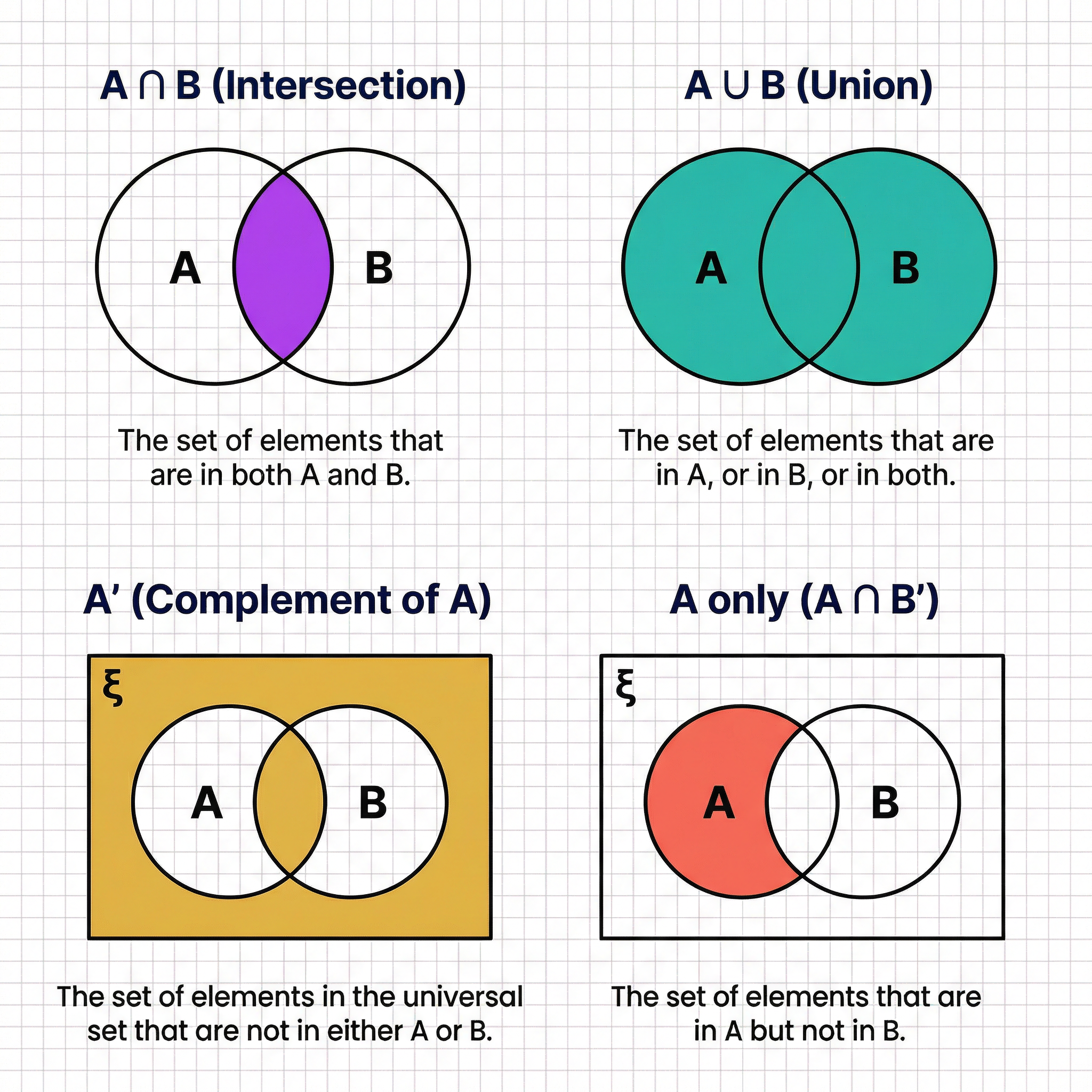
These are the two fundamental operations you perform on sets. The Intersection of two sets, A and B, written as A ∩ B, contains only the elements that are in BOTH set A AND set B. Think of it as the overlap between the circles on a Venn diagram. The Union of two sets, A and B, written as A ∪ B, contains all the elements that are in set A OR set B OR both. It is everything inside both circles combined.
Example: If A = {1, 2, 3} and B = {2, 3, 4}, then:
- Intersection: A ∩ B = {2, 3}
- Union: A ∪ B = {1, 2, 3, 4}
Concept 3: The Complement (A') and the Empty Set (∅)
The Complement of a set A, written as A', consists of all elements within the universal set (ξ) that are NOT in set A. It is everything outside of circle A, including elements in other circles and those in the universal set but no specific circle. A common mistake is to forget the elements outside all circles. The Empty Set, written as ∅ or {}, is a set that contains no elements at all.
Example: If ξ = {1, 2, 3, 4, 5} and A = {1, 2}, then A' = {3, 4, 5}. If C = {multiples of 5 greater than 10 but less than 15}, then C = ∅.
Concept 4: Set Builder Notation
Instead of listing elements, we can define a set using a rule. This is called Set Builder Notation. The format is {x : condition} which is read as "the set of all elements x such that the condition is true". This is heavily used for defining sets of numbers based on inequalities.
Example: The set of all integers greater than -3 and less than or equal to 2 can be written as {x ∈ ℤ : -3 < x ≤ 2}. The elements would be {-2, -1, 0, 1, 2}.
Mathematical Relationships
- Number of Elements: The notation
n(A)means the number of elements in set A. It is a single number, not a list. - De Morgan's Laws (Higher Tier): These describe how union and intersection interact with complements.
(A ∪ B)' = A' ∩ B'(The complement of the union is the intersection of the complements).(A ∩ B)' = A' ∪ B'(The complement of the intersection is the union of the complements).
- Addition Rule for Probability:
P(A ∪ B) = P(A) + P(B) - P(A ∩ B). This formula is essential for calculating probabilities and is directly related to the number of elements in the sets:n(A ∪ B) = n(A) + n(B) - n(A ∩ B).

Practical Applications
Set notation is the foundational language for database queries (e.g., finding customers who bought product A AND product B), computer science logic (e.g., filtering data based on multiple criteria), and probability theory. When you search on Google using "AND" or "OR", you are performing set intersection and union operations. In genetics, Punnett squares can be analysed using set theory to determine the probability of offspring inheriting specific traits."
Worked Examples
3 worked examples — open one to explore the question and available guidance.
Practice Questions
Test your understanding — click to reveal model answers
ξ = {positive integers less than 12}. A = {factors of 12}. B = {multiples of 3}. List the members of A ∩ B'.
Hint: First, list the elements of A and B. Then find B' (everything in ξ that is NOT in B). Finally, find the intersection (overlap) of A and B'.
In a class of 30 students, 18 play football, 15 play tennis, and 6 play neither. Calculate how many students play both football and tennis.
Hint: Use the formula n(A ∪ B) = n(A) + n(B) - n(A ∩ B). First, you need to find the number of students who play at least one sport.
Given the sets P = {x : 0 < x ≤ 6, x is an integer} and Q = {odd numbers}. Describe the set P ∩ Q in words and list its elements.
Hint: First, list the integers in set P. Then, identify which of those are also in set Q (odd numbers).
A Venn diagram contains three sets: A, B, and C. Given n(A)=20, n(B)=25, n(C)=30, n(A∩B)=8, n(A∩C)=10, n(B∩C)=12, and n(A∩B∩C)=5. Find the number of elements in A only.
Hint: Start from the central intersection and work your way out. The number in 'A only' is n(A) minus the numbers in all the overlapping parts of A.
State whether the following is true or false, giving a reason: {3, 4} ⊂ {factors of 24}
Hint: The symbol ⊂ means 'is a subset of'. Are all the elements on the left also on the right?
Question 6
Test your understanding of Set Notation
Active recall beats re-reading. Take an instant quiz now to test what you’ve learned and lock it into long-term memory.
7 days Premium · Then free forever · No card, no charge