OCR · GCSE · Further Mathematics
Simultaneous Equations (linear and non-linear)
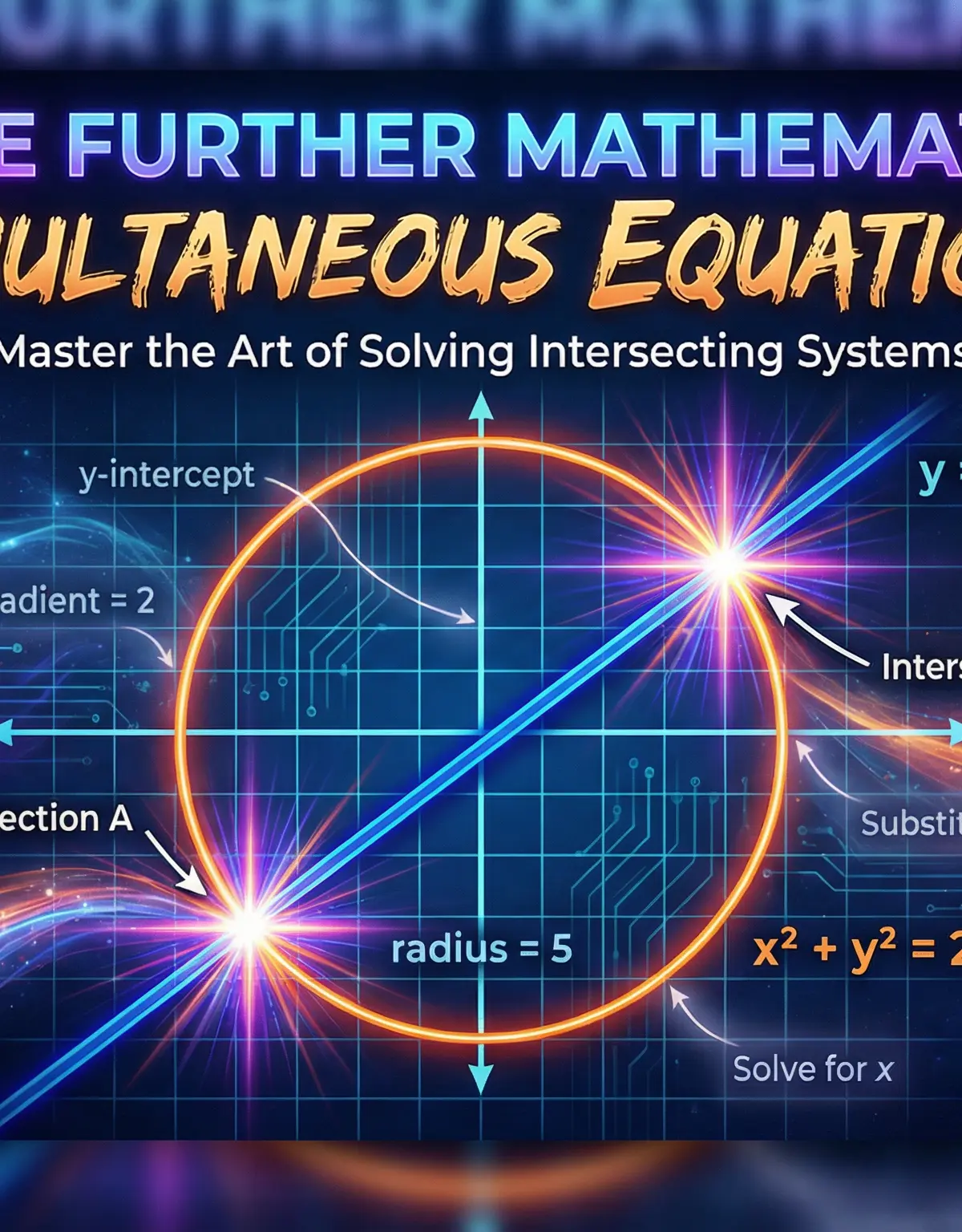
Master the art of solving simultaneous equations in OCR GCSE Further Mathematics. This guide breaks down the essential algebraic techniques for tackling linear and non-linear systems, showing you how to secure top marks by finding the precise intersection points of lines and curves.
- 4 min read
- 3 worked examples
- 5 practice questions
- 6 key terms
Study Notes
Overview
Welcome to the definitive guide for topic 2.2, Simultaneous Equations, from the OCR GCSE Further Mathematics specification. This topic is a cornerstone of the algebra content and a guaranteed feature in your exam papers. It elevates your skills from the GCSE standard of solving two linear equations to the more complex and rewarding challenge of solving a system with one linear and one non-linear equation. Typically, this involves finding the intersection points of a straight line with a curve, such as a circle or a parabola. Mastery here is not just about algebraic manipulation; it's about understanding the geometric relationship between the equations. Examiners frequently use these questions to test your precision, your ability to handle quadratic equations, and your attention to detail in presenting a final solution. In this guide, we will dissect the core methods, highlight common pitfalls, and provide examiner-level insights to help you confidently claim every mark available.
Key Concepts
Concept 1: The Substitution Method
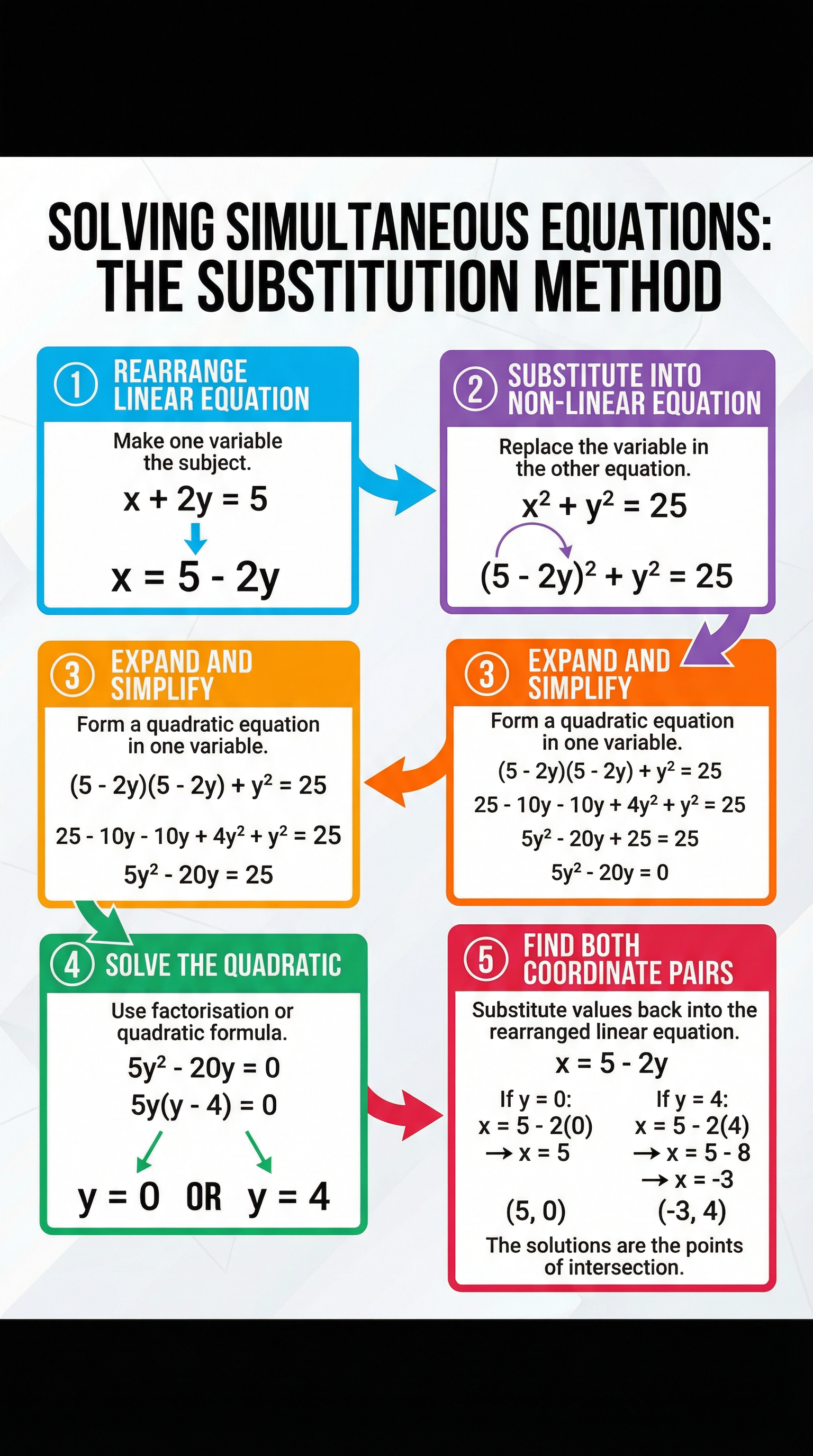
The substitution method is the primary technique you will use. It involves rearranging the linear equation to express one variable in terms of the other, and then substituting this expression into the non-linear equation. This process eliminates one of the variables, leaving you with a single equation in one variable, which can then be solved.
Why it works: By substituting, you are essentially finding the points (x, y) that lie on both the line and the curve simultaneously. The resulting equation is a new equation whose solutions are the x- or y-coordinates of these intersection points.

Concept 2: Geometric Interpretation
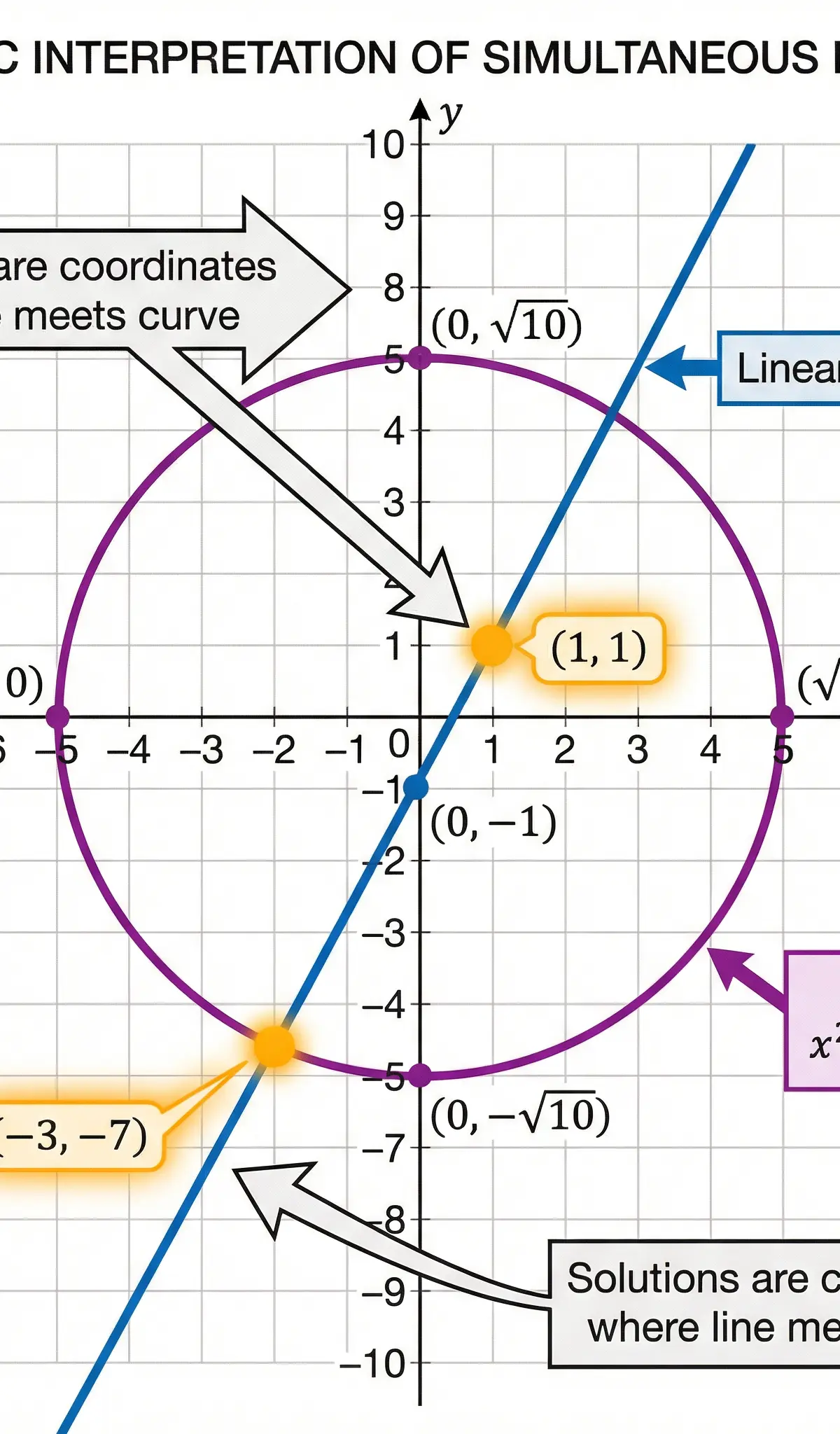
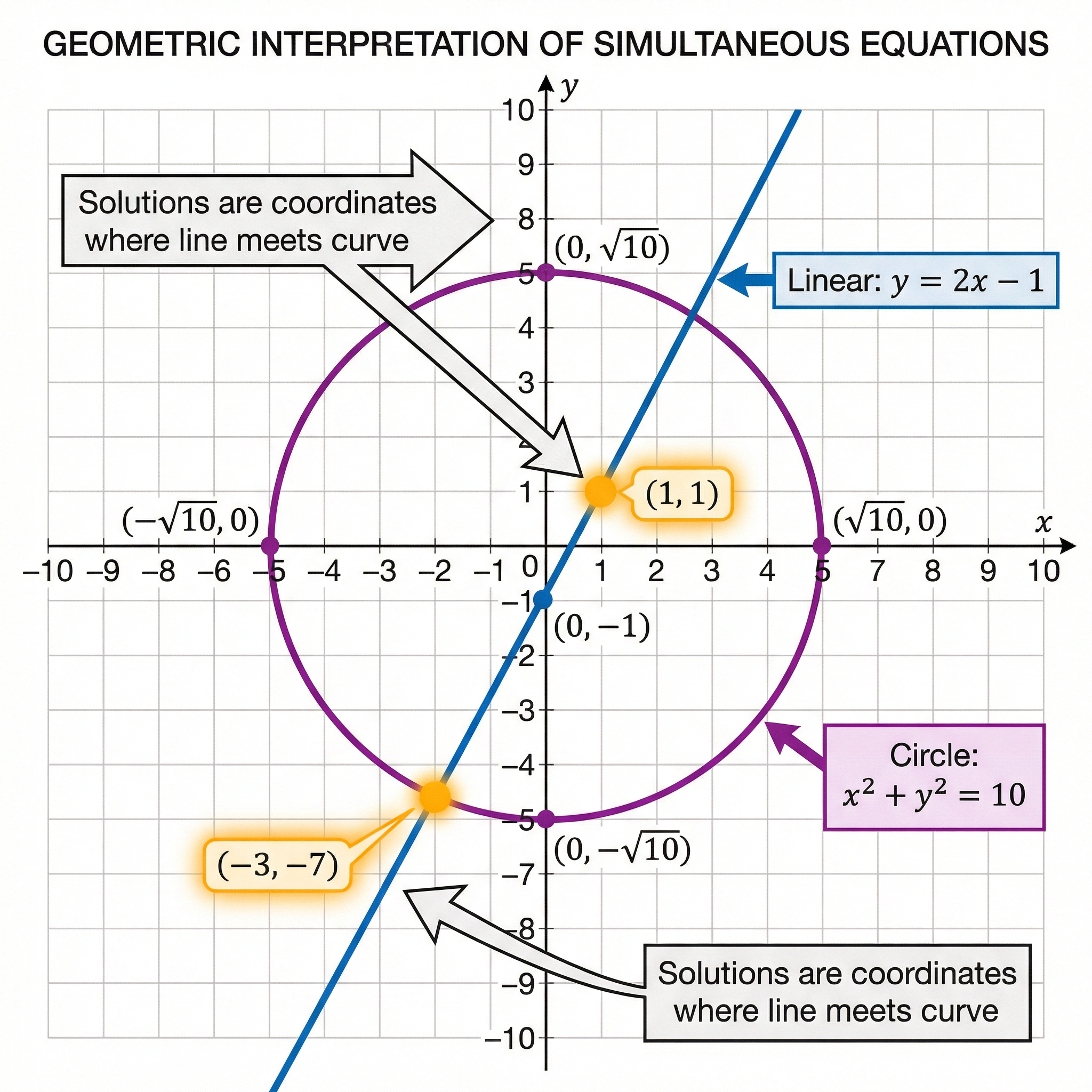
It is vital to understand what your solutions represent visually. The solutions to a pair of simultaneous equations are the coordinates of the points of intersection of their graphs.
- Two Distinct Solutions: The line crosses the curve at two different points. This occurs when the quadratic equation you form has two distinct real roots (i.e., the discriminant b²-4ac > 0).
- One Repeated Solution: The line is a tangent to the curve, touching it at exactly one point. This occurs when the quadratic has one repeated real root (discriminant b²-4ac = 0).
- No Real Solutions: The line and the curve do not intersect at all. This occurs when the quadratic has no real roots (discriminant b²-4ac < 0).
Mathematical Relationships
1. The Linear Equation
- Form: y = mx + c or ax + by = c
- Represents: A straight line.
2. The Non-Linear Equation
- Circle: x² + y² = r² (A circle centred at the origin with radius r). Must memorise.
- Parabola: y = ax² + bx + c (A 'u' or 'n' shaped curve). Must memorise.
- Other Quadratics: Can include terms like xy, e.g., xy = 4.
3. The Discriminant
- Formula: Δ = b² - 4ac (from the quadratic equation ax² + bx + c = 0). Given on formula sheet.
- Use: Determines the number of real solutions to the quadratic, and therefore the number of intersection points.
Practical Applications
While the questions in your exam are abstract, the principles of solving systems of equations are fundamental in many fields. For example, in physics, they can be used to model the trajectory of a projectile (a parabola) and determine if it will hit a target represented by a line. In economics, they can model the intersection of supply and demand curves to find market equilibrium. Understanding this topic provides a foundation for more advanced mathematical and scientific modelling.
Visual Resources
2 diagrams and illustrations
Interactive Diagrams
2 interactive diagrams to visualise key concepts
Conceptual Flow Outline
A flowchart showing the complete process for solving simultaneous equations using the substitution method.
Conceptual Flow Outline
A concept map showing how the discriminant is used to determine the geometric relationship between the line and the curve.
Worked Examples
3 worked examples — open one to explore the question and available guidance.
Practice Questions
Test your understanding — click to reveal model answers
Solve the simultaneous equations: x + y = 7 and x² + y² = 25.
Hint: Rearrange the linear equation to make y the subject, then substitute into the circle equation.
Find the coordinates of the point(s) of intersection of the line y = 2x + 1 and the curve y = x² + 2x.
Hint: Since both equations are equal to y, you can set them equal to each other.
The line 3x - y = 9 intersects the curve xy = 6 at the points A and B. Find the coordinates of A and B.
Hint: Rearrange the linear equation to y = 3x - 9 and substitute this into the xy = 6 equation.
How many points of intersection are there between the line y = x + 5 and the circle x² + y² = 1? Justify your answer.
Hint: You don't need to find the coordinates. Substitute and use the discriminant to determine the number of solutions.
Solve the simultaneous equations: y = x² and x + y = 6.
Hint: Substitute y = x² into the linear equation.
Test your understanding of Simultaneous Equations (linear and non-linear)
Active recall beats re-reading. Take an instant quiz now to test what you’ve learned and lock it into long-term memory.
7 days Premium · Then free forever · No card, no charge