OCR · GCSE · Further Mathematics
Surds
Surds are irrational roots like √2 that cannot be written as fractions. Mastering surds is essential for exact arithmetic in GCSE Further Maths, as examiners demand rigorous working without decimal approximations. This guide covers simplification, operations, rationalising denominators, and applying surds in geometric contexts to secure full marks.
- 6 min read
- 4 worked examples
- 6 practice questions
- 7 key terms
Study Notes
Overview
Surds are the language of mathematical precision. They are expressions involving irrational roots, like √2 or √75, which cannot be written as a simple fraction. In OCR GCSE Further Mathematics, your ability to work with surds is a direct test of your algebraic fluency and your understanding of the number system. Examiners use surds to ensure you can manipulate and solve problems without resorting to a calculator's decimal approximations, thereby preserving exact values. This topic is fundamental, forming the bedrock for more advanced algebraic and geometric problems, including exact trigonometric values and Pythagoras' theorem in 2D and 3D space. A typical exam question will require you to simplify expressions, rationalise denominators, or solve equations, often within a geometric context, demanding complete and rigorous working to secure full marks.
Key Concepts
Concept 1: Simplifying Surds
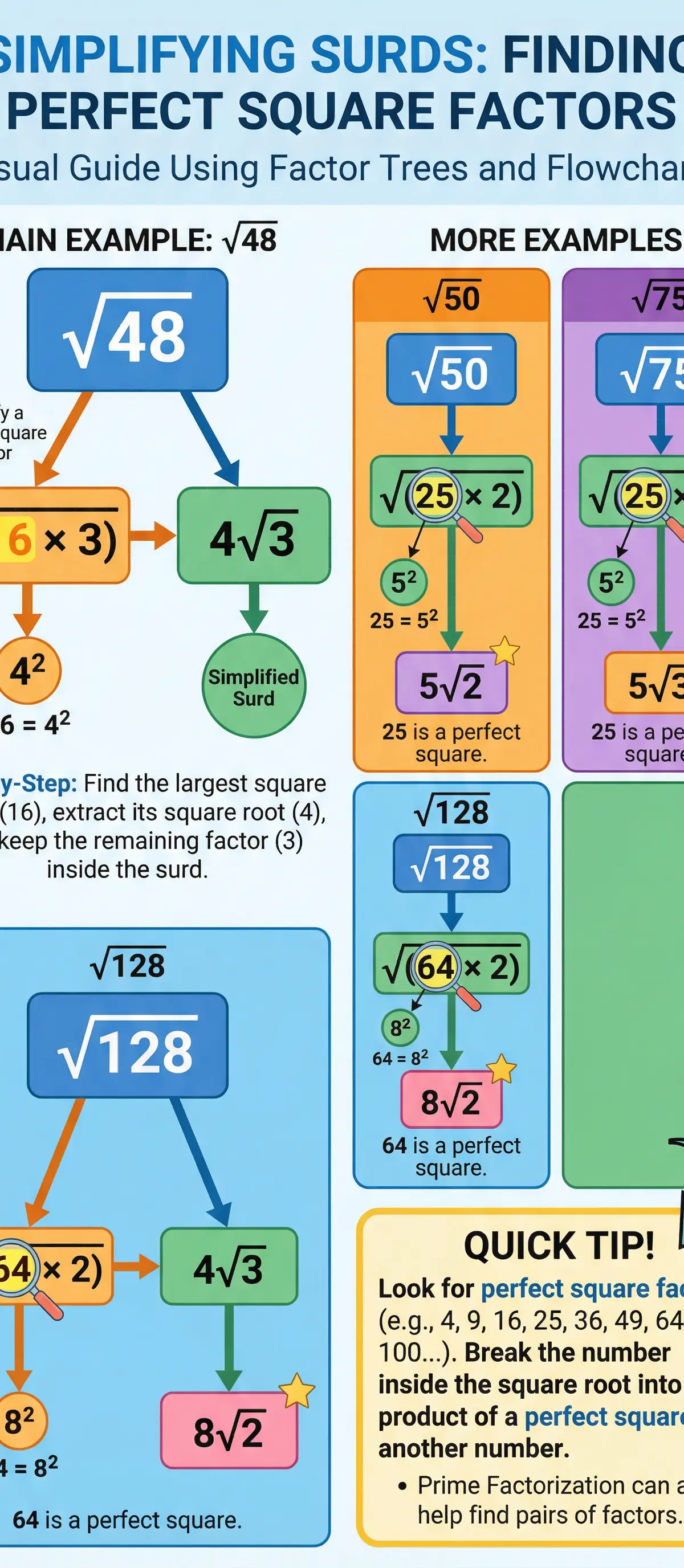
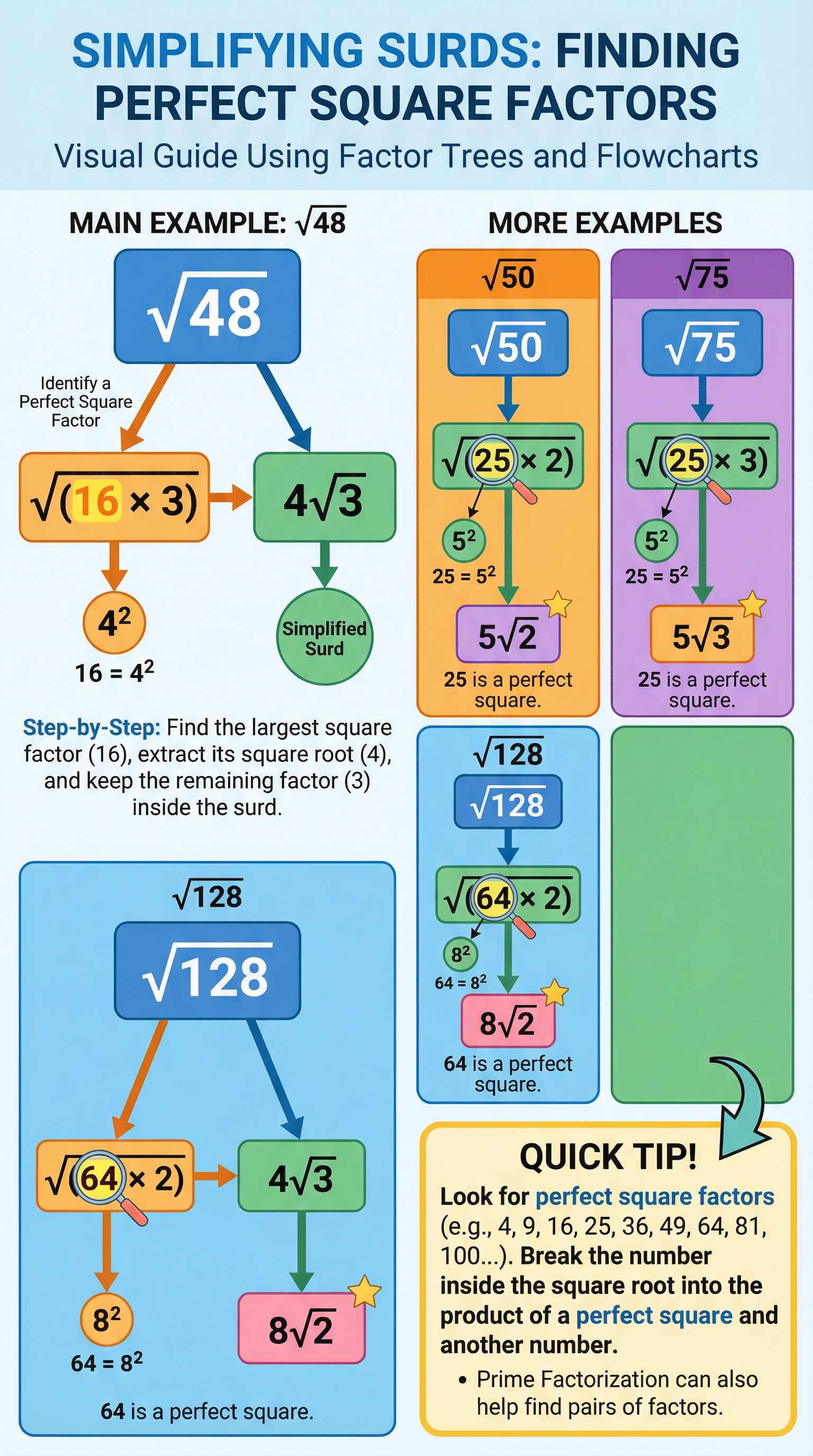
A surd is in its simplest form when the number inside the square root has no square number factors (other than 1). For example, √12 is not in its simplest form because 12 has a factor of 4, which is a perfect square. The entire process hinges on one key rule: √(ab) = √a × √b.
To simplify a surd, you must find the largest square number that divides the number inside the root. You then split the surd into two, one of which can be simplified to an integer. This integer then becomes the coefficient of the remaining surd.
Example: Simplify √48.
- Identify square factors of 48. The square numbers are 4, 9, 16, 25... We can see that 4 is a factor (48 = 4 × 12) and 16 is a factor (48 = 16 × 3).
- Choose the largest square factor, which is 16.
- Rewrite the surd: √48 = √(16 × 3).
- Split the surd: √(16 × 3) = √16 × √3.
- Simplify the square root part: √16 = 4.
- The final answer is 4√3.
Credit is often given (typically a B1 mark) for correctly identifying the largest square factor and splitting the surd, even if the final simplification is incorrect.
Concept 2: Operations with Surds
Addition and Subtraction: You can only add or subtract 'like' surds – those with the same number inside the root. This is identical to collecting like terms in algebra. For example, 5x + 2x = 7x, and similarly, 5√3 + 2√3 = 7√3. You cannot simplify 5√3 + 2√5.
Multiplication: To multiply surds, you multiply the numbers outside the roots together, and the numbers inside the roots together. For example, (2√3) × (4√5) = (2×4)√(3×5) = 8√15. A critical rule is that √a × √a = a.
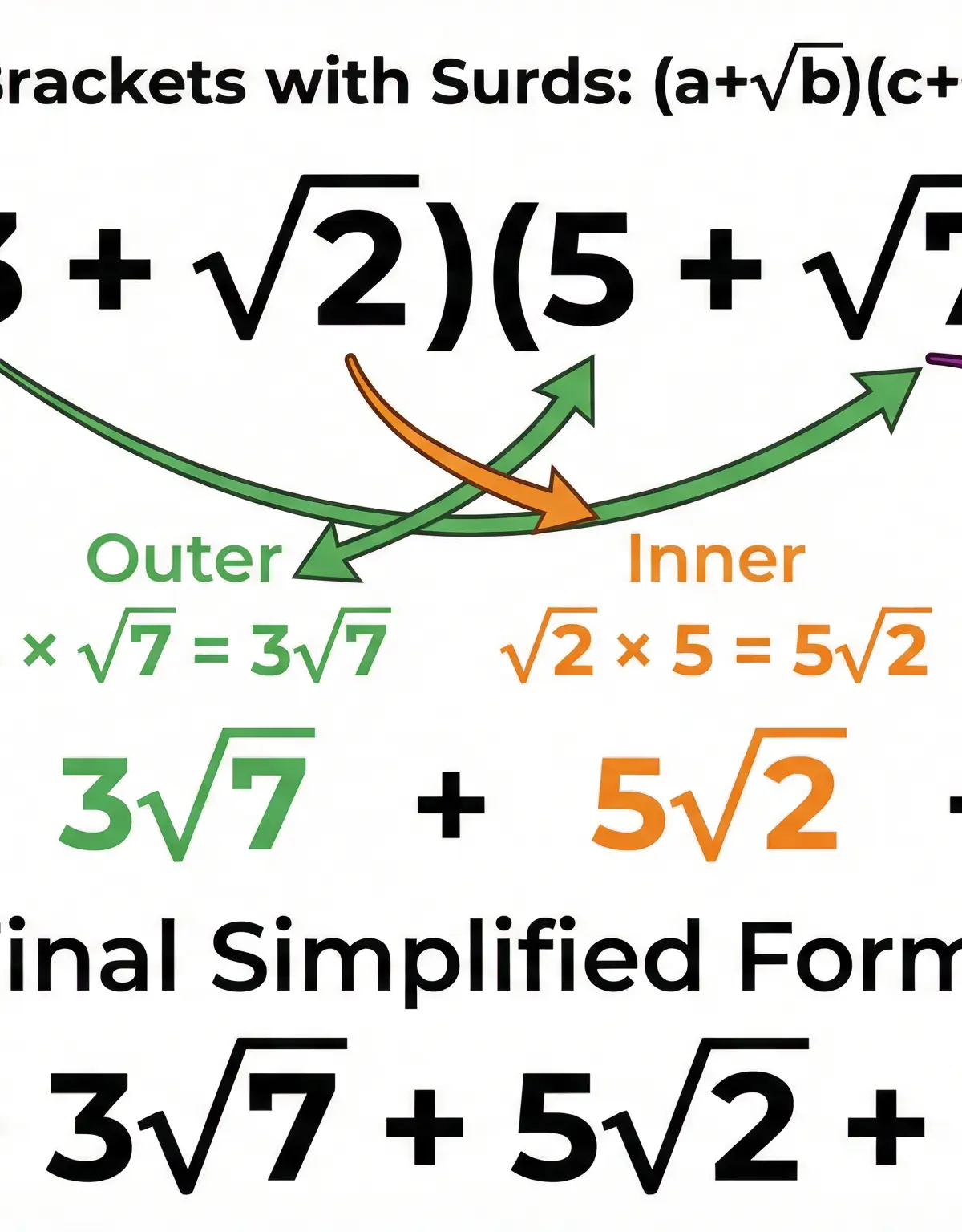
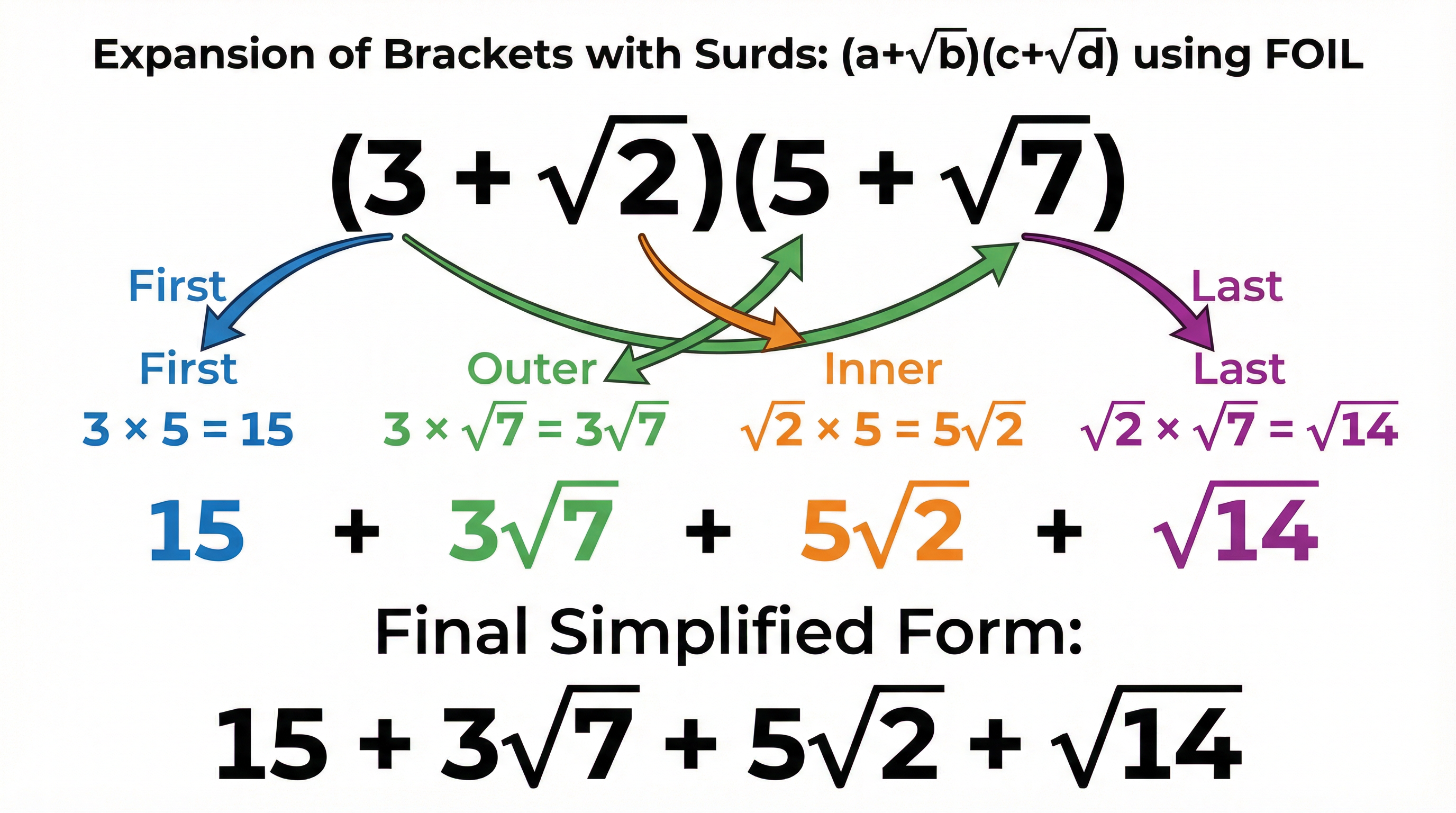
Expansion of Brackets: When expanding brackets containing surds, you must use the standard rules of algebra, such as the FOIL method (First, Outer, Inner, Last). For 'Show that' questions, examiners expect to see all four terms of the expansion written out explicitly before simplification.
Concept 3: Rationalising the Denominator
It is a mathematical convention not to have a surd in the denominator of a fraction. The process of removing it is called rationalising. There are two cases:
**Case 1: Denominator is a single surd (e.g., k/√a)**To rationalise, you multiply the numerator and denominator by the surd. For example, to rationalise 12/√3, you calculate (12/√3) × (√3/√3) = 12√3/3 = 4√3.
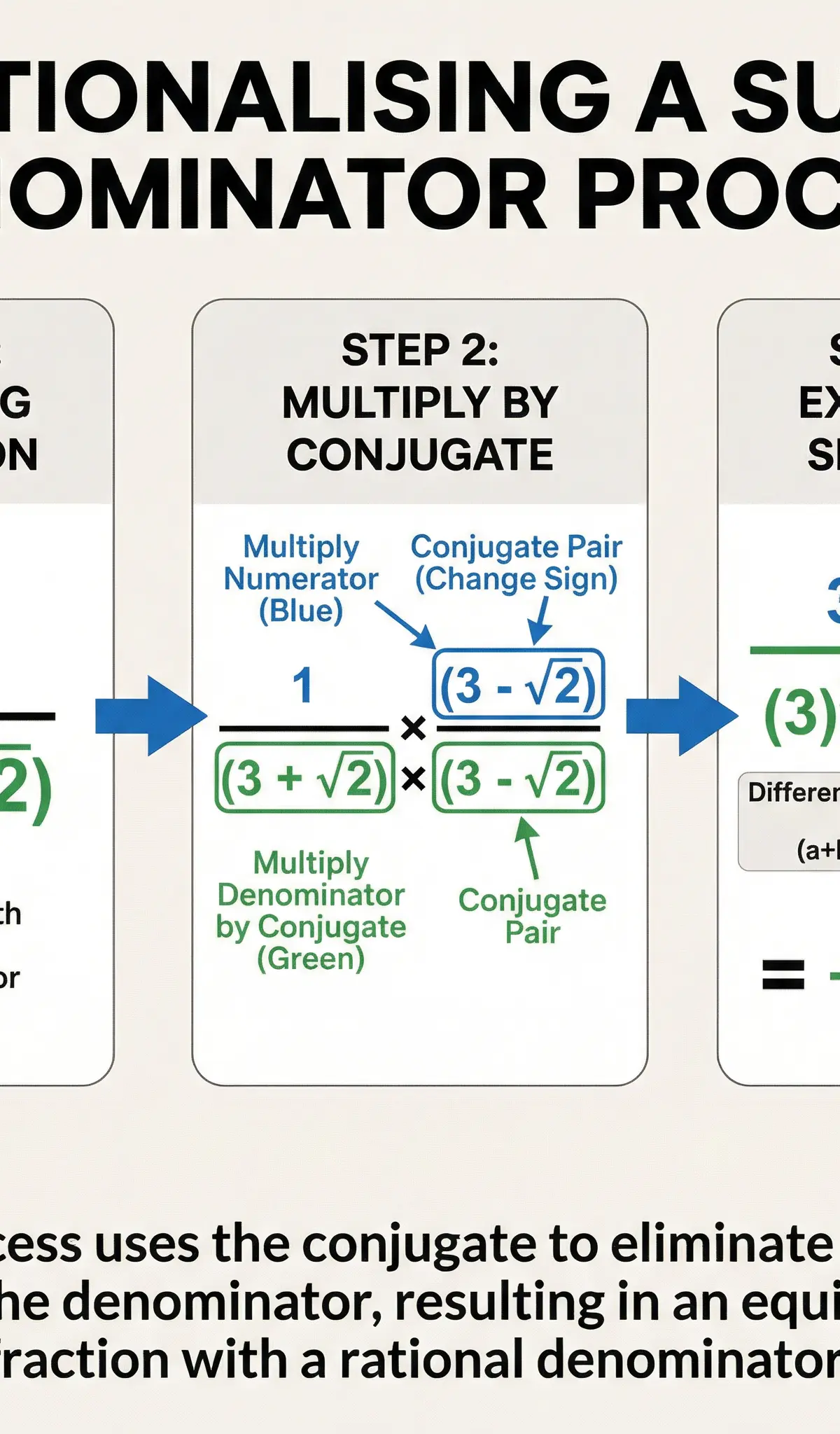
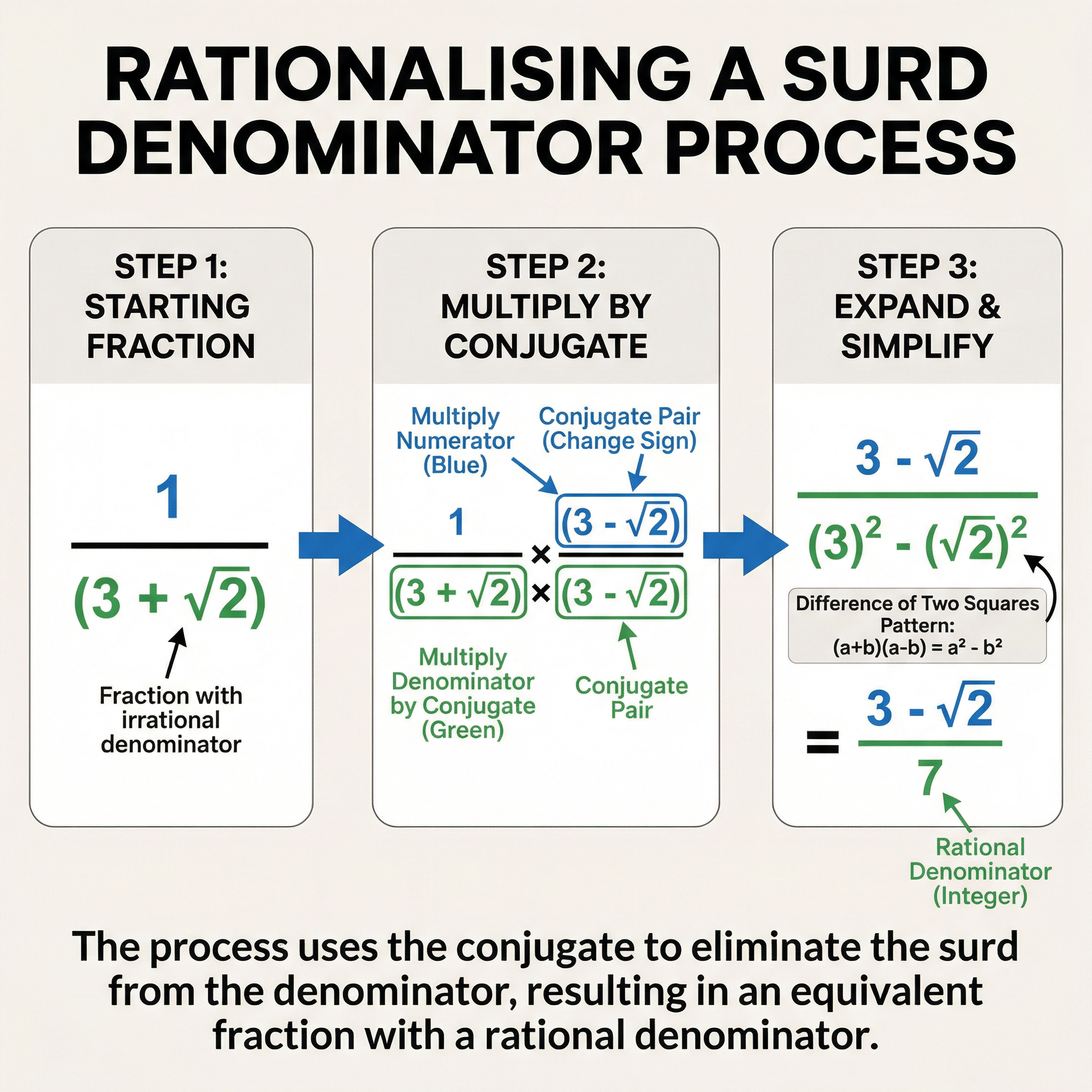
**Case 2: Denominator is a compound expression (e.g., k/(a+√b))**To rationalise this form, you must multiply the numerator and denominator by the conjugate of the denominator. The conjugate is formed by changing the sign in the middle of the expression. The conjugate of (a + √b) is (a - √b). When you multiply an expression by its conjugate, you create a difference of two squares, (a+√b)(a-√b) = a² - (√b)² = a² - b, which is always a rational number.
Example: Rationalise the denominator of 4 / (3 + √2).
- Identify the conjugate of the denominator: 3 - √2.
- Multiply the numerator and denominator by the conjugate: 4/(3+√2) × (3-√2)/(3-√2).
- This gives (4(3-√2)) / ((3+√2)(3-√2)).
- The denominator becomes 3² - (√2)² = 9 - 2 = 7.
- The final answer is (12 - 4√2) / 7.
An M1 mark is awarded for the correct method of multiplying by the conjugate.
Mathematical Relationships
- Simplification Law: √(ab) = √a × √b (Must memorise)
- Division Law: √(a/b) = √a / √b (Must memorise)
- Squaring a Surd: (√a)² = a (Must memorise)
- Difference of Two Squares: (a+√b)(a-√b) = a² - b (Must memorise)
- Perfect Square Expansion: (a+√b)² = a² + 2a√b + b (Must memorise)
Practical Applications
While surds may seem abstract, they are essential in fields requiring exact measurements. In architecture and engineering, calculations for diagonal lengths in structures must be exact to ensure stability. For example, the diagonal of a 1m x 1m square is exactly √2 metres. Using a rounded decimal could lead to significant errors on a large scale. Similarly, in computer graphics and game design, surds are used in calculations for distances, angles, and creating precise geometric models. In advanced physics, particularly in quantum mechanics and special relativity, equations often involve surds to represent exact values in the fabric of spacetime.
Visual Resources
3 diagrams and illustrations
Interactive Diagrams
2 interactive diagrams to visualise key concepts
Conceptual Flow Outline
Flowchart for simplifying a surd by identifying and extracting the largest square factor.
Conceptual Flow Outline
Decision tree for rationalising the denominator, showing the two main cases and the appropriate method for each.
Worked Examples
4 worked examples — open one to explore the question and available guidance.
Practice Questions
Test your understanding — click to reveal model answers
Simplify √32.
Hint: Find the largest square number that divides 32. Think of 4, 9, 16, 25...
Calculate (√7)² + (√3)².
Hint: Remember that (√a)² = a.
Expand and simplify (2 + √3)².
Hint: Expand as (2 + √3)(2 + √3) using FOIL, not as 2² + (√3)².
Rationalise the denominator of 10/√5. Give your answer in its simplest form.
Hint: Multiply the numerator and denominator by √5.
Express 8/(3-√2) in the form a + b√2, where a and b are rational numbers.
Hint: Multiply the numerator and denominator by the conjugate of 3-√2.
Solve the equation (x-1)² = 18, giving your answer in the form a ± b√c, where a, b, and c are integers.
Hint: Take the square root of both sides, remembering the ± sign, then simplify √18.
Test your understanding of Surds
Active recall beats re-reading. Take an instant quiz now to test what you’ve learned and lock it into long-term memory.
7 days Premium · Then free forever · No card, no charge