AQA · A-Level · Geography
Course version: 7037 · Version from Sept 2018
Origin and development of landforms of mid and low latitude deserts:…
Full specification wording
Arid landscape development in contrasting settings: Origin and development of landforms of mid and low latitude deserts: aeolian – deflation hollows, desert pavements, ventifacts, yardangs, zeugen, barchans and seif dunes; water – wadis, bahadas, pediments, playas, inselbergs.
Desert landforms in mid and low latitudes develop through aeolian and fluvial processes.
Checked against the AQA 7037 specification (opens in a new tab) on .
- 4 key terms
Study notes
From the checked teaching notes for this specification point.
The idea
Desert landforms in mid and low latitudes develop through aeolian and fluvial processes. Wind erosion creates deflation hollows by removing loose sand, leaving behind coarse desert pavements. Abrasion shapes faceted rocks called ventifacts, and carves parallel ridges into soft rock (yardangs) or undercuts hard rock layers (zeugen). Wind deposition forms crescent-shaped barchans and linear seif dunes. Despite aridity, water is a dominant geomorphic agent. Flash floods erode steep-sided wadis and retreat mountain fronts, leaving gently sloping pediments and isolated inselbergs. Deposited sediment forms coalescing alluvial fans known as bahadas, while ephemeral lakes evaporate in closed basins to leave flat, salt-crusted playas.
What earns the marks
- Explain how deflation removes fine particles to form deflation hollows and concentrates coarse gravels to create desert pavements.
- Differentiate aeolian abrasion landforms: ventifacts (faceted stones), yardangs (vertical strata eroded into parallel ridges), and zeugen (horizontal strata undercut into mushroom rocks).
- Describe aeolian deposition: barchans form in unidirectional winds with limited sand, while seif dunes develop from bidirectional winds.
- Detail fluvial erosion: episodic flash floods carve steep wadis and drive parallel retreat of slopes, leaving pediments and residual inselbergs.
- Explain fluvial deposition: alluvial fans merge to form bahadas at mountain fronts, and water pooling in basins evaporates to form playas.
Common mistakes and how to put them right
Confusing yardangs and zeugen.
Put it right: Yardangs form in vertical strata aligned with the wind, whereas zeugen form in horizontal strata with a hard cap rock.
Attributing wadis and inselbergs primarily to wind erosion.
Put it right: These are predominantly formed by episodic fluvial erosion and slope retreat.
Mixing up barchan and seif dunes.
Put it right: Barchans are crescent-shaped and migrate with unidirectional winds, while seif dunes are linear and require bidirectional winds.
Exam tips
- Always link the formation of aeolian landforms to specific wind processes (deflation or abrasion) and local geology (horizontal versus vertical strata).
- Emphasise the role of past wetter climates (pluvials) when explaining large-scale fluvial landforms like deep wadis or extensive inselbergs.
- Use annotated diagrams to show the sequence of fluvial landforms from the mountain front (wadis) across the pediment and bahada to the playa.
Try the lesson
The start of the Arid landscape development in contrasting settings: Origin and development of landforms of mid and low latitude deserts: aeolian – deflation hollows, desert pavements, ventifacts, yardangs, zeugen, barchans and seif dunes; water – wadis, bahadas, pediments, playas, inselbergs. lesson, made from checked teaching notes for this specification point.
Have a go first
Which of the following describes the formation of a zeugen in a desert environment?
Listen
Desert landforms in mid and low latitudes develop through aeolian and fluvial processes. Wind erosion creates deflation hollows by removing loose sand, leaving behind coarse desert pavements. Abrasion shapes faceted rocks called ventifacts, and carves parallel ridges into soft rock (yardangs) or undercuts hard rock layers (zeugen). Wind deposition forms crescent-shaped barchans and linear seif dunes. Despite aridity, water is a dominant geomorphic agent. Flash floods erode steep-sided wadis and retreat mountain fronts, leaving gently sloping pediments and isolated inselbergs. Deposited sediment forms coalescing alluvial fans known as bahadas, while ephemeral lakes evaporate in closed basins to leave flat, salt-crusted playas. A strong answer earns marks for these points. Explain how deflation removes fine particles to form deflation hollows and concentrates coarse gravels to create desert pavements. Differentiate aeolian abrasion landforms: ventifacts (faceted stones), yardangs (vertical strata eroded into parallel ridges), and zeugen (horizontal strata undercut into mushroom rocks). Describe aeolian deposition: barchans form in unidirectional winds with limited sand, while seif dunes develop from bidirectional winds. Detail fluvial erosion: episodic flash floods carve steep wadis and drive parallel retreat of slopes, leaving pediments and residual inselbergs. Exam tip: Always link the formation of aeolian landforms to specific wind processes (deflation or abrasion) and local geology (horizontal versus vertical strata).
See it

Key words
Say what each word means before you turn the card.
Aeolian processes
Try answering aloud or in your head before turning the card.
Fluvial processes
Try answering aloud or in your head before turning the card.
Deflation hollows
Try answering aloud or in your head before turning the card.
Yardangs
Try answering aloud or in your head before turning the card.
See every definition
- Aeolian processes
- Wind erosion creates deflation hollows by removing loose sand and abrasion shapes ventifacts, yardangs and zeugen, while wind deposition forms barchans and seif dunes.
- Fluvial processes
- Episodic flash floods carve steep wadis and drive parallel retreat of slopes, leaving pediments and residual inselbergs, while deposited sediment forms bahadas and playas.
- Deflation hollows
- Wind erosion creates these by removing loose sand, leaving behind coarse desert pavements.
- Yardangs
- Parallel ridges carved by abrasion into soft rock of vertical strata aligned with the wind.
Label the diagram
Some boxes have lost their names. Pick the right name for each number.
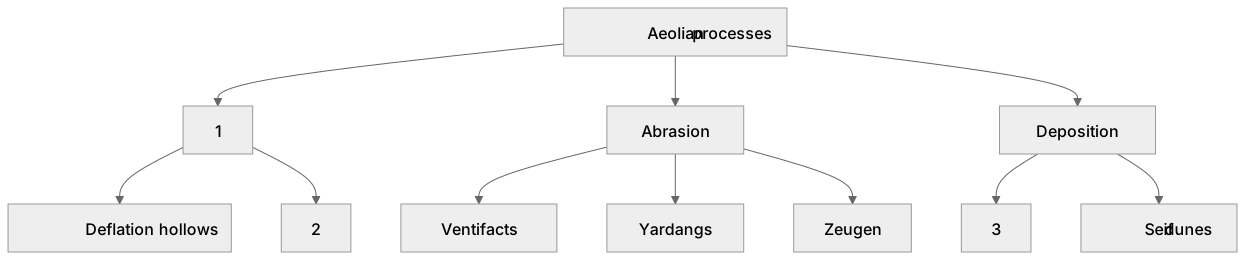
1Box 1
2Box 2
3Box 3
There is more to this lesson
The full lesson goes on to check your understanding and help you earn the marks. Create a free account to carry on, with your progress saved.
A week of Premium from your first lesson · Then the free plan continues · No card, no charge
Test your understanding of Arid landscape development in contrasting settings: Origin and development of landforms of mid and low latitude deserts: aeolian – deflation hollows, desert pavements, ventifacts, yardangs, zeugen, barchans and seif dunes; water – wadis, bahadas, pediments, playas, inselbergs.
Active recall beats re-reading. Take an instant quiz now to test what you’ve learned and lock it into long-term memory.
A week of Premium from your first lesson · Then the free plan continues · No card, no charge