AQA · A-Level · Geography
Course version: 7037 · Version from Sept 2018
Origin and development of landforms and landscapes of coastal erosion:…
Full specification wording
Coastal landscape development: Origin and development of landforms and landscapes of coastal erosion: cliffs and wave cut platforms, cliff profile features including caves, arches and stacks; factors and processes in their development.
Coastal erosion creates distinct landforms through processes like hydraulic action, abrasion, and corrosion.
Checked against the AQA 7037 specification (opens in a new tab) on .
- Point 1 of 6
- 4 key terms
Study notes
From the checked teaching notes for this specification point.
The idea
Coastal erosion creates distinct landforms through processes like hydraulic action, abrasion, and corrosion. Cliffs retreat as waves undercut the base, forming a wave-cut notch. Over time, the unsupported overhang collapses, leaving a gently sloping wave-cut platform that dissipates wave energy. Cliff profile features develop where rock resistance varies. Faults or joints are exploited to form caves. If a cave erodes through a headland, an arch forms. Weathering and gravity eventually cause the arch roof to collapse, leaving an isolated stack. Factors influencing this development include rock lithology (hard vs soft), geological structure (dip and faults), wave energy, and sub-aerial weathering processes.
What earns the marks
- Explain the formation of a wave-cut notch and subsequent cliff retreat leading to a wave-cut platform.
- Describe the sequence of erosion from a fault or joint to a cave, arch, and stack.
- Evaluate the role of specific marine erosion processes, such as hydraulic action and abrasion, in shaping cliff profiles.
- Assess how geological factors, such as lithology and structural dip, influence the rate and morphology of coastal erosion.
Common mistakes and how to put them right
Confusing hydraulic action with abrasion.
Put it right: Hydraulic action is the force of water and trapped air compressing in cracks, whereas abrasion involves waves throwing sediment against the cliff.
Stating that wave-cut platforms are completely flat.
Put it right: Wave-cut platforms typically slope gently towards the sea and are often uneven with rock pools.
Ignoring sub-aerial processes in cliff development.
Put it right: Include weathering and mass movement as key factors that work alongside marine erosion to shape cliff profiles.
Exam tips
- Use specific, named examples of coastal landforms, such as Old Harry Rocks for a stack, to support your explanations.
- When explaining the cave-arch-stack sequence, ensure you link specific erosional processes to each stage of development.
- Discuss how the width of a wave-cut platform eventually limits further cliff erosion by dissipating wave energy before it reaches the cliff base.
Try the lesson
The start of the Coastal landscape development: Origin and development of landforms and landscapes of coastal erosion: cliffs and wave cut platforms, cliff profile features including caves, arches and stacks; factors and processes in their development. lesson, made from checked teaching notes for this specification point.
Have a go first
Which sequence correctly describes the typical development of erosional landforms on a coastal headland?
Listen
Coastal erosion creates distinct landforms through processes like hydraulic action, abrasion, and corrosion. Cliffs retreat as waves undercut the base, forming a wave-cut notch. Over time, the unsupported overhang collapses, leaving a gently sloping wave-cut platform that dissipates wave energy. Cliff profile features develop where rock resistance varies. Faults or joints are exploited to form caves. If a cave erodes through a headland, an arch forms. Weathering and gravity eventually cause the arch roof to collapse, leaving an isolated stack. Factors influencing this development include rock lithology (hard vs soft), geological structure (dip and faults), wave energy, and sub-aerial weathering processes. A strong answer earns marks for these points. Explain the formation of a wave-cut notch and subsequent cliff retreat leading to a wave-cut platform. Describe the sequence of erosion from a fault or joint to a cave, arch, and stack. Evaluate the role of specific marine erosion processes, such as hydraulic action and abrasion, in shaping cliff profiles. Assess how geological factors, such as lithology and structural dip, influence the rate and morphology of coastal erosion. Exam tip: Use specific, named examples of coastal landforms, such as Old Harry Rocks for a stack, to support your explanations.
See it
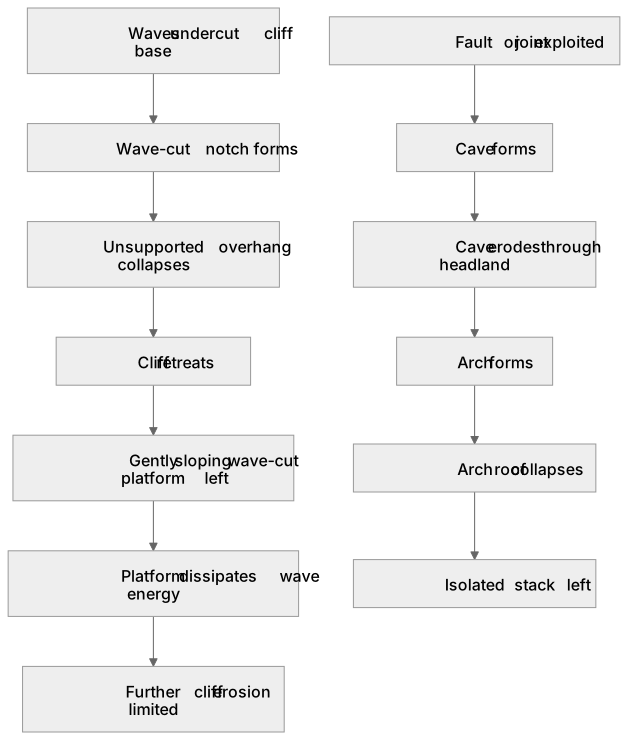
Key words
Say what each word means before you turn the card.
Marine erosion processes
Try answering aloud or in your head before turning the card.
Geological structure and lithology
Try answering aloud or in your head before turning the card.
Sub-aerial weathering
Try answering aloud or in your head before turning the card.
Landscape evolution over time
Try answering aloud or in your head before turning the card.
See every definition
- Marine erosion processes
- Processes such as hydraulic action, abrasion and corrosion that wear away the coast, with hydraulic action being the force of water and trapped air compressing in cracks.
- Geological structure and lithology
- Factors influencing coastal development, including rock lithology of hard versus soft rock and geological structure such as dip and faults.
- Sub-aerial weathering
- Weathering and mass movement that work alongside marine erosion to shape cliff profiles, and which with gravity eventually cause an arch roof to collapse.
- Landscape evolution over time
- Cliffs retreat as waves undercut the base, and over time the unsupported overhang collapses, leaving a gently sloping wave-cut platform that dissipates wave energy.
Label the diagram
Some boxes have lost their names. Pick the right name for each number.
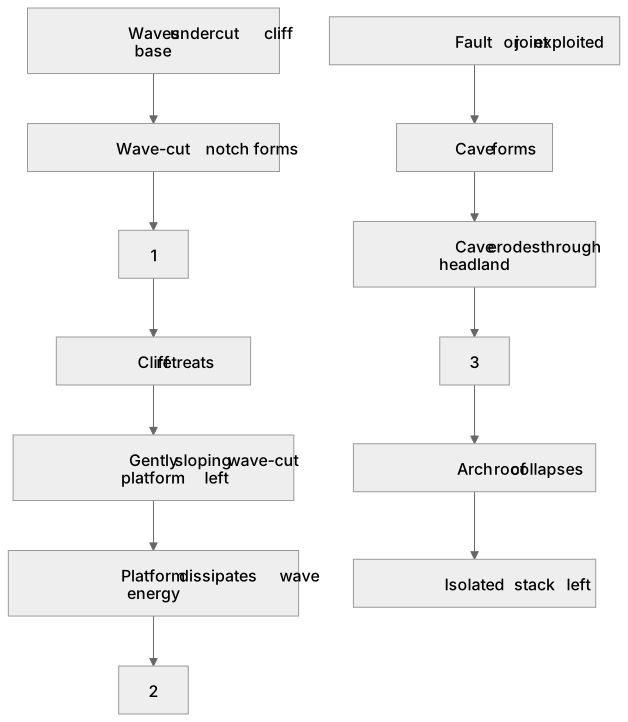
1Box 1
2Box 2
3Box 3
There is more to this lesson
The full lesson goes on to check your understanding and help you earn the marks. Create a free account to carry on, with your progress saved.
A week of Premium from your first lesson · Then the free plan continues · No card, no charge
Test your understanding of Coastal landscape development: Origin and development of landforms and landscapes of coastal erosion: cliffs and wave cut platforms, cliff profile features including caves, arches and stacks; factors and processes in their development.
Active recall beats re-reading. Take an instant quiz now to test what you’ve learned and lock it into long-term memory.
A week of Premium from your first lesson · Then the free plan continues · No card, no charge