AQA · A-Level · Geography
Course version: 7037 · Version from Sept 2018
Human intervention in coastal landscapes. Traditional approaches to…
Full specification wording
Coastal management: Human intervention in coastal landscapes. Traditional approaches to coastal flood and erosion risk: hard and soft engineering. Sustainable approaches to coastal flood risk and coastal erosion management: shoreline management/integrated coastal zone management.
Human intervention in coastal landscapes aims to mitigate flood and erosion risks through various strategies.
Checked against the AQA 7037 specification (opens in a new tab) on .
- 2 key terms
Study notes
From the checked teaching notes for this specification point.
The idea
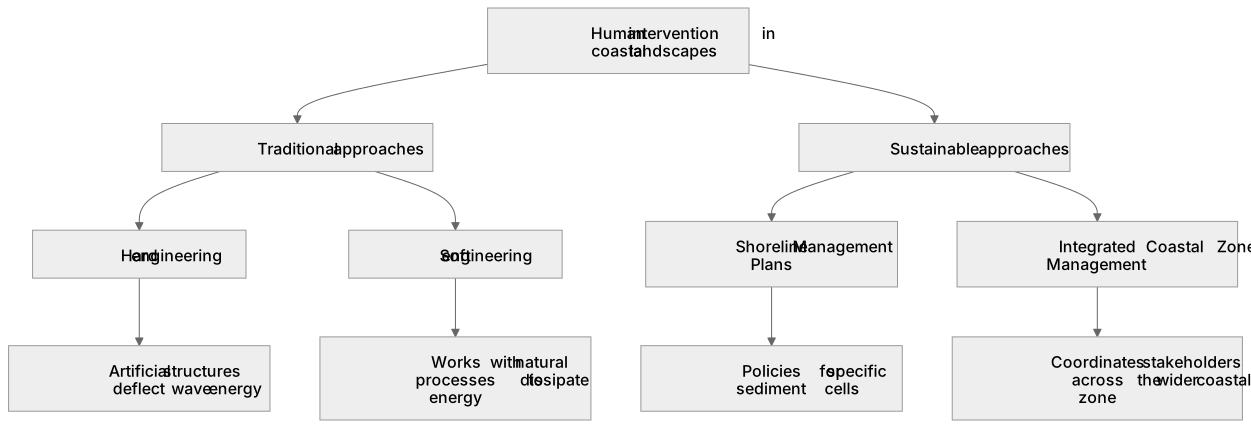
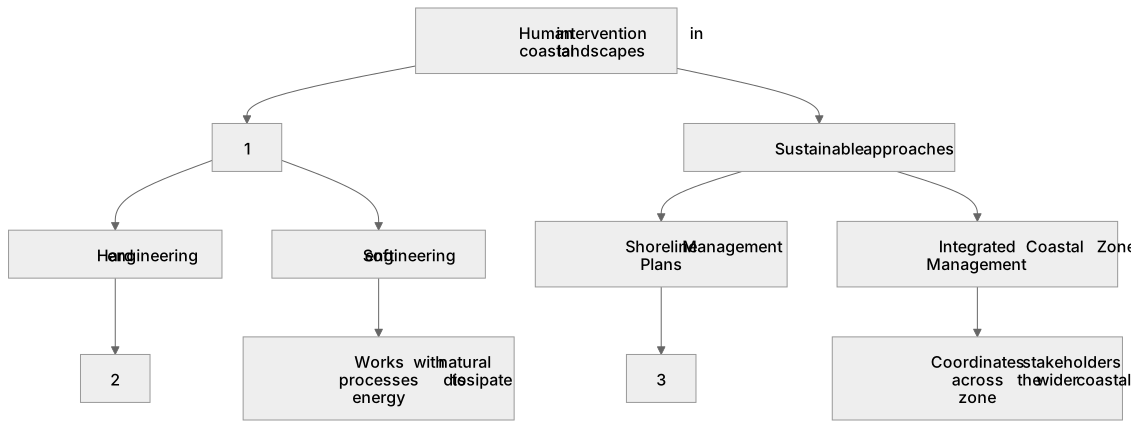
Human intervention in coastal landscapes aims to mitigate flood and erosion risks through various strategies. Traditional approaches often rely on hard engineering, using artificial structures like sea walls to deflect wave energy, or soft engineering, such as beach nourishment, which works with natural processes to dissipate energy. Increasingly, management has shifted towards sustainable approaches that consider the entire coastal system. Shoreline Management Plans (SMPs) dictate policies like 'managed retreat' for specific sediment cells. Integrated Coastal Zone Management (ICZM) broadens this by coordinating all stakeholders to balance environmental, economic, and social needs across the wider coastal zone.
What earns the marks
- Distinguish between hard engineering (e.g., groynes, sea walls) and soft engineering (e.g., dune regeneration) in managing erosion and flood risk.
- Evaluate the cost-benefit and environmental impacts of traditional coastal defence strategies.
- Explain the principles of Shoreline Management Plans (SMPs) and the four policy options: hold the line, advance the line, managed realignment, and no active intervention.
- Analyse how Integrated Coastal Zone Management (ICZM) provides a holistic, sustainable approach by involving multiple stakeholders and considering entire sediment cells.
Common mistakes and how to put them right
Using SMP and ICZM interchangeably.
Put it right: SMPs focus specifically on shoreline defence policies for sediment cells, whereas ICZM is a broader framework managing all coastal activities and stakeholders.
Assuming hard engineering is always the most effective solution.
Put it right: Acknowledge that hard engineering can disrupt sediment cells, causing terminal groyne syndrome, making soft or sustainable approaches preferable.
Failing to link management strategies to both flood risk and erosion risk.
Put it right: Explicitly state whether a strategy is designed to prevent inundation (flooding) or land loss (erosion), or both.
Exam tips
- Always evaluate management strategies using specific, named examples of coastal locations where they have been implemented.
- Consider the unintended consequences of human intervention, such as how protecting one area might accelerate erosion downdrift.
- When discussing sustainable approaches, weigh up the conflicting interests of different stakeholders, such as local residents versus environmental conservationists.
Try the lesson
The start of the Coastal management: Human intervention in coastal landscapes. Traditional approaches to coastal flood and erosion risk: hard and soft engineering. Sustainable approaches to coastal flood risk and coastal erosion management: shoreline management/integrated coastal zone management. lesson, made from checked teaching notes for this specification point.
Have a go first
Which of the following is a characteristic of Integrated Coastal Zone Management (ICZM) compared to traditional hard engineering approaches?
Listen
Human intervention in coastal landscapes aims to mitigate flood and erosion risks through various strategies. Traditional approaches often rely on hard engineering, using artificial structures like sea walls to deflect wave energy, or soft engineering, such as beach nourishment, which works with natural processes to dissipate energy. Increasingly, management has shifted towards sustainable approaches that consider the entire coastal system. Shoreline Management Plans (SMPs) dictate policies like 'managed retreat' for specific sediment cells. Integrated Coastal Zone Management (ICZM) broadens this by coordinating all stakeholders to balance environmental, economic, and social needs across the wider coastal zone. A strong answer earns marks for these points. Distinguish between hard engineering (e.g., groynes, sea walls) and soft engineering (e.g., dune regeneration) in managing erosion and flood risk. Evaluate the cost-benefit and environmental impacts of traditional coastal defence strategies. Explain the principles of Shoreline Management Plans (SMPs) and the four policy options: hold the line, advance the line, managed realignment, and no active intervention. Analyse how Integrated Coastal Zone Management (ICZM) provides a holistic, sustainable approach by involving multiple stakeholders and considering entire sediment cells. A common slip: Using SMP and ICZM interchangeably. Instead, SMPs focus specifically on shoreline defence policies for sediment cells, whereas ICZM is a broader framework managing all coastal activities and stakeholders. Exam tip: Always evaluate management strategies using specific, named examples of coastal locations where they have been implemented.
See it
Key words
Say what each word means before you turn the card.
Human intervention
Try answering aloud or in your head before turning the card.
Stakeholder conflict
Try answering aloud or in your head before turning the card.
See every definition
- Human intervention
- Action in coastal landscapes that aims to mitigate flood and erosion risks through various strategies.
- Stakeholder conflict
- The conflicting interests of different stakeholders, such as local residents versus environmental conservationists, that must be weighed up when discussing sustainable approaches.
Label the diagram
Some boxes have lost their names. Pick the right name for each number.
1Box 1
2Box 2
3Box 3
There is more to this lesson
The full lesson goes on to check your understanding and help you earn the marks. Create a free account to carry on, with your progress saved.
A week of Premium from your first lesson · Then the free plan continues · No card, no charge
Test your understanding of Coastal management: Human intervention in coastal landscapes. Traditional approaches to coastal flood and erosion risk: hard and soft engineering. Sustainable approaches to coastal flood risk and coastal erosion management: shoreline management/integrated coastal zone management.
Active recall beats re-reading. Take an instant quiz now to test what you’ve learned and lock it into long-term memory.
A week of Premium from your first lesson · Then the free plan continues · No card, no charge