AQA · A-Level · Geography
Course version: 7037 · Version from Sept 2018
Systems in physical geography: systems concepts and their application to…
Full specification wording
Coasts as natural systems: Systems in physical geography: systems concepts and their application to the development of coastal landscapes – inputs, outputs, energy, stores/components, flows/transfers, positive/negative feedback, dynamic equilibrium. The concepts of landform and landscape and how related landforms combine to form characteristic landscapes.
Coastal environments operate as open systems, exchanging both energy and matter with their surroundings.
Checked against the AQA 7037 specification (opens in a new tab) on .
- 4 key terms
Study notes
From the checked teaching notes for this specification point.
The idea
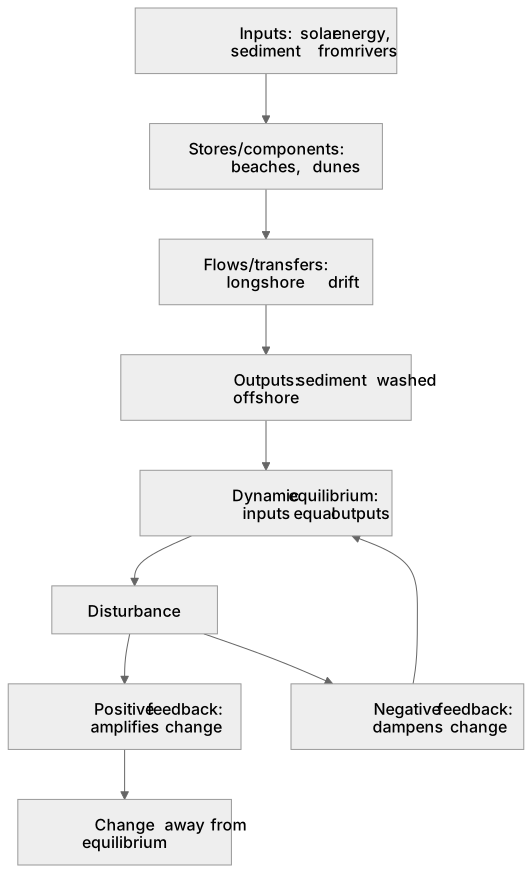
Coastal environments operate as open systems, exchanging both energy and matter with their surroundings. Inputs like solar energy and sediment from rivers drive flows and transfers, such as longshore drift, moving material between stores like beaches and dunes. Outputs include sediment washed offshore. When inputs equal outputs, the system achieves dynamic equilibrium. Disturbances trigger feedback: positive feedback amplifies change (e.g., storm erosion removing vegetation, leading to further dune loss), while negative feedback dampens it (e.g., cliff collapse creating a protective scree slope). A landform is an individual feature, like a stack or spit. Related landforms combine to create a characteristic landscape, such as a coastal plain featuring spits, salt marshes, and lagoons working together.
What earns the marks
- Define coasts as open systems with inputs (sediment, energy), outputs (sediment loss), stores (beaches), and flows (longshore drift).
- Explain dynamic equilibrium as the balanced state where inputs and outputs are equal, maintaining a stable coastal system over time.
- Distinguish between positive feedback (amplifying change, e.g., blowout development in dunes) and negative feedback (restoring balance, e.g., beach profiling during storms).
- Differentiate a landform (an individual relief feature like a wave-cut platform) from a landscape (a broader area comprising multiple interacting landforms).
- Illustrate how landforms combine into landscapes, such as a headland, cave, arch, and stack sequence forming a high-energy rocky coastal landscape.
Common mistakes and how to put them right
Confusing positive and negative feedback.
Put it right: Positive feedback amplifies a change away from equilibrium, whereas negative feedback restores the system to its original state.
Using 'landform' and 'landscape' interchangeably.
Put it right: A landform is a single distinct feature (e.g., a spit), while a landscape is the wider visual and physical environment made of multiple landforms.
Assuming coastal systems are closed.
Put it right: Coasts are open systems because they transfer both energy (e.g., wave power) and matter (e.g., sediment) across their boundaries.
Exam tips
- Always use specific coastal examples when defining systems terminology, such as citing a beach as a sediment store.
- When discussing dynamic equilibrium, explain the specific mechanisms of negative feedback that help restore the balance after a storm event.
- Structure landscape answers by showing the spatial and genetic relationships between individual landforms, like how a spit shelters a salt marsh.
Try the lesson
The start of the Coasts as natural systems: Systems in physical geography: systems concepts and their application to the development of coastal landscapes – inputs, outputs, energy, stores/components, flows/transfers, positive/negative feedback, dynamic equilibrium. The concepts of landform and landscape and how related landforms combine to form characteristic landscapes. lesson, made from checked teaching notes for this specification point.
Have a go first
In the context of coastal systems, which scenario best describes a state of dynamic equilibrium?
Listen
Coastal environments operate as open systems, exchanging both energy and matter with their surroundings. Inputs like solar energy and sediment from rivers drive flows and transfers, such as longshore drift, moving material between stores like beaches and dunes. Outputs include sediment washed offshore. When inputs equal outputs, the system achieves dynamic equilibrium. Disturbances trigger feedback: positive feedback amplifies change (e.g., storm erosion removing vegetation, leading to further dune loss), while negative feedback dampens it (e.g., cliff collapse creating a protective scree slope). A landform is an individual feature, like a stack or spit. Related landforms combine to create a characteristic landscape, such as a coastal plain featuring spits, salt marshes, and lagoons working together. A strong answer earns marks for these points. Define coasts as open systems with inputs (sediment, energy), outputs (sediment loss), stores (beaches), and flows (longshore drift). Explain dynamic equilibrium as the balanced state where inputs and outputs are equal, maintaining a stable coastal system over time. Distinguish between positive feedback (amplifying change, e.g., blowout development in dunes) and negative feedback (restoring balance, e.g., beach profiling during storms). Differentiate a landform (an individual relief feature like a wave-cut platform) from a landscape (a broader area comprising multiple interacting landforms). A common slip: Confusing positive and negative feedback. Instead, positive feedback amplifies a change away from equilibrium, whereas negative feedback restores the system to its original state. Exam tip: Always use specific coastal examples when defining systems terminology, such as citing a beach as a sediment store.
See it
Key words
Say what each word means before you turn the card.
Dynamic equilibrium
Try answering aloud or in your head before turning the card.
Positive feedback
Try answering aloud or in your head before turning the card.
Negative feedback
Try answering aloud or in your head before turning the card.
Landform
Try answering aloud or in your head before turning the card.
See every definition
- Dynamic equilibrium
- The balanced state where inputs and outputs are equal, maintaining a stable coastal system over time.
- Positive feedback
- A process that amplifies change away from equilibrium, such as storm erosion removing vegetation and leading to further dune loss.
- Negative feedback
- A process that dampens change and restores balance, such as cliff collapse creating a protective scree slope.
- Landform
- An individual feature, like a stack or spit, that combines with related features to create a characteristic landscape.
Label the diagram
Some boxes have lost their names. Pick the right name for each number.
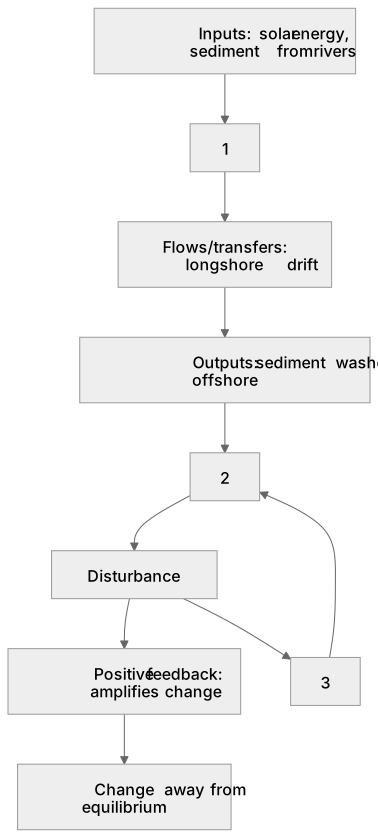
1Box 1
2Box 2
3Box 3
There is more to this lesson
The full lesson goes on to check your understanding and help you earn the marks. Create a free account to carry on, with your progress saved.
A week of Premium from your first lesson · Then the free plan continues · No card, no charge
Test your understanding of Coasts as natural systems: Systems in physical geography: systems concepts and their application to the development of coastal landscapes – inputs, outputs, energy, stores/components, flows/transfers, positive/negative feedback, dynamic equilibrium. The concepts of landform and landscape and how related landforms combine to form characteristic landscapes.
Active recall beats re-reading. Take an instant quiz now to test what you’ve learned and lock it into long-term memory.
A week of Premium from your first lesson · Then the free plan continues · No card, no charge