AQA · A-Level · Geography
Course version: 7037 · Version from Sept 2018
Systems in physical geography: systems concepts and their application to…
Full specification wording
Deserts as natural systems: Systems in physical geography: systems concepts and their application to the development of desert landscapes – inputs, outputs, energy, stores/components, flows/transfers, positive/negative feedback, dynamic equilibrium. The concepts of landform and landscape and how related landforms combine to form characteristic landscapes.
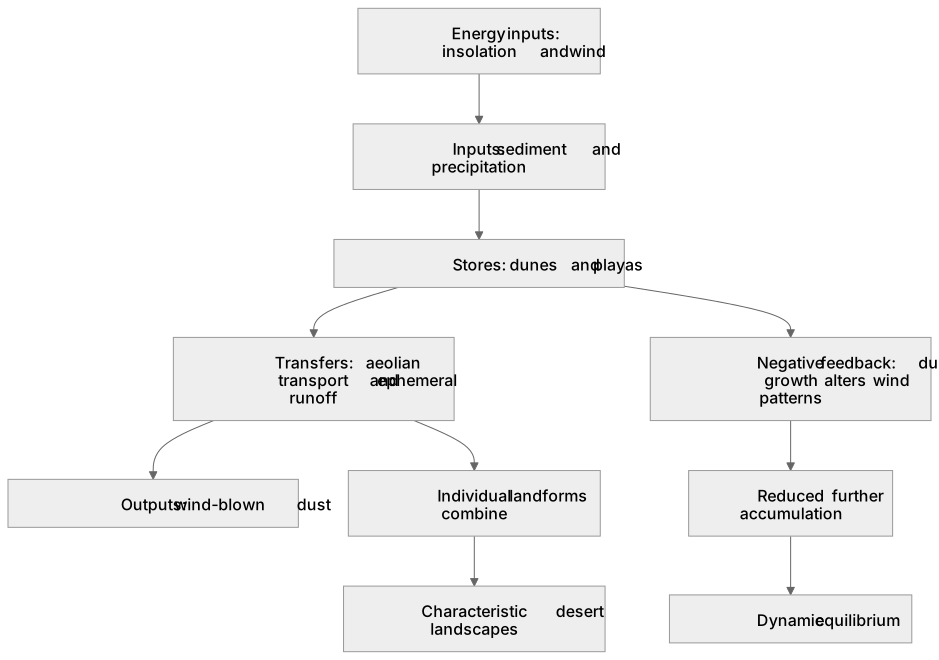
Desert environments operate as open systems driven by energy inputs like insolation and wind.
Checked against the AQA 7037 specification (opens in a new tab) on .
- Point 1 of 4
- 4 key terms
Study notes
From the checked teaching notes for this specification point.
The idea
Desert environments operate as open systems driven by energy inputs like insolation and wind. Understanding feedback mechanisms is crucial; for example, negative feedback where dune growth alters wind patterns, reducing further accumulation to maintain dynamic equilibrium.
What earns the marks
- Define desert environments as open systems with distinct inputs, outputs, energy sources, stores, and transfers.
- Explain how energy, such as solar radiation and wind energy, drives geomorphic processes and sediment flows within the desert system.
- Apply the concepts of positive and negative feedback to explain how desert systems respond to environmental changes and maintain dynamic equilibrium.
- Distinguish between individual desert landforms and the broader characteristic landscapes they create when combined.
Common mistakes and how to put them right
Confusing the terms 'landform' and 'landscape'.
Put it right: Use 'landform' for individual features like a single dune, and 'landscape' for the wider area comprising multiple interacting landforms.
Misidentifying feedback mechanisms in geomorphic systems.
Put it right: Ensure negative feedback is described as a process that dampens change to restore equilibrium, while positive feedback amplifies change.
Treating desert systems as closed systems.
Put it right: Explicitly state that desert landscapes are open systems because both energy and matter cross their boundaries.
Exam tips
- Create a systems diagram for a specific desert environment, clearly labelling the inputs, stores, transfers, and outputs to help visualise the connections.
- When discussing dynamic equilibrium, use a concrete example such as the balance between wind velocity and sediment transport in dune formation.
- Always link individual landforms together when asked about a 'landscape', explaining how processes like water runoff connect a wadi to an alluvial fan.
Try the lesson
The start of the Deserts as natural systems: Systems in physical geography: systems concepts and their application to the development of desert landscapes – inputs, outputs, energy, stores/components, flows/transfers, positive/negative feedback, dynamic equilibrium. The concepts of landform and landscape and how related landforms combine to form characteristic landscapes. lesson, made from checked teaching notes for this specification point.
Have a go first
In the context of a desert landscape system, which of the following represents a primary input of energy that drives geomorphic processes?
Listen
Desert environments operate as open systems driven by energy inputs like insolation and wind. Understanding feedback mechanisms is crucial; for example, negative feedback where dune growth alters wind patterns, reducing further accumulation to maintain dynamic equilibrium. A strong answer earns marks for these points. Define desert environments as open systems with distinct inputs, outputs, energy sources, stores, and transfers. Explain how energy, such as solar radiation and wind energy, drives geomorphic processes and sediment flows within the desert system. Apply the concepts of positive and negative feedback to explain how desert systems respond to environmental changes and maintain dynamic equilibrium. Distinguish between individual desert landforms and the broader characteristic landscapes they create when combined. A common slip: Confusing the terms 'landform' and 'landscape'. Instead, Use 'landform' for individual features like a single dune, and 'landscape' for the wider area comprising multiple interacting landforms. Exam tip: Create a systems diagram for a specific desert environment, clearly labelling the inputs, stores, transfers, and outputs to help visualise the connections.
See it
Key words
Say what each word means before you turn the card.
Systems theory in physical geography
Try answering aloud or in your head before turning the card.
Geomorphic feedback and equilibrium
Try answering aloud or in your head before turning the card.
Landscape evolution
Try answering aloud or in your head before turning the card.
Landform
Try answering aloud or in your head before turning the card.
See every definition
- Systems theory in physical geography
- Systems concepts and their application to the development of desert landscapes, involving inputs, outputs, energy, stores/components and flows/transfers.
- Geomorphic feedback and equilibrium
- Positive and negative feedback, and dynamic equilibrium, applied to explain how desert systems respond to environmental changes.
- Landscape evolution
- How related landforms combine to form characteristic landscapes, with individual landforms spatially combining and interacting over time.
- Landform
- An individual feature, such as a single barchan dune or wadi, distinguished from the broader landscape.
Label the diagram
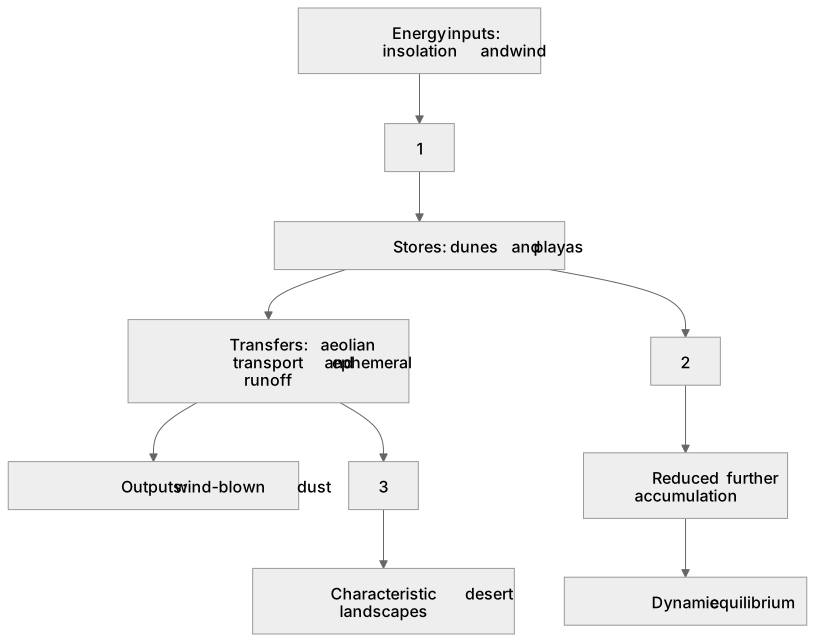
Some boxes have lost their names. Pick the right name for each number.
1Box 1
2Box 2
3Box 3
There is more to this lesson
The full lesson goes on to check your understanding and help you earn the marks. Create a free account to carry on, with your progress saved.
A week of Premium from your first lesson · Then the free plan continues · No card, no charge
Test your understanding of Deserts as natural systems: Systems in physical geography: systems concepts and their application to the development of desert landscapes – inputs, outputs, energy, stores/components, flows/transfers, positive/negative feedback, dynamic equilibrium. The concepts of landform and landscape and how related landforms combine to form characteristic landscapes.
Active recall beats re-reading. Take an instant quiz now to test what you’ve learned and lock it into long-term memory.
A week of Premium from your first lesson · Then the free plan continues · No card, no charge