AQA · A-Level · Geography
Course version: 7037 · Version from Sept 2018
Succession and climatic climax as illustrated by lithoseres and hydroseres.
Full specification wording
Ecosystems in the British Isles over time: Succession and climatic climax as illustrated by lithoseres and hydroseres.
Ecological succession is the directional change in a plant community over time, culminating in a stable climatic climax community determined by regional climate, such as UK deciduous woodland.
Checked against the AQA 7037 specification (opens in a new tab) on .
- Point 1 of 3
- 4 key terms
Study notes
From the checked teaching notes for this specification point.
The idea
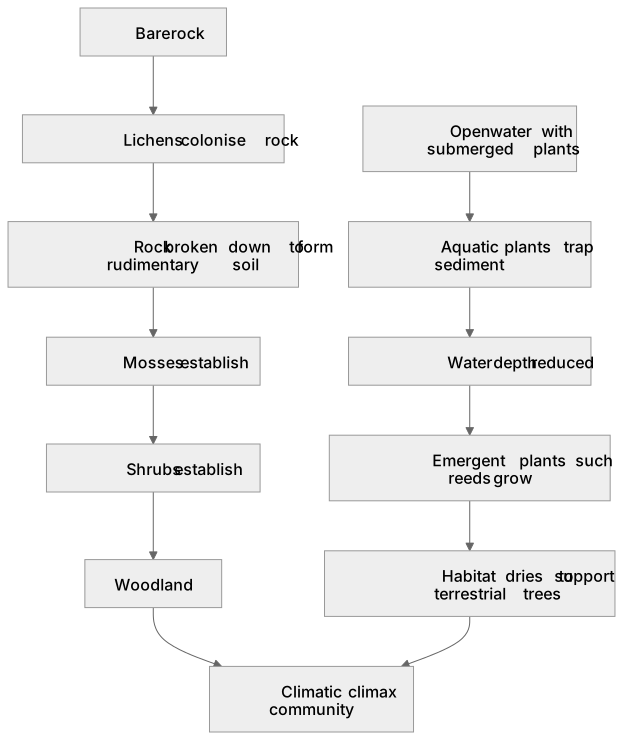
Ecological succession is the directional change in a plant community over time, culminating in a stable climatic climax community determined by regional climate, such as UK deciduous woodland. This is illustrated by primary succession on bare rock (a lithosere) and in freshwater (a hydrosere). In a lithosere, pioneer species like lichens colonise rock, breaking it down to form rudimentary soil, allowing mosses and eventually shrubs to establish. In a hydrosere, aquatic plants trap sediment in a pond, gradually reducing water depth. This allows emergent plants like reeds to grow, eventually drying the habitat to support terrestrial trees. Both pathways show how early colonisers modify the abiotic environment for subsequent seral stages.
What earns the marks
- Define succession as the progressive change in species composition over time, leading to a climatic climax community.
- Explain the role of pioneer species in modifying the abiotic environment to facilitate subsequent seral stages.
- Detail the specific stages of a lithosere, from bare rock colonised by lichens to the eventual establishment of woodland.
- Detail the specific stages of a hydrosere, from open water with submerged plants to a terrestrial climax community as the water body fills with sediment.
Common mistakes and how to put them right
Confusing primary and secondary succession.
Put it right: Lithoseres and hydroseres are examples of primary succession starting on newly formed, lifeless substrates, not secondary succession which occurs on previously vegetated land.
Assuming the climatic climax is always a dense forest.
Put it right: The climatic climax depends entirely on the regional climate; in some areas, it may be grassland or tundra rather than woodland.
Stating that pioneer species outcompete later species.
Put it right: Pioneer species actually modify the environment to make it less suitable for themselves and more suitable for later successional species, which then outcompete them.
Exam tips
- Learn the specific names of plant types at each seral stage for both lithoseres and hydroseres to add detail to your answers.
- Clearly explain the mechanism of change between stages, focusing on how vegetation alters soil depth, moisture, and nutrient availability.
- Use diagrams if helpful, but ensure you can write a step-by-step explanation of how a hydrosere transitions from aquatic to terrestrial.
Try the lesson
The start of the Ecosystems in the British Isles over time: Succession and climatic climax as illustrated by lithoseres and hydroseres. lesson, made from checked teaching notes for this specification point.
Have a go first
In the development of a lithosere, which organisms are typically the first colonisers (pioneer species) on the bare rock surface?
Listen
Ecological succession is the directional change in a plant community over time, culminating in a stable climatic climax community determined by regional climate, such as UK deciduous woodland. This is illustrated by primary succession on bare rock (a lithosere) and in freshwater (a hydrosere). In a lithosere, pioneer species like lichens colonise rock, breaking it down to form rudimentary soil, allowing mosses and eventually shrubs to establish. In a hydrosere, aquatic plants trap sediment in a pond, gradually reducing water depth. This allows emergent plants like reeds to grow, eventually drying the habitat to support terrestrial trees. Both pathways show how early colonisers modify the abiotic environment for subsequent seral stages. A strong answer earns marks for these points. Define succession as the progressive change in species composition over time, leading to a climatic climax community. Explain the role of pioneer species in modifying the abiotic environment to facilitate subsequent seral stages. Detail the specific stages of a lithosere, from bare rock colonised by lichens to the eventual establishment of woodland. Detail the specific stages of a hydrosere, from open water with submerged plants to a terrestrial climax community as the water body fills with sediment. A common slip: Confusing primary and secondary succession. Instead, Lithoseres and hydroseres are examples of primary succession starting on newly formed, lifeless substrates, not secondary succession which occurs on previously vegetated land. Exam tip: Learn the specific names of plant types at each seral stage for both lithoseres and hydroseres to add detail to your answers.
See it
Key words
Say what each word means before you turn the card.
Ecological succession
Try answering aloud or in your head before turning the card.
Climatic climax
Try answering aloud or in your head before turning the card.
Lithosere
Try answering aloud or in your head before turning the card.
Hydrosere
Try answering aloud or in your head before turning the card.
See every definition
- Ecological succession
- The directional change in a plant community over time, culminating in a stable climatic climax community determined by regional climate.
- Climatic climax
- A stable community determined by regional climate, such as UK deciduous woodland.
- Lithosere
- Primary succession on bare rock, where pioneer species like lichens colonise rock, breaking it down to form rudimentary soil.
- Hydrosere
- Primary succession in freshwater, where aquatic plants trap sediment in a pond, gradually reducing water depth.
Label the diagram
Some boxes have lost their names. Pick the right name for each number.
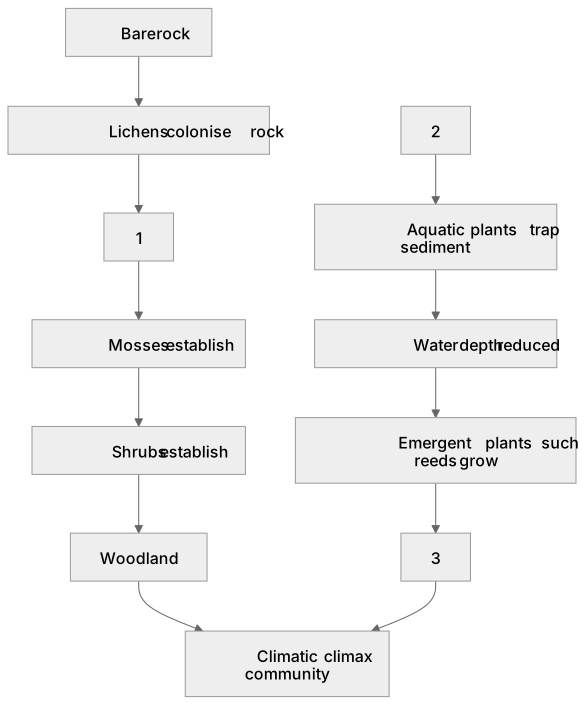
1Box 1
2Box 2
3Box 3
There is more to this lesson
The full lesson goes on to check your understanding and help you earn the marks. Create a free account to carry on, with your progress saved.
A week of Premium from your first lesson · Then the free plan continues · No card, no charge
Test your understanding of Ecosystems in the British Isles over time: Succession and climatic climax as illustrated by lithoseres and hydroseres.
Active recall beats re-reading. Take an instant quiz now to test what you’ve learned and lock it into long-term memory.
A week of Premium from your first lesson · Then the free plan continues · No card, no charge