AQA · A-Level · Geography
Course version: 7037 · Version from Sept 2018
Characteristics and distribution of two key zonal soils to exemplify…
Full specification wording
Environment and population: Characteristics and distribution of two key zonal soils to exemplify relationship between soils and human activities especially agriculture. Soil problems and their management as they relate to agriculture: soil erosion, waterlogging, salinisation, structural deterioration.
Zonal soils, such as Podzols (taiga) and Chernozems (steppes), demonstrate how climate and vegetation shape soil profiles and agricultural potential.
Checked against the AQA 7037 specification (opens in a new tab) on .
- Point 3 of 4
- 4 key terms
Study notes
From the checked teaching notes for this specification point.
The idea
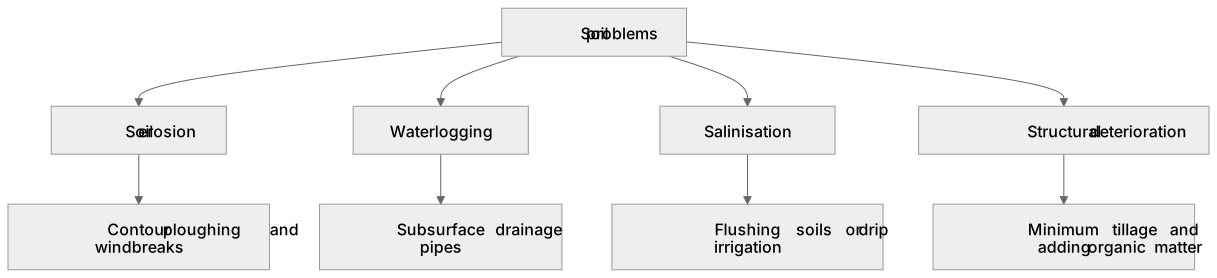
Zonal soils, such as Podzols (taiga) and Chernozems (steppes), demonstrate how climate and vegetation shape soil profiles and agricultural potential. Podzols are acidic and nutrient-poor, requiring heavy fertilisation for farming, whereas Chernozems possess a deep, organic-rich mull humus layer ideal for cereal cultivation. Intensive agriculture often triggers severe soil degradation. Soil erosion removes fertile topsoil, managed by contour ploughing and windbreaks. Waterlogging suffocates roots, mitigated by installing subsurface drainage pipes. Salinisation occurs when high evaporation draws salts to the surface, managed by flushing soils or drip irrigation. Structural deterioration, caused by heavy machinery compacting peds, is alleviated by minimum tillage and adding organic matter.
What earns the marks
- Identify the distinct horizons, pH, and nutrient status of two chosen zonal soils, such as Podzols and Chernozems.
- Explain how the natural characteristics of these soils influence specific agricultural practices and crop choices.
- Describe the physical and chemical processes leading to soil erosion, waterlogging, salinisation, and structural deterioration.
- Evaluate the effectiveness of specific management strategies, such as drip irrigation for salinisation or minimum tillage for structural deterioration.
Common mistakes and how to put them right
Confusing salinisation with waterlogging.
Put it right: Salinisation is the accumulation of salts often due to capillary action, whereas waterlogging is the saturation of pore spaces with water.
Assuming Podzols are highly fertile due to forest cover.
Put it right: They are actually highly acidic and heavily leached, requiring significant lime and fertiliser for agriculture.
Describing structural deterioration merely as 'bad soil'.
Put it right: It specifically refers to the loss of soil aggregates (peds) and pore spaces, often due to compaction by heavy machinery.
Exam tips
- Always link the specific characteristics of your chosen zonal soils, like the eluvial horizon in Podzols, directly to how humans must adapt their agricultural methods.
- When discussing soil management, evaluate the sustainability and cost-effectiveness of the strategies rather than just describing them.
- Use specific geographic examples of where these soil problems occur, such as salinisation in the Murray-Darling Basin or wind erosion in the US Midwest.
Try the lesson
The start of the Environment and population: Characteristics and distribution of two key zonal soils to exemplify relationship between soils and human activities especially agriculture. Soil problems and their management as they relate to agriculture: soil erosion, waterlogging, salinisation, structural deterioration. lesson, made from checked teaching notes for this specification point.
Have a go first
Which agricultural practice is most likely to lead to the salinisation of soils in arid environments?
Listen
Zonal soils, such as Podzols (taiga) and Chernozems (steppes), demonstrate how climate and vegetation shape soil profiles and agricultural potential. Podzols are acidic and nutrient-poor, requiring heavy fertilisation for farming, whereas Chernozems possess a deep, organic-rich mull humus layer ideal for cereal cultivation. Intensive agriculture often triggers severe soil degradation. Soil erosion removes fertile topsoil, managed by contour ploughing and windbreaks. Waterlogging suffocates roots, mitigated by installing subsurface drainage pipes. Salinisation occurs when high evaporation draws salts to the surface, managed by flushing soils or drip irrigation. Structural deterioration, caused by heavy machinery compacting peds, is alleviated by minimum tillage and adding organic matter. A strong answer earns marks for these points. Identify the distinct horizons, pH, and nutrient status of two chosen zonal soils, such as Podzols and Chernozems. Explain how the natural characteristics of these soils influence specific agricultural practices and crop choices. Describe the physical and chemical processes leading to soil erosion, waterlogging, salinisation, and structural deterioration. Evaluate the effectiveness of specific management strategies, such as drip irrigation for salinisation or minimum tillage for structural deterioration. Exam tip: Always link the specific characteristics of your chosen zonal soils, like the eluvial horizon in Podzols, directly to how humans must adapt their agricultural methods.
See it
Key words
Say what each word means before you turn the card.
Soil profiles and horizons
Try answering aloud or in your head before turning the card.
Agricultural sustainability
Try answering aloud or in your head before turning the card.
Environmental degradation
Try answering aloud or in your head before turning the card.
Human-environment interaction
Try answering aloud or in your head before turning the card.
See every definition
- Soil profiles and horizons
- The layers shaped by climate and vegetation that make up a soil, as shown by zonal soils such as Podzols and Chernozems.
- Agricultural sustainability
- The extent to which management strategies for soil problems can be continued without damaging the soil, judged on sustainability and cost-effectiveness.
- Environmental degradation
- Severe soil degradation often triggered by intensive agriculture, including soil erosion, waterlogging, salinisation and structural deterioration.
- Human-environment interaction
- The relationship between soils and human activities, especially agriculture, in which soil characteristics influence practices and crop choices.
Label the diagram
Some boxes have lost their names. Pick the right name for each number.
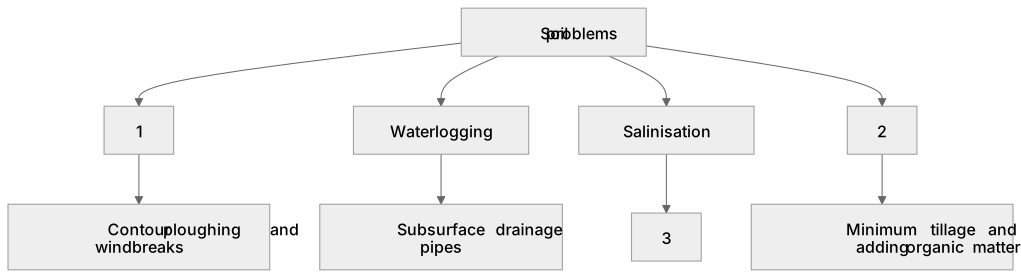
1Box 1
2Box 2
3Box 3
There is more to this lesson
The full lesson goes on to check your understanding and help you earn the marks. Create a free account to carry on, with your progress saved.
A week of Premium from your first lesson · Then the free plan continues · No card, no charge
Test your understanding of Environment and population: Characteristics and distribution of two key zonal soils to exemplify relationship between soils and human activities especially agriculture. Soil problems and their management as they relate to agriculture: soil erosion, waterlogging, salinisation, structural deterioration.
Active recall beats re-reading. Take an instant quiz now to test what you’ve learned and lock it into long-term memory.
A week of Premium from your first lesson · Then the free plan continues · No card, no charge