AQA · A-Level · Geography
Course version: 7037 · Version from Sept 2018
Role of international agencies and NGOs in promoting health and combating…
Full specification wording
Environment, health and well-being: Role of international agencies and NGOs in promoting health and combating disease at the global scale.
International agencies like the World Health Organization (WHO) operate at a macro-level to promote health by setting global standards, coordinating research, and directing funding for vaccination…
Checked against the AQA 7037 specification (opens in a new tab) on .
- Point 5 of 5
Study notes
From the checked teaching notes for this specification point.
The idea
International agencies like the World Health Organization (WHO) operate at a macro-level to promote health by setting global standards, coordinating research, and directing funding for vaccination programmes. They combat disease globally by monitoring outbreaks, such as Ebola, and declaring public health emergencies. Non-Governmental Organisations (NGOs), like Médecins Sans Frontières (MSF), often work at the micro-level, delivering direct medical care and sanitation in crisis zones where governments cannot cope. Together, these actors form a multi-scalar approach: agencies provide the overarching strategic framework and epidemiological data, while NGOs offer agile, on-the-ground interventions to combat diseases worldwide.
What earns the marks
- Identify specific international agencies (e.g., WHO, UNAIDS) and explain their role in global health governance, data collection, and policy-making.
- Evaluate the role of NGOs (e.g., MSF, WaterAid) in providing emergency medical relief, grassroots health education, and sanitation infrastructure.
- Distinguish between 'promoting health' (preventative measures, education, sanitation) and 'combating disease' (reactive treatments, vaccination drives, outbreak containment).
- Assess the effectiveness of these organisations at the global scale, considering challenges such as funding limitations, geopolitical barriers, and logistical constraints during pandemics.
Common mistakes and how to put them right
Confusing international agencies with NGOs.
Put it right: Clearly distinguish intergovernmental bodies like the WHO (funded by member states) from independent NGOs like MSF (funded largely by public donations).
Focusing only on treating diseases rather than promoting health.
Put it right: Ensure answers also discuss preventative strategies, such as the WHO's campaigns on sanitation, nutrition, and maternal health.
Providing highly localised examples without linking them to the global scale.
Put it right: Connect local NGO interventions to broader global health targets, such as the UN Sustainable Development Goals (SDGs).
Exam tips
- Use a specific global health crisis, such as the West African Ebola outbreak or COVID-19, to illustrate the complementary roles of the WHO and NGOs.
- Critically evaluate the limitations of NGOs, such as their reliance on donor funding which can lead to uneven distribution of health resources.
- When discussing the global scale, reference the Sustainable Development Goals (specifically SDG 3: Good Health and Well-being) to frame the overarching objectives of these organisations.
Try the lesson
The start of the Environment, health and well-being: Role of international agencies and NGOs in promoting health and combating disease at the global scale. lesson, made from checked teaching notes for this specification point.
Have a go first
Which of the following best describes a primary function of the World Health Organization (WHO) in combating disease at the global scale?
Listen
International agencies like the World Health Organization (WHO) operate at a macro-level to promote health by setting global standards, coordinating research, and directing funding for vaccination programmes. They combat disease globally by monitoring outbreaks, such as Ebola, and declaring public health emergencies. Non-Governmental Organisations (NGOs), like Médecins Sans Frontières (MSF), often work at the micro-level, delivering direct medical care and sanitation in crisis zones where governments cannot cope. Together, these actors form a multi-scalar approach: agencies provide the overarching strategic framework and epidemiological data, while NGOs offer agile, on-the-ground interventions to combat diseases worldwide. A strong answer earns marks for these points. Identify specific international agencies (e.g., WHO, UNAIDS) and explain their role in global health governance, data collection, and policy-making. Evaluate the role of NGOs (e.g., MSF, WaterAid) in providing emergency medical relief, grassroots health education, and sanitation infrastructure. Distinguish between 'promoting health' (preventative measures, education, sanitation) and 'combating disease' (reactive treatments, vaccination drives, outbreak containment). Assess the effectiveness of these organisations at the global scale, considering challenges such as funding limitations, geopolitical barriers, and logistical constraints during pandemics. A common slip: Confusing international agencies with NGOs. Instead, Clearly distinguish intergovernmental bodies like the WHO (funded by member states) from independent NGOs like MSF (funded largely by public donations). Exam tip: Use a specific global health crisis, such as the West African Ebola outbreak or COVID-19, to illustrate the complementary roles of the WHO and NGOs.
See it
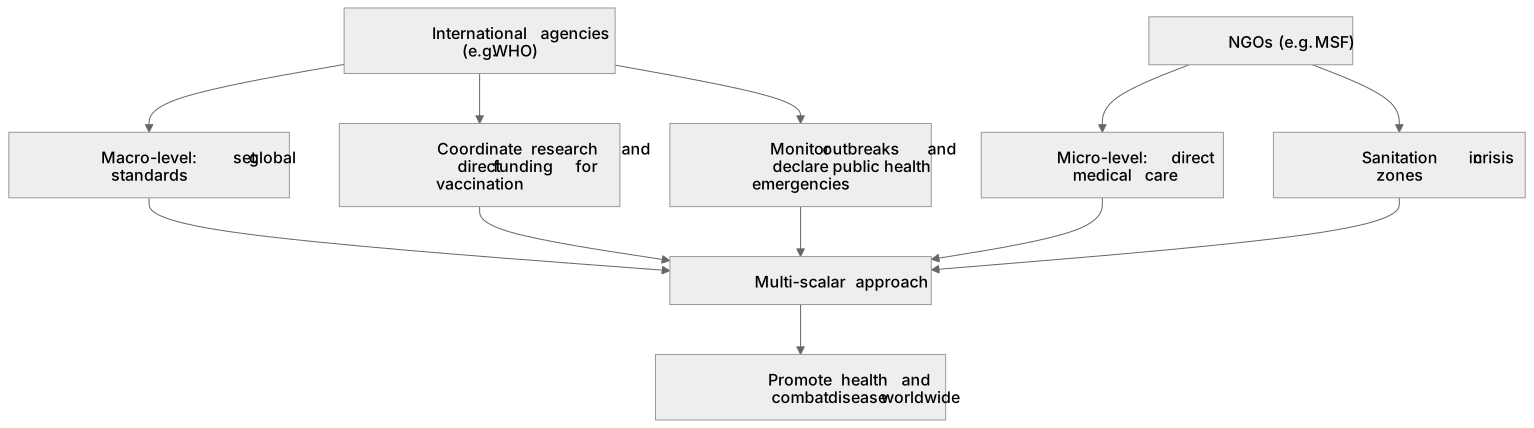
Label the diagram
Some boxes have lost their names. Pick the right name for each number.
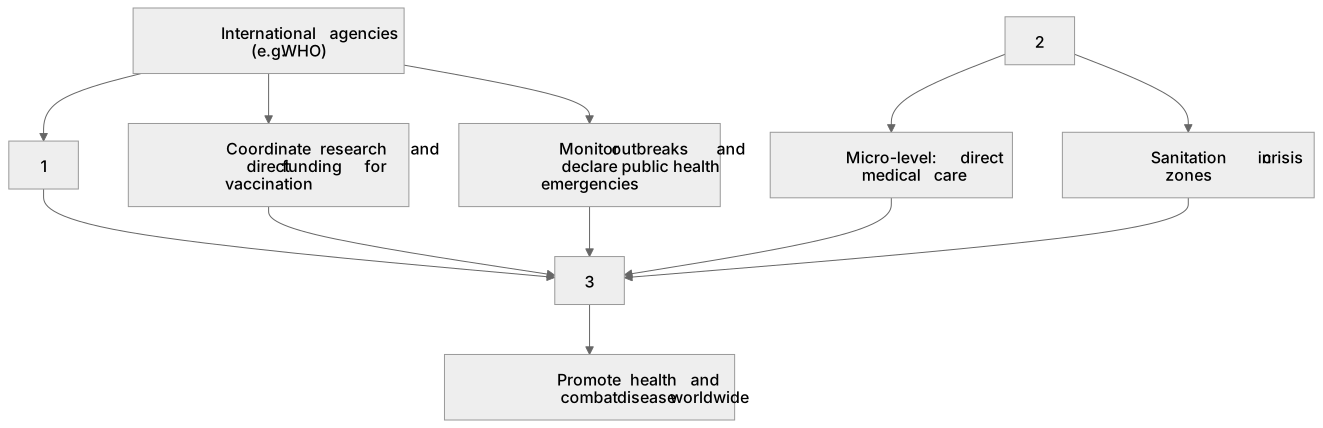
1Box 1
2Box 2
3Box 3
There is more to this lesson
The full lesson goes on to check your understanding and help you earn the marks. Create a free account to carry on, with your progress saved.
A week of Premium from your first lesson · Then the free plan continues · No card, no charge
Test your understanding of Environment, health and well-being: Role of international agencies and NGOs in promoting health and combating disease at the global scale.
Active recall beats re-reading. Take an instant quiz now to test what you’ve learned and lock it into long-term memory.
A week of Premium from your first lesson · Then the free plan continues · No card, no charge