AQA · A-Level · Geography
Course version: 7037 · Version from Sept 2018
Impact and human responses as evidenced by a recent wild fire event.
Full specification wording
Fires in nature: Impact and human responses as evidenced by a recent wild fire event.
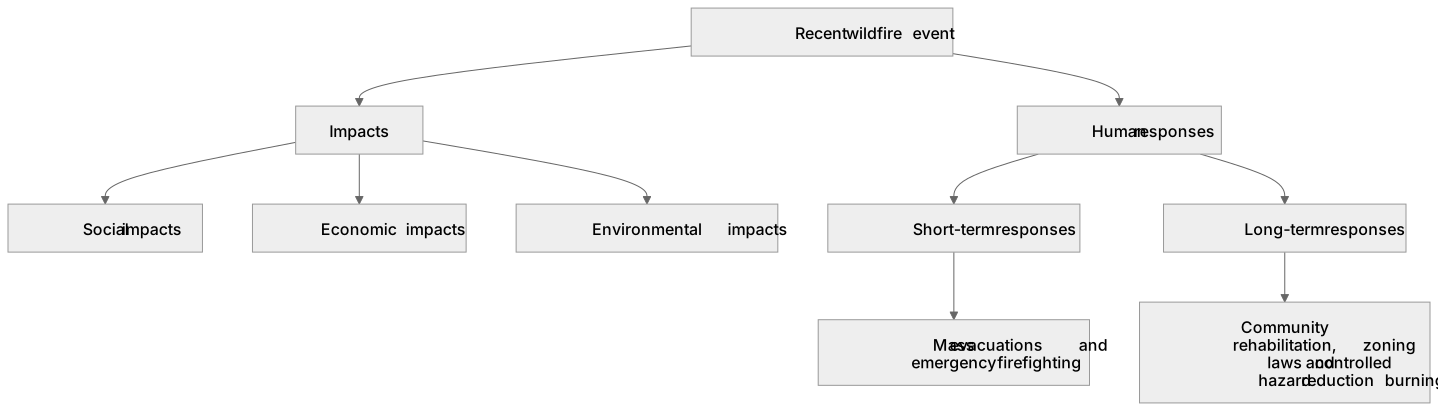
Impacts must be categorised into social (loss of life, displacement), economic (destruction of infrastructure, agricultural losses), and environmental (habitat destruction, massive carbon dioxide…
Checked against the AQA 7037 specification (opens in a new tab) on .
- Point 2 of 2
- 4 key terms
Study notes
From the checked teaching notes for this specification point.
The idea
Impacts must be categorised into social (loss of life, displacement), economic (destruction of infrastructure, agricultural losses), and environmental (habitat destruction, massive carbon dioxide emissions). Human responses should be evaluated across different timescales. Short-term responses include mass evacuations and emergency firefighting efforts. Long-term responses involve community rehabilitation, changes to zoning laws, and enhanced mitigation strategies like controlled hazard reduction burning to build future resilience against increasingly severe fire seasons.
What earns the marks
- Categorise impacts into primary (immediate destruction of property and habitats) and secondary (long-term health issues from smoke inhalation, economic downturn).
- Evaluate the effectiveness of short-term emergency responses, such as evacuation orders, emergency shelter provision, and aerial water drops.
- Analyse long-term human responses, including changes to building codes, improved early warning systems, and community education programmes.
- Assess how the severity of the impacts is influenced by the level of preparedness and the specific geographical context of the chosen recent wildfire event.
Common mistakes and how to put them right
Describing a historical wildfire that is not considered 'recent' (e.g., Ash Wednesday 1983).
Put it right: Ensure the chosen case study occurred within the last decade to accurately reflect modern responses and climate contexts.
Focusing solely on the environmental destruction without addressing social and economic impacts.
Put it right: Provide a balanced analysis that covers social, economic, and environmental impacts equally.
Confusing mitigation with adaptation in the context of responses.
Put it right: Clearly distinguish mitigation (reducing the severity of the fire, such as controlled burns) from adaptation (learning to live with the threat, such as building fire-resistant homes).
Exam tips
- Use specific, quantifiable data from your chosen case study, such as the area burned in hectares or the financial cost of the damage, to support your analysis.
- Structure essay responses by categorising impacts and responses into social, economic, and environmental dimensions to ensure comprehensive coverage.
- Critically evaluate the success of the human responses rather than just listing them; consider who benefited and what limitations existed.
Try the lesson
The start of the Fires in nature: Impact and human responses as evidenced by a recent wild fire event. lesson, made from checked teaching notes for this specification point.
Have a go first
Which of the following was a primary environmental impact of the 2019-2020 Australian 'Black Summer' wildfires?
Listen
Impacts must be categorised into social (loss of life, displacement), economic (destruction of infrastructure, agricultural losses), and environmental (habitat destruction, massive carbon dioxide emissions). Human responses should be evaluated across different timescales. Short-term responses include mass evacuations and emergency firefighting efforts. Long-term responses involve community rehabilitation, changes to zoning laws, and enhanced mitigation strategies like controlled hazard reduction burning to build future resilience against increasingly severe fire seasons. A strong answer earns marks for these points. Categorise impacts into primary (immediate destruction of property and habitats) and secondary (long-term health issues from smoke inhalation, economic downturn). Evaluate the effectiveness of short-term emergency responses, such as evacuation orders, emergency shelter provision, and aerial water drops. Analyse long-term human responses, including changes to building codes, improved early warning systems, and community education programmes. Assess how the severity of the impacts is influenced by the level of preparedness and the specific geographical context of the chosen recent wildfire event. A common slip: Describing a historical wildfire that is not considered 'recent' (e.g., Ash Wednesday 1983). Instead, Ensure the chosen case study occurred within the last decade to accurately reflect modern responses and climate contexts. Exam tip: Use specific, quantifiable data from your chosen case study, such as the area burned in hectares or the financial cost of the damage, to support your analysis.
See it
Key words
Say what each word means before you turn the card.
Mitigation
Try answering aloud or in your head before turning the card.
Resilience
Try answering aloud or in your head before turning the card.
Environmental impact
Try answering aloud or in your head before turning the card.
Short-term responses
Try answering aloud or in your head before turning the card.
See every definition
- Mitigation
- Strategies such as controlled hazard reduction burning that reduce the severity of the fire.
- Resilience
- The capacity built through enhanced mitigation strategies to withstand future, increasingly severe fire seasons.
- Environmental impact
- Habitat destruction and massive carbon dioxide emissions caused by a wildfire event.
- Short-term responses
- Mass evacuations and emergency firefighting efforts carried out during a wildfire event.
Label the diagram
Some boxes have lost their names. Pick the right name for each number.
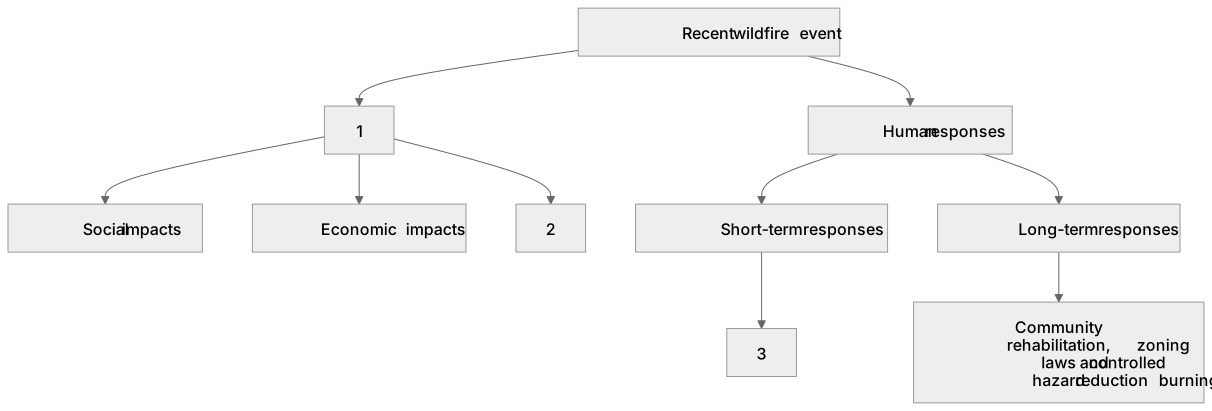
1Box 1
2Box 2
3Box 3
There is more to this lesson
The full lesson goes on to check your understanding and help you earn the marks. Create a free account to carry on, with your progress saved.
A week of Premium from your first lesson · Then the free plan continues · No card, no charge
Test your understanding of Fires in nature: Impact and human responses as evidenced by a recent wild fire event.
Active recall beats re-reading. Take an instant quiz now to test what you’ve learned and lock it into long-term memory.
A week of Premium from your first lesson · Then the free plan continues · No card, no charge