AQA · A-Level · Geography
Course version: 7037 · Version from Sept 2018
Factors in globalisation: the development of technologies, systems and…
Full specification wording
Globalisation: Factors in globalisation: the development of technologies, systems and relationships, including financial, transport, security, communications, management and information systems and trade agreements.
Globalisation is driven by evolving technologies, systems, and relationships that shrink time and space.
Checked against the AQA 7037 specification (opens in a new tab) on .
- Point 2 of 2
Study notes
From the checked teaching notes for this specification point.
The idea
Globalisation is driven by evolving technologies, systems, and relationships that shrink time and space. Financial systems now allow instant capital transfers via electronic trading, while transport innovations like containerisation drastically reduce shipping costs. Security systems have adapted to global threats using international customs databases. Communications and information systems, such as fibre-optic networks, enable real-time connectivity. Management systems like just-in-time production optimise global supply chains. Furthermore, relationships forged through trade agreements, such as the EU single market, remove tariffs to accelerate the flow of goods and services across borders.
What earns the marks
- Explain how containerisation and larger aircraft have lowered unit costs and increased the speed of global transport.
- Describe the role of deregulation and electronic trading in creating a 24/7 global financial system.
- Assess how trade agreements stimulate globalisation by reducing protectionist barriers like tariffs and quotas.
- Evaluate the impact of information and communication technologies on global management systems, such as coordinating just-in-time manufacturing.
- Discuss how global security systems, including cybersecurity and international customs cooperation, facilitate safe global trade.
Common mistakes and how to put them right
Confusing management systems with communication technologies.
Put it right: Clearly distinguish management systems (like global supply chain logistics) from the communication tools (like the internet) used to operate them.
Assuming trade agreements only involve the physical movement of goods.
Put it right: Note that modern trade agreements also heavily regulate services, intellectual property, and financial flows.
Overlooking security as a factor in globalisation.
Put it right: Include security measures, such as the World Customs Organization's frameworks, which are essential for maintaining trust and flow in global supply chains.
Exam tips
- Use specific examples of trade agreements, such as USMCA or ASEAN, to illustrate how political relationships facilitate economic globalisation.
- When discussing transport, explicitly mention 'containerisation' and explain its role in reducing the friction of distance and lowering unit costs.
- Link different factors together in essay questions, for example, how communication technologies enable modern global management systems.
Try the lesson
The start of the Globalisation: Factors in globalisation: the development of technologies, systems and relationships, including financial, transport, security, communications, management and information systems and trade agreements. lesson, made from checked teaching notes for this specification point.
Have a go first
Which of the following best describes how the development of transport systems has acted as a factor in accelerating globalisation?
Listen
Globalisation is driven by evolving technologies, systems, and relationships that shrink time and space. Financial systems now allow instant capital transfers via electronic trading, while transport innovations like containerisation drastically reduce shipping costs. Security systems have adapted to global threats using international customs databases. Communications and information systems, such as fibre-optic networks, enable real-time connectivity. Management systems like just-in-time production optimise global supply chains. Furthermore, relationships forged through trade agreements, such as the EU single market, remove tariffs to accelerate the flow of goods and services across borders. A strong answer earns marks for these points. Explain how containerisation and larger aircraft have lowered unit costs and increased the speed of global transport. Describe the role of deregulation and electronic trading in creating a 24/7 global financial system. Assess how trade agreements stimulate globalisation by reducing protectionist barriers like tariffs and quotas. Evaluate the impact of information and communication technologies on global management systems, such as coordinating just-in-time manufacturing. A common slip: Confusing management systems with communication technologies. Instead, Clearly distinguish management systems (like global supply chain logistics) from the communication tools (like the internet) used to operate them. Exam tip: Use specific examples of trade agreements, such as USMCA or ASEAN, to illustrate how political relationships facilitate economic globalisation.
See it

Label the diagram
Some boxes have lost their names. Pick the right name for each number.
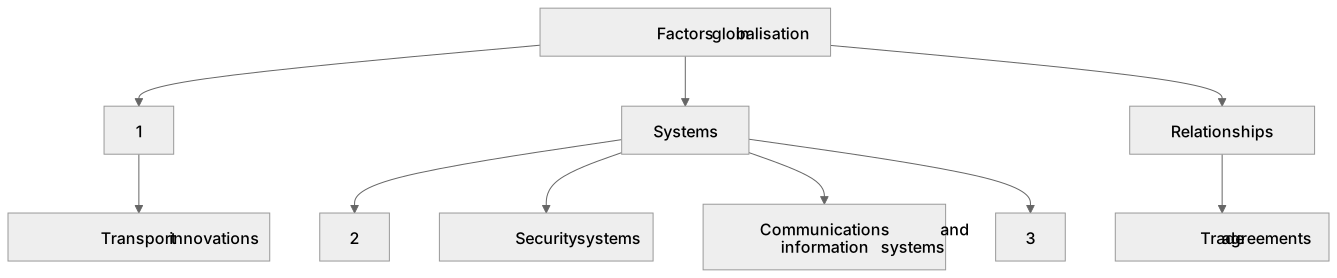
1Box 1
2Box 2
3Box 3
There is more to this lesson
The full lesson goes on to check your understanding and help you earn the marks. Create a free account to carry on, with your progress saved.
A week of Premium from your first lesson · Then the free plan continues · No card, no charge
Test your understanding of Globalisation: Factors in globalisation: the development of technologies, systems and relationships, including financial, transport, security, communications, management and information systems and trade agreements.
Active recall beats re-reading. Take an instant quiz now to test what you’ve learned and lock it into long-term memory.
A week of Premium from your first lesson · Then the free plan continues · No card, no charge