AQA · A-Level · Geography
Course version: 7037 · Version from Sept 2018
Global features and trends in the volume and pattern of international…
Full specification wording
International trade and access to markets: Global features and trends in the volume and pattern of international trade and investment associated with globalisation.
Globalisation has profoundly transformed the volume and pattern of international trade and investment.
Checked against the AQA 7037 specification (opens in a new tab) on .
- Point 1 of 3
- 3 key terms
Study notes
From the checked teaching notes for this specification point.
The idea
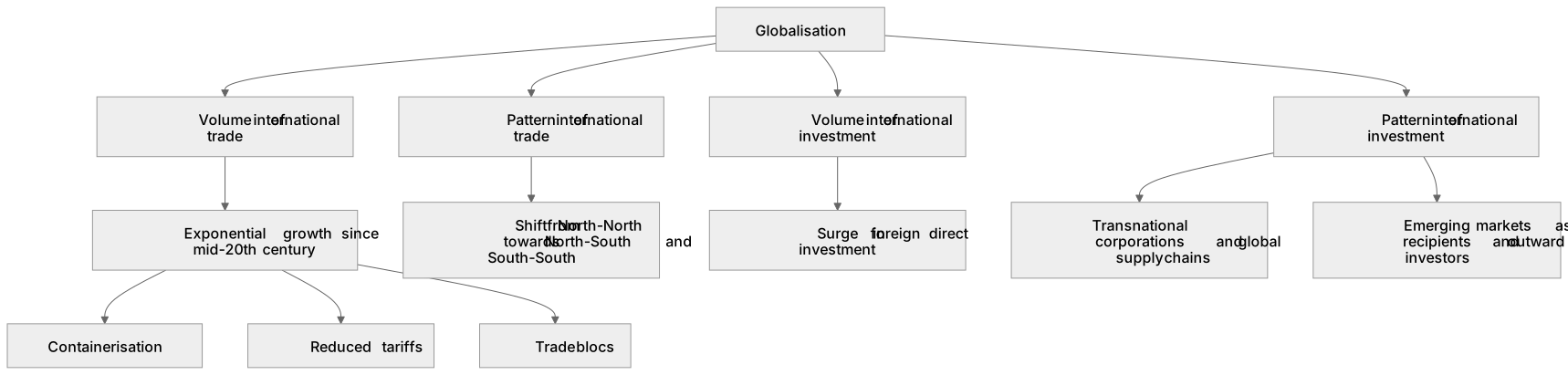
Globalisation has profoundly transformed the volume and pattern of international trade and investment. Historically dominated by North-North exchanges, the pattern has shifted towards North-South and South-South trade, driven by the rapid industrialisation of emerging economies like the BRICS nations. The volume of global trade has grown exponentially, facilitated by containerisation, reduced tariffs, and trade blocs. Similarly, foreign direct investment (FDI) has surged, with transnational corporations establishing complex global supply chains. While high-income countries remain major sources of FDI, emerging markets are increasingly becoming both significant recipients and outward investors, altering the global economic architecture.
What earns the marks
- Describe the exponential increase in the volume of international trade since the mid-20th century, linking it to technological and transport innovations.
- Explain the changing spatial pattern of trade, highlighting the relative decline in the share of advanced economies and the rise of emerging economies.
- Analyse the trends in global investment, specifically the growth and directional shifts of Foreign Direct Investment orchestrated by Transnational Corporations.
- Evaluate the role of trade liberalisation and the World Trade Organization in facilitating increased global trade volumes.
- Identify the growing importance of South-South trade and investment flows in the contemporary globalised economy.
Common mistakes and how to put them right
Confusing the volume of trade with the pattern of trade.
Put it right: Ensure volume refers to the total value or quantity, while pattern refers to the geographical direction and participants.
Assuming only developed nations invest globally.
Put it right: Acknowledge that emerging economies, such as China, are now major sources of outward foreign direct investment.
Overlooking the role of services in trade.
Put it right: Explicitly mention that international trade includes both manufactured goods and the rapidly growing services sector.
Exam tips
- Memorise key statistics regarding the percentage share of global trade for major economies to provide concrete evidence for changing patterns.
- Use the concept of the 'new international division of labour' to explain why investment patterns have shifted towards developing nations.
- When discussing trends, always establish a temporal baseline (e.g., since the 1980s) to clearly demonstrate how globalisation has altered trade and investment.
Try the lesson
The start of the International trade and access to markets: Global features and trends in the volume and pattern of international trade and investment associated with globalisation. lesson, made from checked teaching notes for this specification point.
Have a go first
Which of the following describes a major global trend in the pattern of international trade associated with globalisation over recent decades?
Listen
Globalisation has profoundly transformed the volume and pattern of international trade and investment. Historically dominated by North-North exchanges, the pattern has shifted towards North-South and South-South trade, driven by the rapid industrialisation of emerging economies like the BRICS nations. The volume of global trade has grown exponentially, facilitated by containerisation, reduced tariffs, and trade blocs. Similarly, foreign direct investment (FDI) has surged, with transnational corporations establishing complex global supply chains. While high-income countries remain major sources of FDI, emerging markets are increasingly becoming both significant recipients and outward investors, altering the global economic architecture. A strong answer earns marks for these points. Describe the exponential increase in the volume of international trade since the mid-20th century, linking it to technological and transport innovations. Explain the changing spatial pattern of trade, highlighting the relative decline in the share of advanced economies and the rise of emerging economies. Analyse the trends in global investment, specifically the growth and directional shifts of Foreign Direct Investment orchestrated by Transnational Corporations. Evaluate the role of trade liberalisation and the World Trade Organization in facilitating increased global trade volumes. A common slip: Confusing the volume of trade with the pattern of trade. Instead, ensure volume refers to the total value or quantity, while pattern refers to the geographical direction and participants. Exam tip: Memorise key statistics regarding the percentage share of global trade for major economies to provide concrete evidence for changing patterns.
See it
Key words
Say what each word means before you turn the card.
Trade and investment
Try answering aloud or in your head before turning the card.
Shifting economic power
Try answering aloud or in your head before turning the card.
Transnational corporations
Try answering aloud or in your head before turning the card.
See every definition
- Trade and investment
- International flows whose volume and pattern have been profoundly transformed by globalisation.
- Shifting economic power
- A change in the global economic architecture as emerging markets become both significant recipients and outward investors.
- Transnational corporations
- Companies that establish complex global supply chains and orchestrate foreign direct investment.
Label the diagram
Some boxes have lost their names. Pick the right name for each number.
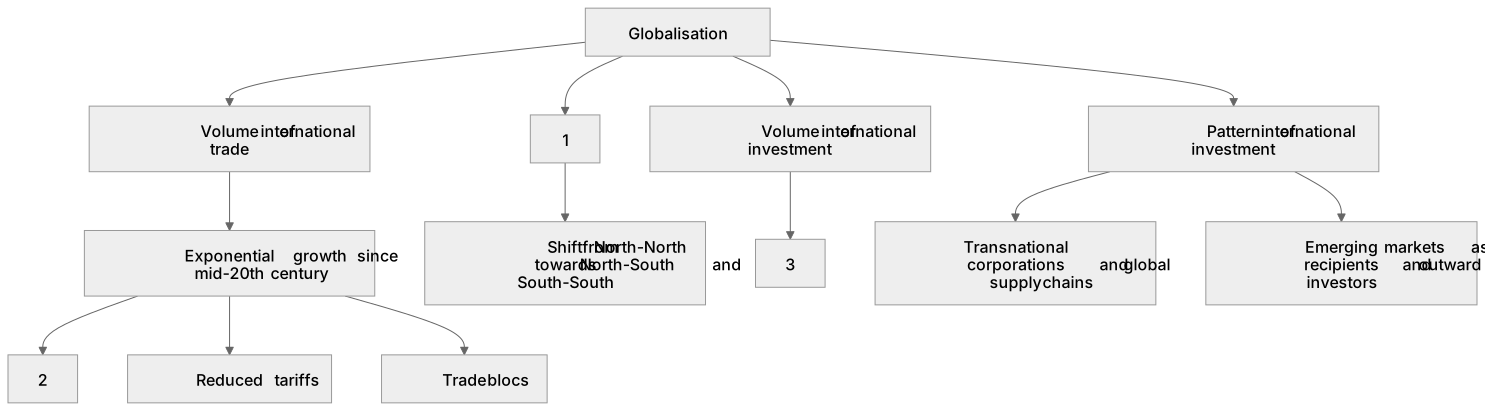
1Box 1
2Box 2
3Box 3
There is more to this lesson
The full lesson goes on to check your understanding and help you earn the marks. Create a free account to carry on, with your progress saved.
A week of Premium from your first lesson · Then the free plan continues · No card, no charge
Test your understanding of International trade and access to markets: Global features and trends in the volume and pattern of international trade and investment associated with globalisation.
Active recall beats re-reading. Take an instant quiz now to test what you’ve learned and lock it into long-term memory.
A week of Premium from your first lesson · Then the free plan continues · No card, no charge