AQA · A-Level · Geography
Course version: 7037 · Version from Sept 2018
World trade in at least one food commodity or one manufacturing product.
Full specification wording
International trade and access to markets: World trade in at least one food commodity or one manufacturing product.
The global trade of a specific commodity, such as bananas (a food commodity), highlights the complexities of international supply chains and market access.
Checked against the AQA 7037 specification (opens in a new tab) on .
- Point 3 of 3
- 2 key terms
Study notes
From the checked teaching notes for this specification point.
The idea
The global trade of a specific commodity, such as bananas (a food commodity), highlights the complexities of international supply chains and market access. Bananas are primarily grown in developing regions like Latin America and the Caribbean, but are consumed massively in high-income regions like Europe and North America. This trade is dominated by a few large transnational corporations (TNCs) that control purchasing, transport, and ripening, though fairtrade initiatives are increasingly challenging this oligopoly. Studying this commodity reveals the impacts of trade agreements, tariff barriers, and geopolitical disputes (such as the Lome Convention and subsequent banana wars) on producers, alongside the environmental costs of monoculture plantations.
What earns the marks
- Identify the primary regions of production (e.g., Latin America for bananas) and the main regions of consumption (e.g., North America and the EU).
- Explain the role of TNCs in controlling the supply chain, from production and transportation to retail distribution.
- Analyse the impact of trade agreements, tariffs, and quotas on the global flow of the chosen commodity.
- Evaluate the socio-economic and environmental impacts of producing the commodity on the source countries, such as monoculture degradation or reliance on a single export.
- Discuss the rise of alternative trading networks, such as Fairtrade, and their effectiveness in supporting primary producers.
Common mistakes and how to put them right
Discussing trade in general terms without focusing on a specific commodity.
Put it right: Base the entire response on detailed facts and figures for one specific food or manufactured product.
Ignoring the historical or geopolitical context of the trade.
Put it right: Include relevant trade disputes or agreements, such as the WTO's role in resolving the banana wars.
Assuming primary producers receive a large share of the retail price.
Put it right: Acknowledge that the vast majority of the profit is retained by retailers and TNCs in the consuming countries.
Exam tips
- Memorise specific statistics for your chosen commodity, such as the percentage of global export share held by the top producing countries.
- Structure your essay to trace the commodity's journey from production to consumption, highlighting where value is added and who captures the profit.
- Contrast the traditional TNC-dominated supply chain with ethical trading alternatives to demonstrate critical evaluation.
Try the lesson
The start of the International trade and access to markets: World trade in at least one food commodity or one manufacturing product. lesson, made from checked teaching notes for this specification point.
Have a go first
Which of the following best describes the typical global trade pattern for bananas as a food commodity?
Listen
The global trade of a specific commodity, such as bananas (a food commodity), highlights the complexities of international supply chains and market access. Bananas are primarily grown in developing regions like Latin America and the Caribbean, but are consumed massively in high-income regions like Europe and North America. This trade is dominated by a few large transnational corporations (TNCs) that control purchasing, transport, and ripening, though fairtrade initiatives are increasingly challenging this oligopoly. Studying this commodity reveals the impacts of trade agreements, tariff barriers, and geopolitical disputes (such as the Lome Convention and subsequent banana wars) on producers, alongside the environmental costs of monoculture plantations. A strong answer earns marks for these points. Identify the primary regions of production (e.g., Latin America for bananas) and the main regions of consumption (e.g., North America and the EU). Explain the role of TNCs in controlling the supply chain, from production and transportation to retail distribution. Analyse the impact of trade agreements, tariffs, and quotas on the global flow of the chosen commodity. Evaluate the socio-economic and environmental impacts of producing the commodity on the source countries, such as monoculture degradation or reliance on a single export. A common slip: Discussing trade in general terms without focusing on a specific commodity. Instead, Base the entire response on detailed facts and figures for one specific food or manufactured product. Exam tip: Memorise specific statistics for your chosen commodity, such as the percentage of global export share held by the top producing countries.
See it
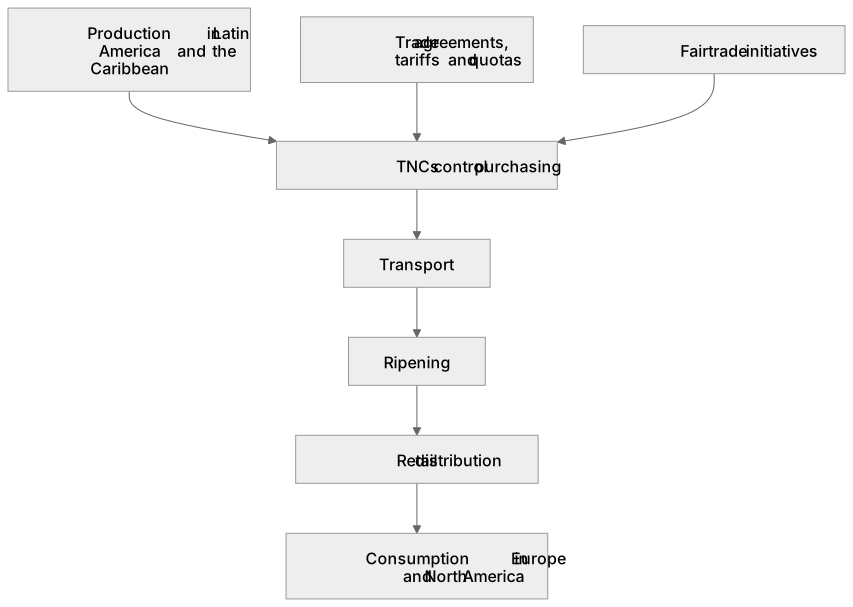
Key words
Say what each word means before you turn the card.
Global supply chains
Try answering aloud or in your head before turning the card.
Trade inequalities
Try answering aloud or in your head before turning the card.
See every definition
- Global supply chains
- The complexities of international supply chains through which a commodity is purchased, transported and ripened by large transnational corporations.
- Trade inequalities
- The vast majority of the profit being retained by retailers and TNCs in the consuming countries rather than by primary producers.
Label the diagram
Some boxes have lost their names. Pick the right name for each number.
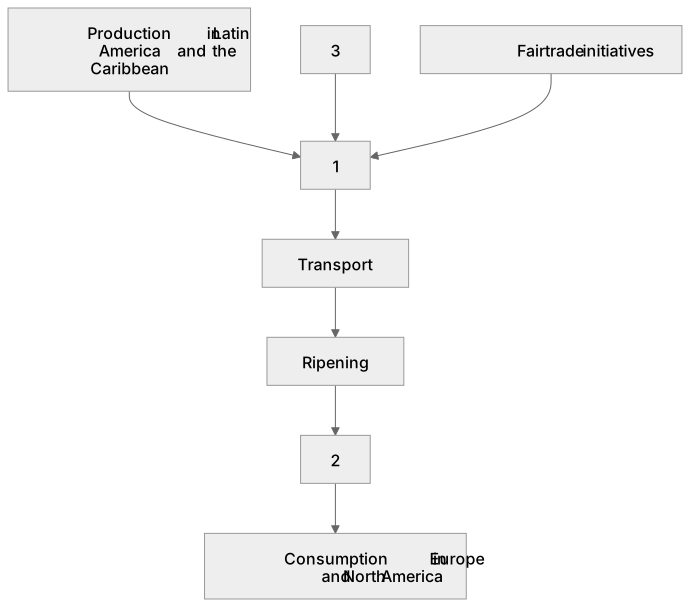
1Box 1
2Box 2
3Box 3
There is more to this lesson
The full lesson goes on to check your understanding and help you earn the marks. Create a free account to carry on, with your progress saved.
A week of Premium from your first lesson · Then the free plan continues · No card, no charge
Test your understanding of International trade and access to markets: World trade in at least one food commodity or one manufacturing product.
Active recall beats re-reading. Take an instant quiz now to test what you’ve learned and lock it into long-term memory.
A week of Premium from your first lesson · Then the free plan continues · No card, no charge