AQA · A-Level · Geography
Course version: 7037 · Version from Sept 2018
The environmental context for human population characteristics and change.…
Full specification wording
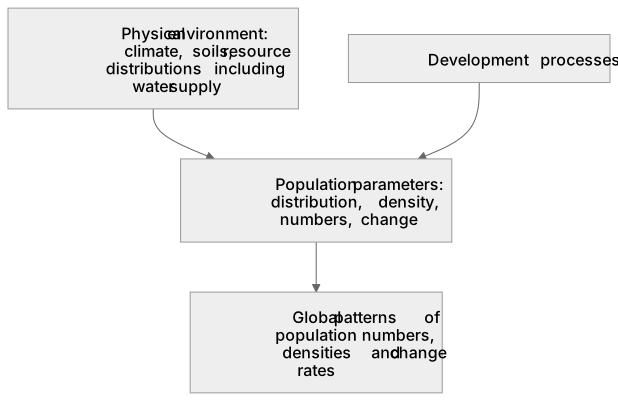
Introduction: The environmental context for human population characteristics and change. Key elements in the physical environment: climate, soils, resource distributions including water supply. Key population parameters: distribution, density, numbers, change. Key role of development processes. Global patterns of population numbers, densities and change rates.
This topic explores how the physical environment dictates human population dynamics.
Checked against the AQA 7037 specification (opens in a new tab) on .
- 4 key terms
Study notes
From the checked teaching notes for this specification point.
The idea
This topic explores how the physical environment dictates human population dynamics. You must analyse how key elements like climate (temperature and precipitation), soil fertility, and resource distribution (especially water supply) influence where people live. These environmental factors directly affect key population parameters: total numbers, spatial distribution, population density (measured in people per km²), and rates of change. Furthermore, you must evaluate the key role of development processes, such as industrialisation and agricultural advancement, in altering these relationships over time. Finally, you need to identify and explain global patterns of population numbers, densities, and change rates, contrasting regions like Sub-Saharan Africa with Western Europe.
What earns the marks
- Explanation of how physical environmental factors (climate, soils, water supply) influence population distribution and density.
- Accurate use of population parameters, including calculating or interpreting density (people per km²) and rates of natural change.
- Analysis of the relationship between resource distribution and population numbers at a global scale.
- Evaluation of how development processes (e.g., technological advances in farming or medicine) modify the environmental constraints on population change.
- Identification and explanation of contemporary global patterns in population numbers, densities, and growth rates.
Common mistakes and how to put them right
Confusing population distribution (the spatial spread of people) with population density (the number of people per unit area).
Put it right: Use 'distribution' for patterns (e.g., clustered, linear) and 'density' for ratios of people to land area.
Assuming physical environment is the only factor determining population density.
Put it right: Integrate the role of human development processes, such as technology and trade, which can overcome physical limitations.
Using outdated global population patterns or growth rates.
Put it right: Ensure you reference contemporary demographic data, acknowledging that growth rates are slowing globally but remain high in specific regions like Sub-Saharan Africa.
Exam tips
- When discussing population density, always specify the unit of measurement, typically people per km², to demonstrate geographical precision.
- Use specific examples of extreme environments (e.g., the Sahel or the Arctic) to illustrate how climate and soils limit population numbers and density.
- Link development processes to the Demographic Transition Model to explain variations in global population change rates.
Try the lesson
The start of the Introduction: The environmental context for human population characteristics and change. Key elements in the physical environment: climate, soils, resource distributions including water supply. Key population parameters: distribution, density, numbers, change. Key role of development processes. Global patterns of population numbers, densities and change rates. lesson, made from checked teaching notes for this specification point.
Have a go first
Which combination represents the key elements in the physical environment that provide the context for human population characteristics and change?
Listen
This topic explores how the physical environment dictates human population dynamics. You must analyse how key elements like climate (temperature and precipitation), soil fertility, and resource distribution (especially water supply) influence where people live. These environmental factors directly affect key population parameters: total numbers, spatial distribution, population density (measured in people per km²), and rates of change. Furthermore, you must evaluate the key role of development processes, such as industrialisation and agricultural advancement, in altering these relationships over time. Finally, you need to identify and explain global patterns of population numbers, densities, and change rates, contrasting regions like Sub-Saharan Africa with Western Europe. A strong answer earns marks for these points. Explanation of how physical environmental factors (climate, soils, water supply) influence population distribution and density. Accurate use of population parameters, including calculating or interpreting density (people per km²) and rates of natural change. Analysis of the relationship between resource distribution and population numbers at a global scale. Evaluation of how development processes (e.g., technological advances in farming or medicine) modify the environmental constraints on population change. A common slip: Confusing population distribution (the spatial spread of people) with population density (the number of people per unit area). Instead, Use 'distribution' for patterns (e.g., clustered, linear) and 'density' for ratios of people to land area. Exam tip: When discussing population density, always specify the unit of measurement, typically people per km², to demonstrate geographical precision.
See it
Key words
Say what each word means before you turn the card.
Population distribution
Try answering aloud or in your head before turning the card.
Population density
Try answering aloud or in your head before turning the card.
Development processes
Try answering aloud or in your head before turning the card.
Population parameters
Try answering aloud or in your head before turning the card.
See every definition
- Population distribution
- The spatial spread of people, described in patterns such as clustered or linear.
- Population density
- The number of people per unit area, typically measured in people per km².
- Development processes
- Processes such as industrialisation and agricultural advancement that alter relationships between the physical environment and population over time.
- Population parameters
- Distribution, density, numbers and change, which are affected by environmental factors.
Label the diagram
Some boxes have lost their names. Pick the right name for each number.
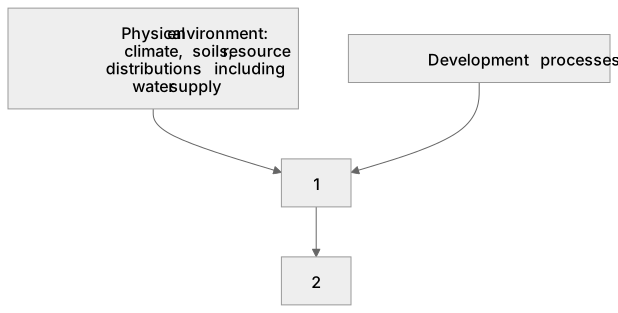
1Box 1
2Box 2
There is more to this lesson
The full lesson goes on to check your understanding and help you earn the marks. Create a free account to carry on, with your progress saved.
A week of Premium from your first lesson · Then the free plan continues · No card, no charge
Test your understanding of Introduction: The environmental context for human population characteristics and change. Key elements in the physical environment: climate, soils, resource distributions including water supply. Key population parameters: distribution, density, numbers, change. Key role of development processes. Global patterns of population numbers, densities and change rates.
Active recall beats re-reading. Take an instant quiz now to test what you’ve learned and lock it into long-term memory.
A week of Premium from your first lesson · Then the free plan continues · No card, no charge