AQA · A-Level · Geography
Course version: 7037 · Version from Sept 2018
The distribution and main characteristics of coral reef ecosystems.…
Full specification wording
Marine ecosystems: The distribution and main characteristics of coral reef ecosystems. Environmental conditions associated with reef development.
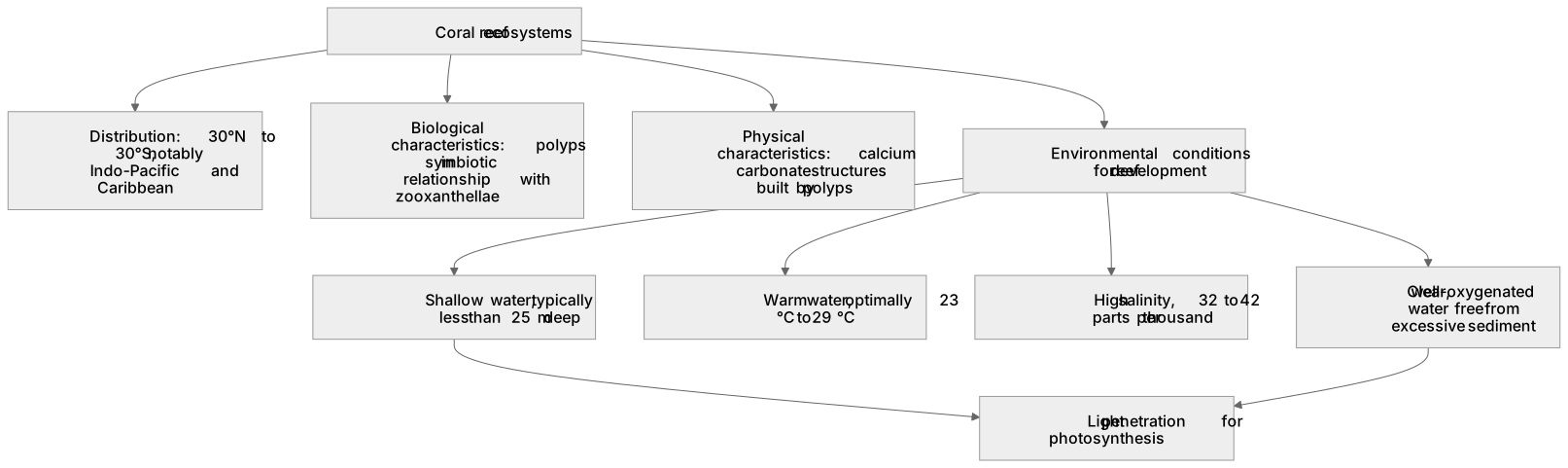
Coral reefs are highly biodiverse marine ecosystems primarily distributed between 30°N and 30°S of the equator, notably in the Indo-Pacific and Caribbean.
Checked against the AQA 7037 specification (opens in a new tab) on .
- 2 key terms
Study notes
From the checked teaching notes for this specification point.
The idea
Coral reefs are highly biodiverse marine ecosystems primarily distributed between 30°N and 30°S of the equator, notably in the Indo-Pacific and Caribbean. Their main characteristics include complex calcium carbonate structures built by polyps in a symbiotic relationship with zooxanthellae algae, supporting immense marine life. Reef development requires specific environmental conditions: shallow water (typically less than 25 m deep) for light penetration essential for photosynthesis, warm water temperatures (optimally 23 °C to 29 °C), high salinity (32 to 42 parts per thousand), and clear, well-oxygenated water free from excessive sediment which can smother the polyps.
What earns the marks
- Identify the global distribution of coral reefs, focusing on tropical and subtropical shallow waters between 30°N and 30°S.
- Describe the biological characteristics of reefs, including the symbiotic relationship between coral polyps and zooxanthellae.
- Explain the physical characteristics, such as the secretion of calcium carbonate to form complex, three-dimensional reef structures.
- Detail the environmental prerequisites for reef formation: temperatures of 23 °C to 29 °C, depths under 25 m, and salinities of 32 to 42 parts per thousand.
- Explain why clear, sediment-free water is necessary to allow sunlight penetration for algal photosynthesis.
Common mistakes and how to put them right
Stating that corals are plants.
Put it right: Corals are marine animals (polyps) that host photosynthetic algae (zooxanthellae).
Claiming reefs can grow at any depth.
Put it right: Reef-building corals require shallow water (usually under 25 m) because their symbiotic algae need sunlight.
Confusing coral bleaching with coral death.
Put it right: Bleaching is the expulsion of zooxanthellae due to stress, which can lead to death if conditions do not improve, but the coral is not immediately dead.
Exam tips
- Use specific data when describing environmental conditions, such as the optimal temperature range of 23 °C to 29 °C.
- Link the physical conditions directly to biological processes, for example, explaining how shallow water facilitates photosynthesis for zooxanthellae.
- Be prepared to annotate a world map showing the distribution of major coral reef systems like the Great Barrier Reef.
Try the lesson
The start of the Marine ecosystems: The distribution and main characteristics of coral reef ecosystems. Environmental conditions associated with reef development. lesson, made from checked teaching notes for this specification point.
Have a go first
Which of the following environmental conditions is generally required for the optimal development of shallow-water coral reef ecosystems?
Listen
Coral reefs are highly biodiverse marine ecosystems primarily distributed between 30°N and 30°S of the equator, notably in the Indo-Pacific and Caribbean. Their main characteristics include complex calcium carbonate structures built by polyps in a symbiotic relationship with zooxanthellae algae, supporting immense marine life. Reef development requires specific environmental conditions: shallow water (typically less than 25 m deep) for light penetration essential for photosynthesis, warm water temperatures (optimally 23 °C to 29 °C), high salinity (32 to 42 parts per thousand), and clear, well-oxygenated water free from excessive sediment which can smother the polyps. A strong answer earns marks for these points. Identify the global distribution of coral reefs, focusing on tropical and subtropical shallow waters between 30°N and 30°S. Describe the biological characteristics of reefs, including the symbiotic relationship between coral polyps and zooxanthellae. Explain the physical characteristics, such as the secretion of calcium carbonate to form complex, three-dimensional reef structures. Detail the environmental prerequisites for reef formation: temperatures of 23 °C to 29 °C, depths under 25 m, and salinities of 32 to 42 parts per thousand. A common slip: Stating that corals are plants. Instead, corals are marine animals (polyps) that host photosynthetic algae (zooxanthellae). Exam tip: Use specific data when describing environmental conditions, such as the optimal temperature range of 23 °C to 29 °C.
See it
Key words
Say what each word means before you turn the card.
Biodiversity
Try answering aloud or in your head before turning the card.
Symbiosis
Try answering aloud or in your head before turning the card.
See every definition
- Biodiversity
- The immense variety of marine life supported by coral reef ecosystems, which are highly biodiverse.
- Symbiosis
- The relationship between coral polyps and zooxanthellae algae, in which the polyps host the photosynthetic algae.
Label the diagram
Some boxes have lost their names. Pick the right name for each number.
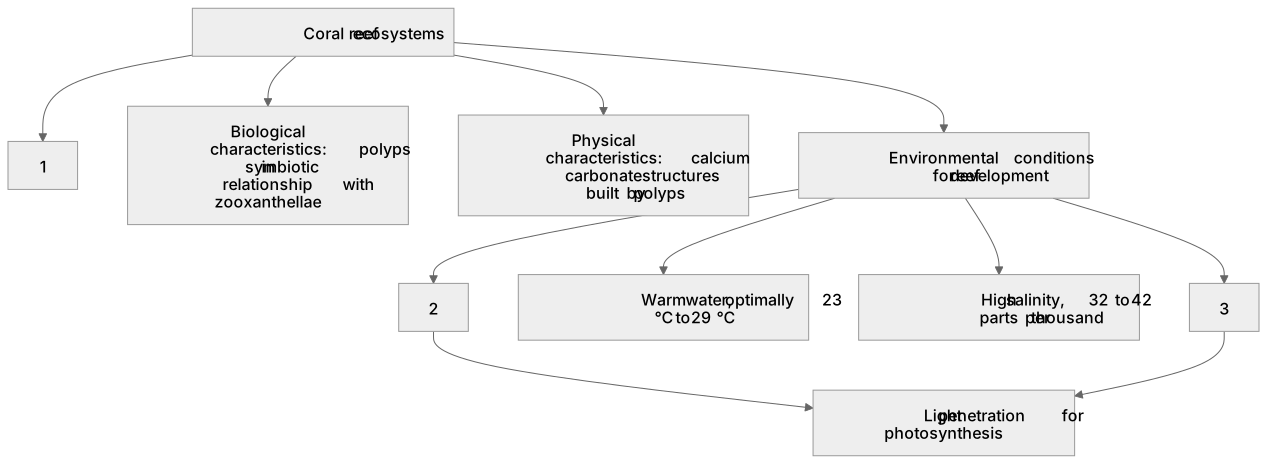
1Box 1
2Box 2
3Box 3
There is more to this lesson
The full lesson goes on to check your understanding and help you earn the marks. Create a free account to carry on, with your progress saved.
A week of Premium from your first lesson · Then the free plan continues · No card, no charge
Test your understanding of Marine ecosystems: The distribution and main characteristics of coral reef ecosystems. Environmental conditions associated with reef development.
Active recall beats re-reading. Take an instant quiz now to test what you’ve learned and lock it into long-term memory.
A week of Premium from your first lesson · Then the free plan continues · No card, no charge