AQA · A-Level · Geography
Course version: 7037 · Version from Sept 2018
Sources of the specified ore. Distribution of reserves/resources. End uses…
Full specification wording
Mineral security: Sources of the specified ore. Distribution of reserves/resources. End uses of the ore. Components of demand for ore. Role of specified ore in global commerce and industry.
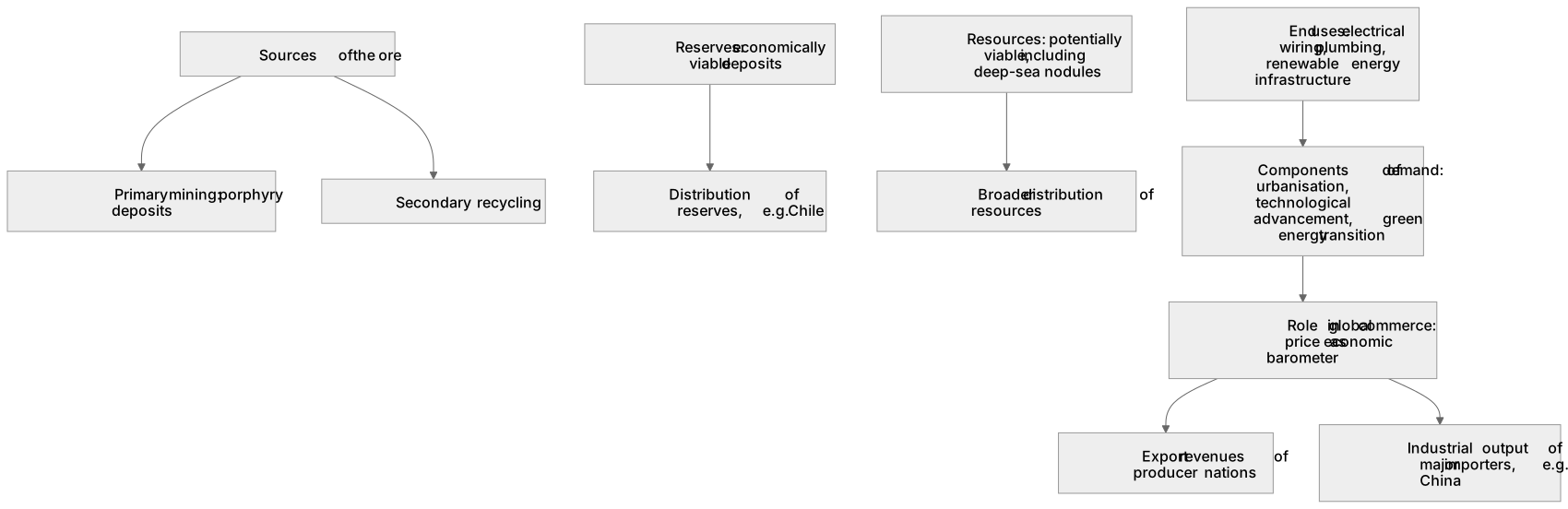
Sources include primary mining (porphyry deposits) and secondary recycling.
Checked against the AQA 7037 specification (opens in a new tab) on .
- Point 1 of 2
- 4 key terms
Study notes
From the checked teaching notes for this specification point.
The idea
Sources include primary mining (porphyry deposits) and secondary recycling. The distribution of reserves (economically viable deposits, like in Chile) differs from broader resources (potentially viable, including deep-sea nodules). End uses are diverse, encompassing electrical wiring, plumbing, and renewable energy infrastructure. Components of demand are driven by urbanisation, technological advancement, and the green energy transition. In global commerce, copper plays a pivotal role; its price often acts as an economic barometer, heavily influencing the export revenues of producer nations and the industrial output of major importers like China.
What earns the marks
- Distinguish clearly between reserves (currently profitable to extract) and resources (total known amount, regardless of current economic viability).
- Identify specific global sources and spatial distribution patterns of the chosen ore, naming key producer and consumer nations.
- Explain the various components of demand, linking them to broader global trends such as urbanisation, population growth, or the transition to renewable energy.
- Analyse the ore's role in global commerce, including how price fluctuations impact both exporting economies and global industrial supply chains.
Common mistakes and how to put them right
Confusing reserves with resources.
Put it right: Reserves are the economically and technically viable subset of total resources.
Focusing only on primary extraction.
Put it right: Include secondary sources such as recycling and urban mining when discussing overall sources.
Describing end uses without linking them to demand components.
Put it right: Explicitly connect uses (e.g. wiring) to the drivers of demand (e.g. electrification and infrastructure development).
Exam tips
- Always use a specific, named ore (e.g. copper, iron ore, lithium) to contextualise your answers rather than speaking about minerals generically.
- When discussing global commerce, reference recent geopolitical or economic events that have impacted the supply chain or price of your chosen ore.
- Use specific data points, such as the percentage of global reserves held by a top producing country, to strengthen your geographical analysis.
Try the lesson
The start of the Mineral security: Sources of the specified ore. Distribution of reserves/resources. End uses of the ore. Components of demand for ore. Role of specified ore in global commerce and industry. lesson, made from checked teaching notes for this specification point.
Have a go first
Which of the following represents the primary end use of copper in the global economy?
Listen
Sources include primary mining (porphyry deposits) and secondary recycling. The distribution of reserves (economically viable deposits, like in Chile) differs from broader resources (potentially viable, including deep-sea nodules). End uses are diverse, encompassing electrical wiring, plumbing, and renewable energy infrastructure. Components of demand are driven by urbanisation, technological advancement, and the green energy transition. In global commerce, copper plays a pivotal role; its price often acts as an economic barometer, heavily influencing the export revenues of producer nations and the industrial output of major importers like China. A strong answer earns marks for these points. Distinguish clearly between reserves (currently profitable to extract) and resources (total known amount, regardless of current economic viability). Identify specific global sources and spatial distribution patterns of the chosen ore, naming key producer and consumer nations. Explain the various components of demand, linking them to broader global trends such as urbanisation, population growth, or the transition to renewable energy. Analyse the ore's role in global commerce, including how price fluctuations impact both exporting economies and global industrial supply chains. A common slip: Confusing reserves with resources. Instead, reserves are the economically and technically viable subset of total resources. Exam tip: Always use a specific, named ore (e.g. copper, iron ore, lithium) to contextualise your answers rather than speaking about minerals generically.
See it
Key words
Say what each word means before you turn the card.
Reserves
Try answering aloud or in your head before turning the card.
Resources
Try answering aloud or in your head before turning the card.
End uses
Try answering aloud or in your head before turning the card.
Components of demand
Try answering aloud or in your head before turning the card.
See every definition
- Reserves
- Economically viable deposits, which are distinguished from broader resources that are only potentially viable.
- Resources
- The total known amount of a deposit, regardless of current economic viability, including potentially viable sources such as deep-sea nodules.
- End uses
- The diverse applications of the ore, encompassing electrical wiring, plumbing, and renewable energy infrastructure.
- Components of demand
- The drivers of demand for the ore, including urbanisation, technological advancement, and the green energy transition.
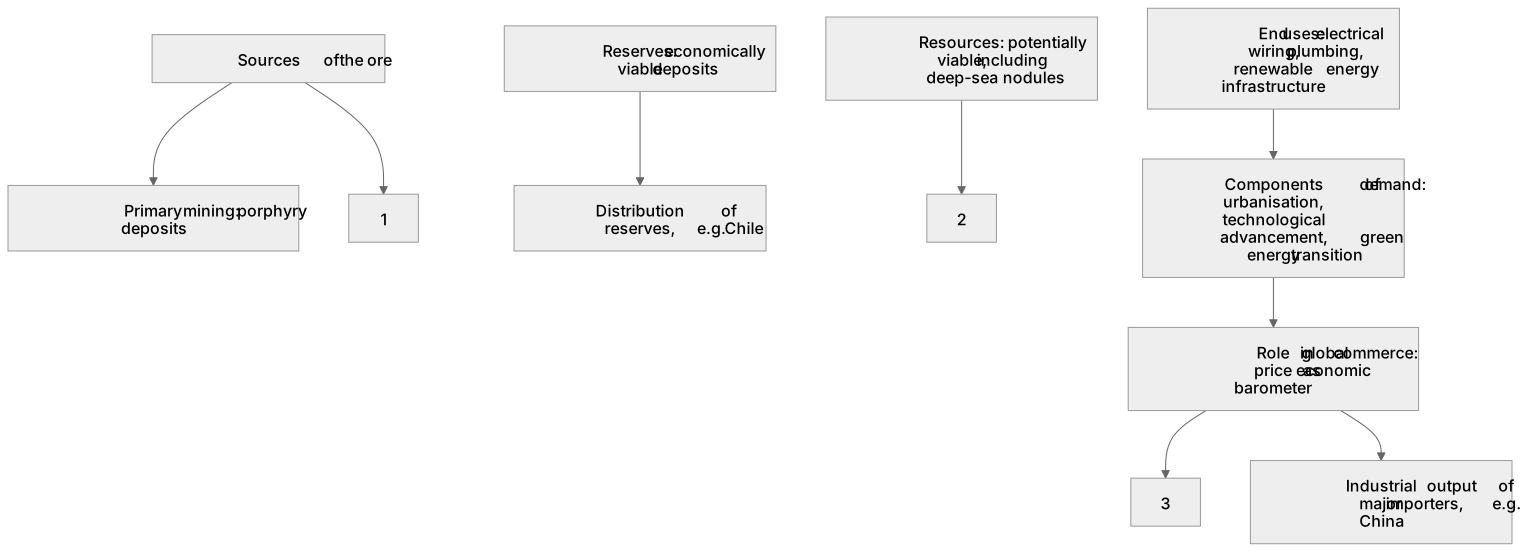
Label the diagram
Some boxes have lost their names. Pick the right name for each number.
1Box 1
2Box 2
3Box 3
There is more to this lesson
The full lesson goes on to check your understanding and help you earn the marks. Create a free account to carry on, with your progress saved.
A week of Premium from your first lesson · Then the free plan continues · No card, no charge
Test your understanding of Mineral security: Sources of the specified ore. Distribution of reserves/resources. End uses of the ore. Components of demand for ore. Role of specified ore in global commerce and industry.
Active recall beats re-reading. Take an instant quiz now to test what you’ve learned and lock it into long-term memory.
A week of Premium from your first lesson · Then the free plan continues · No card, no charge