AQA · A-Level · Geography
Course version: 7037 · Version from Sept 2018
Global patterns of production, consumption and trade/movements of energy…
Full specification wording
Natural resource issues: Global patterns of production, consumption and trade/movements of energy and ore minerals. Global patterns of water availability and demand.
Global resource patterns are highly uneven, driven by physical geography and economic development.
Checked against the AQA 7037 specification (opens in a new tab) on .
- 4 key terms
Study notes
From the checked teaching notes for this specification point.
The idea
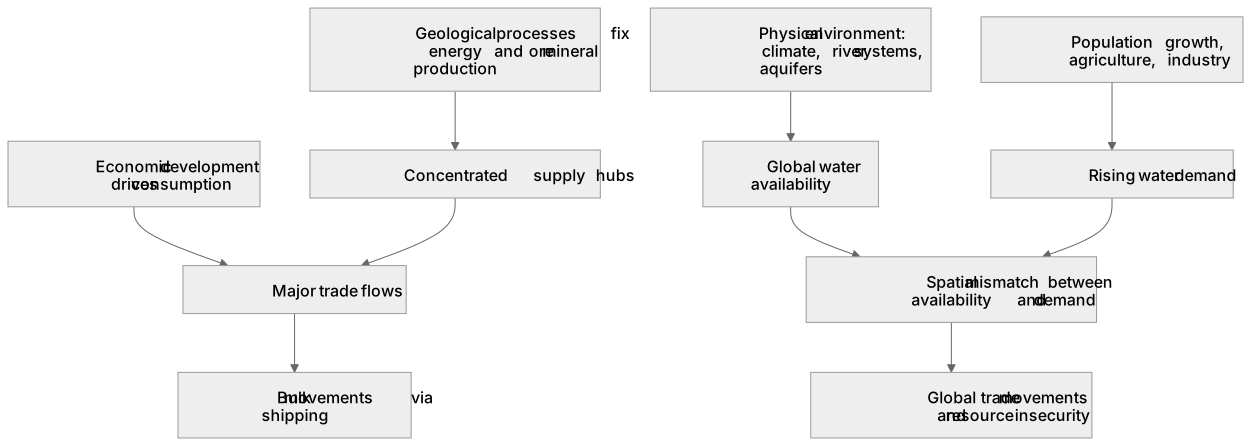
Global resource patterns are highly uneven, driven by physical geography and economic development. Energy and ore mineral production is concentrated where geological reserves exist, such as oil in the Middle East or lithium in South America. Consumption is highest in developed and emerging economies, necessitating complex global trade networks and bulk movements via shipping. Similarly, global water availability depends on climatic factors like precipitation, while demand is surging due to population growth, agriculture, and industry. This spatial mismatch between supply and demand creates geopolitical tensions and water stress, particularly in arid regions where extraction exceeds natural replenishment rates.
What earns the marks
- Identify that the production of energy and ore minerals is geographically fixed by geological processes, leading to concentrated supply hubs.
- Explain that consumption of energy and minerals is driven by economic development, creating major trade flows from resource-rich nations to industrialised regions.
- Describe how global water availability is determined by the physical environment, including climate, river systems, and aquifer locations.
- Analyse the factors increasing global water demand, such as agricultural irrigation, industrial usage, and rising domestic consumption in growing populations.
- Discuss the concept of a spatial mismatch between resource availability and demand, which drives global trade movements and can lead to resource insecurity.
Common mistakes and how to put them right
Treating production and consumption as occurring in the same locations.
Put it right: Production is often geographically distinct from the areas of highest consumption, driving global trade.
Assuming water scarcity is only a physical issue.
Put it right: Economic water scarcity occurs when a region has physical water but lacks the infrastructure to extract or distribute it.
Overlooking ore minerals when discussing trade; students often focus solely on fossil fuels and forget the massive global movements of ores like iron, copper, and lithium.
Exam tips
- Learn specific data points for the top producers and consumers of at least one energy resource, one ore mineral, and one water-stressed region to support your arguments.
- Use maps and spatial terminology, such as core-periphery or transit chokepoints, to describe the trade movements of energy and minerals.
- Distinguish clearly between physical water scarcity, which is a lack of rainfall or surface water, and economic water scarcity, which is a lack of infrastructure, when discussing availability.
Try the lesson
The start of the Natural resource issues: Global patterns of production, consumption and trade/movements of energy and ore minerals. Global patterns of water availability and demand. lesson, made from checked teaching notes for this specification point.
Have a go first
Which of the following best describes the global pattern of water availability and demand?
Listen
Global resource patterns are highly uneven, driven by physical geography and economic development. Energy and ore mineral production is concentrated where geological reserves exist, such as oil in the Middle East or lithium in South America. Consumption is highest in developed and emerging economies, necessitating complex global trade networks and bulk movements via shipping. Similarly, global water availability depends on climatic factors like precipitation, while demand is surging due to population growth, agriculture, and industry. This spatial mismatch between supply and demand creates geopolitical tensions and water stress, particularly in arid regions where extraction exceeds natural replenishment rates. A strong answer earns marks for these points. Identify that the production of energy and ore minerals is geographically fixed by geological processes, leading to concentrated supply hubs. Explain that consumption of energy and minerals is driven by economic development, creating major trade flows from resource-rich nations to industrialised regions. Describe how global water availability is determined by the physical environment, including climate, river systems, and aquifer locations. Analyse the factors increasing global water demand, such as agricultural irrigation, industrial usage, and rising domestic consumption in growing populations. Exam tip: Learn specific data points for the top producers and consumers of at least one energy resource, one ore mineral, and one water-stressed region to support your arguments.
See it
Key words
Say what each word means before you turn the card.
Spatial mismatch
Try answering aloud or in your head before turning the card.
Physical water scarcity
Try answering aloud or in your head before turning the card.
Economic water scarcity
Try answering aloud or in your head before turning the card.
Resource insecurity
Try answering aloud or in your head before turning the card.
See every definition
- Spatial mismatch
- The uneven pattern in which resource availability and demand occur in different places, driving global trade movements and potentially leading to resource insecurity.
- Physical water scarcity
- A lack of rainfall or surface water, reflecting how global water availability is determined by the physical environment, including climate, river systems and aquifer locations.
- Economic water scarcity
- A situation where a region has physical water but lacks the infrastructure to extract or distribute it.
- Resource insecurity
- A consequence of the spatial mismatch between resource supply and demand, which drives global trade movements.
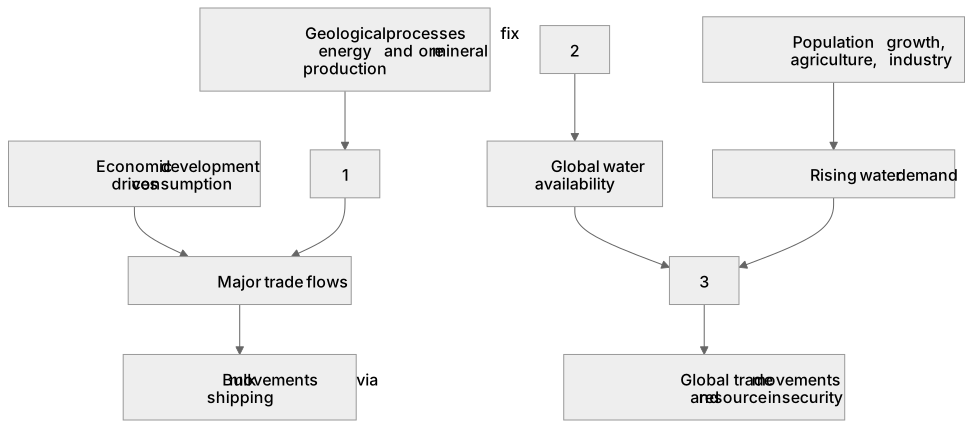
Label the diagram
Some boxes have lost their names. Pick the right name for each number.
1Box 1
2Box 2
3Box 3
There is more to this lesson
The full lesson goes on to check your understanding and help you earn the marks. Create a free account to carry on, with your progress saved.
A week of Premium from your first lesson · Then the free plan continues · No card, no charge
Test your understanding of Natural resource issues: Global patterns of production, consumption and trade/movements of energy and ore minerals. Global patterns of water availability and demand.
Active recall beats re-reading. Take an instant quiz now to test what you’ve learned and lock it into long-term memory.
A week of Premium from your first lesson · Then the free plan continues · No card, no charge