AQA · A-Level · Geography
Course version: 7037 · Version from Sept 2018
Environmental problems in contrasting urban areas: atmospheric pollution,…
Full specification wording
Other contemporary urban environmental issues: Environmental problems in contrasting urban areas: atmospheric pollution, water pollution and dereliction.
Urban environments face severe ecological challenges, notably atmospheric pollution, water pollution, and dereliction, which manifest differently depending on a city's development level.
Checked against the AQA 7037 specification (opens in a new tab) on .
- Point 1 of 2
- 4 key terms
Study notes
From the checked teaching notes for this specification point.
The idea
Urban environments face severe ecological challenges, notably atmospheric pollution, water pollution, and dereliction, which manifest differently depending on a city's development level. Atmospheric pollution, driven by vehicular emissions and industrial activity, causes respiratory diseases and smog. Water pollution arises from inadequate sanitation and industrial effluent contaminating urban watercourses. Dereliction involves abandoned industrial or residential zones, often linked to deindustrialisation.
What earns the marks
- Analyse the causes and impacts of atmospheric pollution, such as particulate matter and nitrogen oxides from transport and industry.
- Explain the sources of urban water pollution, including untreated sewage, surface run-off, and industrial discharge.
- Examine the process of dereliction, linking it to economic restructuring, deindustrialisation, and urban decline.
- Compare how these three environmental problems vary in scale, cause, and management between two contrasting urban areas.
Common mistakes and how to put them right
Focusing solely on one environmental issue while ignoring the others.
Put it right: Ensure balanced coverage of atmospheric pollution, water pollution, and dereliction as required by the specification.
Using contrasting cities but failing to explicitly compare their environmental problems.
Put it right: Directly contrast the issues, for example comparing water pollution from inadequate sewage infrastructure in a developing city with industrial chemical run-off in a developed city.
Confusing dereliction with general urban poverty.
Put it right: Define dereliction specifically as the abandonment and decay of buildings and land, often requiring brownfield remediation.
Exam tips
- Prepare specific, quantifiable evidence for each problem in both contrasting cities, such as air quality index scores or hectares of derelict land.
- Link the environmental problems to their socio-economic impacts, such as the health costs of waterborne diseases or respiratory conditions.
- Evaluate the effectiveness of management strategies used to tackle these issues in your chosen contrasting urban areas.
Try the lesson
The start of the Other contemporary urban environmental issues: Environmental problems in contrasting urban areas: atmospheric pollution, water pollution and dereliction. lesson, made from checked teaching notes for this specification point.
Have a go first
Which of the following processes is most commonly associated with the widespread development of dereliction in older industrial cities?
Listen
Urban environments face severe ecological challenges, notably atmospheric pollution, water pollution, and dereliction, which manifest differently depending on a city's development level. Atmospheric pollution, driven by vehicular emissions and industrial activity, causes respiratory diseases and smog. Water pollution arises from inadequate sanitation and industrial effluent contaminating urban watercourses. Dereliction involves abandoned industrial or residential zones, often linked to deindustrialisation. A strong answer earns marks for these points. Analyse the causes and impacts of atmospheric pollution, such as particulate matter and nitrogen oxides from transport and industry. Explain the sources of urban water pollution, including untreated sewage, surface run-off, and industrial discharge. Examine the process of dereliction, linking it to economic restructuring, deindustrialisation, and urban decline. Compare how these three environmental problems vary in scale, cause, and management between two contrasting urban areas. A common slip: Focusing solely on one environmental issue while ignoring the others. Instead, Ensure balanced coverage of atmospheric pollution, water pollution, and dereliction as required by the specification. Exam tip: Prepare specific, quantifiable evidence for each problem in both contrasting cities, such as air quality index scores or hectares of derelict land.
See it

Key words
Say what each word means before you turn the card.
Atmospheric pollution
Try answering aloud or in your head before turning the card.
Water pollution
Try answering aloud or in your head before turning the card.
Dereliction
Try answering aloud or in your head before turning the card.
Urban decline
Try answering aloud or in your head before turning the card.
See every definition
- Atmospheric pollution
- Pollution driven by vehicular emissions and industrial activity, causing respiratory diseases and smog.
- Water pollution
- Arises from inadequate sanitation and industrial effluent contaminating urban watercourses.
- Dereliction
- Involves abandoned industrial or residential zones, often linked to deindustrialisation.
- Urban decline
- Linked to dereliction through economic restructuring and deindustrialisation.
Label the diagram
Some boxes have lost their names. Pick the right name for each number.
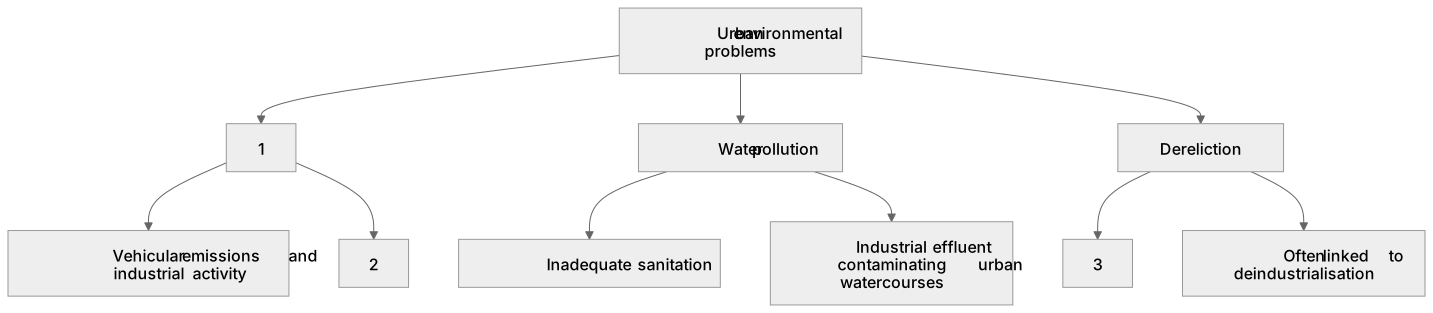
1Box 1
2Box 2
3Box 3
There is more to this lesson
The full lesson goes on to check your understanding and help you earn the marks. Create a free account to carry on, with your progress saved.
A week of Premium from your first lesson · Then the free plan continues · No card, no charge
Test your understanding of Other contemporary urban environmental issues: Environmental problems in contrasting urban areas: atmospheric pollution, water pollution and dereliction.
Active recall beats re-reading. Take an instant quiz now to test what you’ve learned and lock it into long-term memory.
A week of Premium from your first lesson · Then the free plan continues · No card, no charge