AQA · A-Level · Geography
Course version: 7037 · Version from Sept 2018
Students must engage with a range of quantitative and relevant qualitative…
Full specification wording
Quantitative and qualitative skills: Students must engage with a range of quantitative and relevant qualitative skills, within the theme water and carbon cycles. Students must specifically understand simple mass balance, unit conversions and the analysis and presentation of field data.
To master the water and carbon cycles, you must apply both quantitative and qualitative skills to real-world data.
Checked against the AQA 7037 specification (opens in a new tab) on .
- 4 key terms
Study notes
From the checked teaching notes for this specification point.
The idea
To master the water and carbon cycles, you must apply both quantitative and qualitative skills to real-world data. A simple mass balance equation calculates net change by subtracting outputs from inputs, for example when calculating a glacier's mass balance or a catchment's water budget. Unit conversions must preserve dimensions: carbon mass can be converted from kilograms to gigatonnes (1 Gt = 10¹² kg), while rainfall depth can become a discharge only after using catchment area and time, for example Q = rainfall depth × area ÷ time. You also need to analyse and present field data effectively by selecting suitable graphs and combining qualitative observations with statistical analysis.
What earns the marks
- Calculate simple mass balance by identifying and subtracting total system outputs from total system inputs.
- Convert between standard units accurately, such as scaling up from square metres (m²) to hectares (10⁴ m²) or square kilometres (10⁶ m²).
- Select and construct appropriate graphical presentations for field data, such as using proportional symbols or choropleth maps for spatial carbon stores.
- Synthesise quantitative measurements (like infiltration rates in mm h⁻¹) with qualitative field observations (such as land use descriptions) to explain cycle dynamics.
Common mistakes and how to put them right
Failing to align units before calculating mass balance.
Put it right: Ensure all values are converted to a common unit, such as gigatonnes of carbon (GtC), before adding or subtracting.
Miscalculating area conversions; remember that converting from square kilometres to square metres requires multiplying by 10⁶, not 10³.
Presenting field data using inappropriate graphs.
Put it right: Use line graphs for continuous data over time (like river discharge) and bar charts for discrete categories.
Exam tips
- Always write down the mass balance formula (Inputs - Outputs = Change in Storage) before substituting your data values.
- Double-check unit conversions in multi-step calculations, especially when moving between rates like cubic metres per second (m³ s⁻¹) and total daily volumes.
- When analysing field data, explicitly reference anomalous results and suggest qualitative reasons for their occurrence based on site characteristics.
Try the lesson
The start of the Quantitative and qualitative skills: Students must engage with a range of quantitative and relevant qualitative skills, within the theme water and carbon cycles. Students must specifically understand simple mass balance, unit conversions and the analysis and presentation of field data. lesson, made from checked teaching notes for this specification point.
Have a go first
A drainage basin receives 1200 mm of precipitation in a year. Evapotranspiration is 500 mm, and river discharge is 600 mm. Assuming no other transfers occur, what is the annual change in the basin's water storage?
Listen
To master the water and carbon cycles, you must apply both quantitative and qualitative skills to real-world data. A simple mass balance equation calculates net change by subtracting outputs from inputs, for example when calculating a glacier's mass balance or a catchment's water budget. Unit conversions must preserve dimensions: carbon mass can be converted from kilograms to gigatonnes (1 Gt = 10¹² kg), while rainfall depth can become a discharge only after using catchment area and time, for example Q = rainfall depth × area ÷ time. You also need to analyse and present field data effectively by selecting suitable graphs and combining qualitative observations with statistical analysis. A strong answer earns marks for these points. Calculate simple mass balance by identifying and subtracting total system outputs from total system inputs. Convert between standard units accurately, such as scaling up from square metres (m²) to hectares (10⁴ m²) or square kilometres (10⁶ m²). Select and construct appropriate graphical presentations for field data, such as using proportional symbols or choropleth maps for spatial carbon stores. Synthesise quantitative measurements (like infiltration rates in mm h⁻¹) with qualitative field observations (such as land use descriptions) to explain cycle dynamics. Exam tip: Always write down the mass balance formula (Inputs - Outputs = Change in Storage) before substituting your data values.
See it
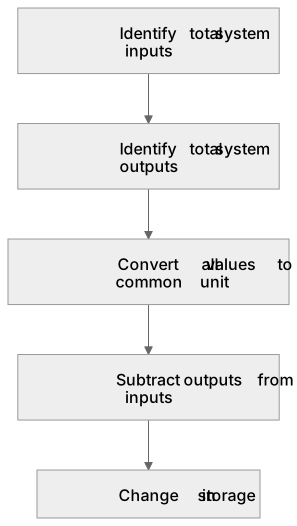
Put it in order
Put these steps in the order they happen.
- 1. Identify total system outputs
- 2. Convert all values to a common unit
- 3. Identify total system inputs
- 4. Change in storage
- 5. Subtract outputs from inputs
Key words
Say what each word means before you turn the card.
Mass balance
Try answering aloud or in your head before turning the card.
Unit conversions
Try answering aloud or in your head before turning the card.
Data presentation
Try answering aloud or in your head before turning the card.
Fieldwork skills
Try answering aloud or in your head before turning the card.
See every definition
- Mass balance
- A simple calculation of net change found by subtracting total system outputs from total system inputs.
- Unit conversions
- Accurately changing between standard units, such as scaling up from square metres to hectares or square kilometres.
- Data presentation
- Selecting and constructing appropriate graphical presentations for field data, such as proportional symbols or choropleth maps for spatial carbon stores.
- Fieldwork skills
- Synthesising quantitative measurements with qualitative field observations to explain cycle dynamics.
Label the diagram
Some boxes have lost their names. Pick the right name for each number.
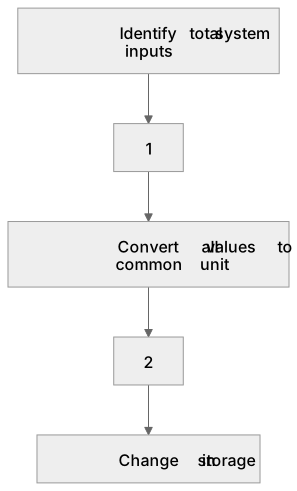
1Box 1
2Box 2
There is more to this lesson
The full lesson goes on to check your understanding and help you earn the marks. Create a free account to carry on, with your progress saved.
A week of Premium from your first lesson · Then the free plan continues · No card, no charge
Test your understanding of Quantitative and qualitative skills: Students must engage with a range of quantitative and relevant qualitative skills, within the theme water and carbon cycles. Students must specifically understand simple mass balance, unit conversions and the analysis and presentation of field data.
Active recall beats re-reading. Take an instant quiz now to test what you’ve learned and lock it into long-term memory.
A week of Premium from your first lesson · Then the free plan continues · No card, no charge