AQA · A-Level · Geography
Course version: 7037 · Version from Sept 2018
The characteristics and impacts of external forces operating at different…
Full specification wording
Relationships and connections: The characteristics and impacts of external forces operating at different scales from local to global, including either government policies or the decisions of transnational corporations or the impacts of international or global institutions.
Places are dynamically shaped by external forces operating across local, regional, national, and global scales.
Checked against the AQA 7037 specification (opens in a new tab) on .
- 4 key terms
Study notes
From the checked teaching notes for this specification point.
The idea
Places are dynamically shaped by external forces operating across local, regional, national, and global scales. These forces possess distinct characteristics, such as the financial power of transnational corporations (TNCs) or the legislative authority of governments, and generate profound demographic, cultural, and economic impacts. For example, a national government policy creating an Enterprise Zone can stimulate local job growth but may displace existing businesses. Alternatively, a TNC's decision to relocate manufacturing globally can trigger local deindustrialisation and severe economic decline. International institutions, such as the EU or World Bank, also dictate funding and infrastructure developments that transform local places.
What earns the marks
- Identify specific external forces operating at various scales, such as local councils, national governments, TNCs, or global institutions.
- Explain the characteristics of these forces, including their motivations, financial resources, and spatial reach.
- Assess the demographic, socio-economic, and cultural impacts of these external forces on specific local places.
- Evaluate how the decisions of TNCs or international institutions can create both positive and negative outcomes for a locality.
Common mistakes and how to put them right
Treating external forces as purely negative.
Put it right: Acknowledge that external forces, such as government regeneration grants or TNC investments, can bring positive economic and social impacts.
Failing to link global forces to local impacts.
Put it right: Explicitly connect macro-scale decisions, like a global institution's trade policy, to micro-scale changes in a specific town's employment structure.
Confusing the scales of different institutions.
Put it right: Accurately categorise forces, ensuring local councils are distinguished from national government policies and global TNCs.
Exam tips
- Select one detailed case study of a TNC or government policy to illustrate how external decisions physically and demographically alter a place.
- Use specific data, such as investment figures or job creation statistics, to quantify the impact of an external force.
- Consider the unequal impacts of external forces, noting that different demographic groups within the same locality may experience changes differently.
Try the lesson
The start of the Relationships and connections: The characteristics and impacts of external forces operating at different scales from local to global, including either government policies or the decisions of transnational corporations or the impacts of international or global institutions. lesson, made from checked teaching notes for this specification point.
Have a go first
Which of the following is an example of a transnational corporation (TNC) acting as an external force that directly impacts a local place?
Listen
Places are dynamically shaped by external forces operating across local, regional, national, and global scales. These forces possess distinct characteristics, such as the financial power of transnational corporations (TNCs) or the legislative authority of governments, and generate profound demographic, cultural, and economic impacts. For example, a national government policy creating an Enterprise Zone can stimulate local job growth but may displace existing businesses. Alternatively, a TNC's decision to relocate manufacturing globally can trigger local deindustrialisation and severe economic decline. International institutions, such as the EU or World Bank, also dictate funding and infrastructure developments that transform local places. A strong answer earns marks for these points. Identify specific external forces operating at various scales, such as local councils, national governments, TNCs, or global institutions. Explain the characteristics of these forces, including their motivations, financial resources, and spatial reach. Assess the demographic, socio-economic, and cultural impacts of these external forces on specific local places. Evaluate how the decisions of TNCs or international institutions can create both positive and negative outcomes for a locality. A common slip: Treating external forces as purely negative. Instead, Acknowledge that external forces, such as government regeneration grants or TNC investments, can bring positive economic and social impacts. Exam tip: Select one detailed case study of a TNC or government policy to illustrate how external decisions physically and demographically alter a place.
See it
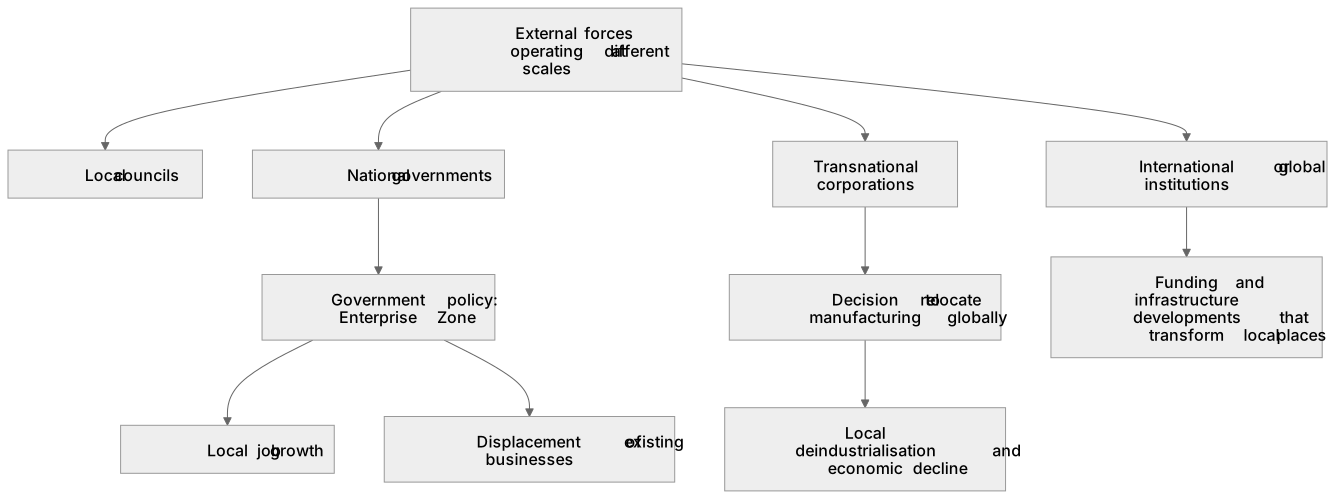
Key words
Say what each word means before you turn the card.
External forces
Try answering aloud or in your head before turning the card.
Transnational corporations
Try answering aloud or in your head before turning the card.
International institutions
Try answering aloud or in your head before turning the card.
Government policies
Try answering aloud or in your head before turning the card.
See every definition
- External forces
- Forces operating at different scales from local to global, including government policies, the decisions of transnational corporations, or the impacts of international or global institutions.
- Transnational corporations
- Forces whose decisions can relocate manufacturing globally, triggering local deindustrialisation and severe economic decline, and which possess financial power.
- International institutions
- Forces such as the EU or World Bank that dictate funding and infrastructure developments which transform local places.
- Government policies
- Forces such as a national government policy creating an Enterprise Zone, which can stimulate local job growth but may displace existing businesses.
Label the diagram
Some boxes have lost their names. Pick the right name for each number.
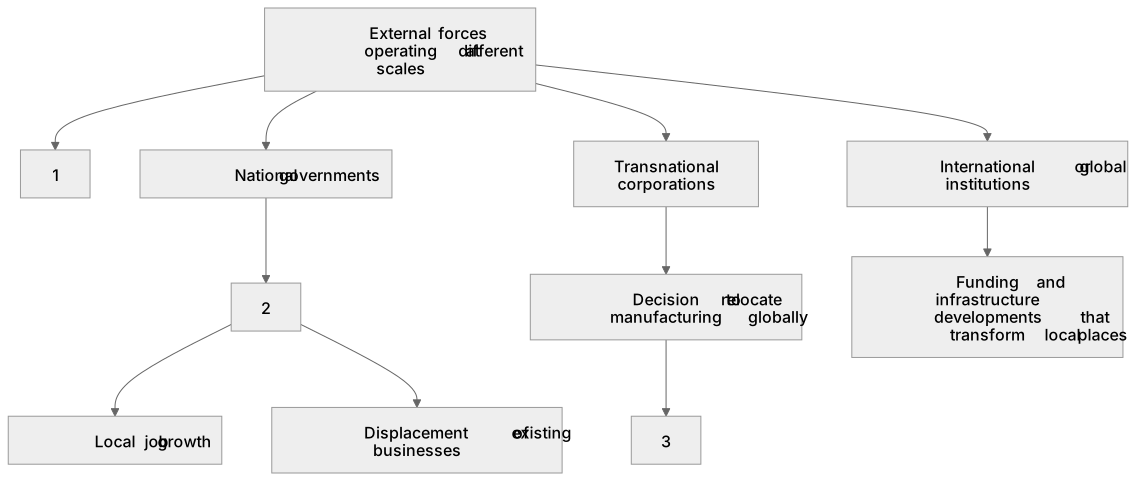
1Box 1
2Box 2
3Box 3
There is more to this lesson
The full lesson goes on to check your understanding and help you earn the marks. Create a free account to carry on, with your progress saved.
A week of Premium from your first lesson · Then the free plan continues · No card, no charge
Test your understanding of Relationships and connections: The characteristics and impacts of external forces operating at different scales from local to global, including either government policies or the decisions of transnational corporations or the impacts of international or global institutions.
Active recall beats re-reading. Take an instant quiz now to test what you’ve learned and lock it into long-term memory.
A week of Premium from your first lesson · Then the free plan continues · No card, no charge