AQA · A-Level · Geography
Course version: 7037 · Version from Sept 2018
Issues associated with economic inequality, social segregation and…
Full specification wording
Social and economic issues associated with urbanisation: Issues associated with economic inequality, social segregation and cultural diversity in contrasting urban areas.
Urban areas exhibit stark contrasts in wealth and opportunity.
Checked against the AQA 7037 specification (opens in a new tab) on .
- Point 1 of 2
- 3 key terms
Study notes
From the checked teaching notes for this specification point.
The idea
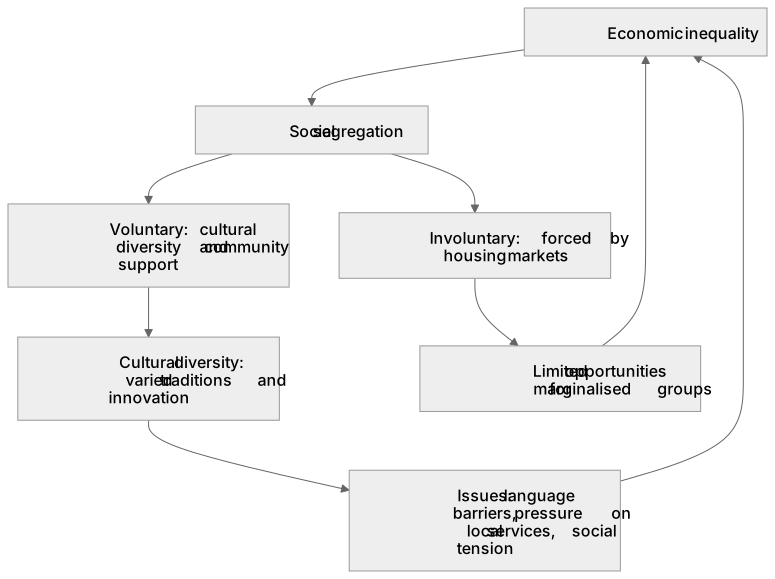
Urban areas exhibit stark contrasts in wealth and opportunity. Economic inequality manifests in disparities in income, employment, and access to services. This often drives social segregation, where different socio-economic or ethnic groups cluster in distinct neighbourhoods. Such spatial sorting can be voluntary, driven by cultural diversity and community support, or involuntary, forced by housing markets. Contrasting areas within London, like affluent Kensington and deprived Newham, highlight these divides. While cultural diversity enriches urban life through varied traditions and innovation, it can also generate issues like language barriers, pressure on local services, and social tension if integration fails and inequality persists.
What earns the marks
- Define economic inequality and explain its spatial manifestation in contrasting urban areas using indices of multiple deprivation.
- Differentiate between voluntary and involuntary causes of social segregation in cities.
- Evaluate the positive impacts of cultural diversity, such as economic innovation and cultural enrichment.
- Discuss the challenges associated with cultural diversity, including language barriers, social tensions, and pressure on educational services.
- Compare the lived experiences of residents in two contrasting urban areas to illustrate the impacts of inequality and segregation.
Common mistakes and how to put them right
Using social segregation and economic inequality interchangeably.
Put it right: Inequality refers to wealth disparities, while segregation refers to the spatial separation of groups.
Viewing cultural diversity solely as a source of conflict.
Put it right: It is essential to also acknowledge its role in economic vitality and cultural enrichment.
Failing to use contrasting examples.
Put it right: Answers must explicitly compare at least two different urban areas or neighbourhoods to highlight disparities.
Exam tips
- Memorise specific data points such as life expectancy or income levels for two contrasting urban areas to strengthen your comparisons.
- Use the Index of Multiple Deprivation (IMD) as a framework to discuss different dimensions of economic inequality.
- Explore the feedback loop where economic inequality exacerbates social segregation, which in turn limits opportunities for marginalised groups.
Try the lesson
The start of the Social and economic issues associated with urbanisation: Issues associated with economic inequality, social segregation and cultural diversity in contrasting urban areas. lesson, made from checked teaching notes for this specification point.
Have a go first
Which of the following best describes the concept of social segregation in an urban area?
Listen
Urban areas exhibit stark contrasts in wealth and opportunity. Economic inequality manifests in disparities in income, employment, and access to services. This often drives social segregation, where different socio-economic or ethnic groups cluster in distinct neighbourhoods. Such spatial sorting can be voluntary, driven by cultural diversity and community support, or involuntary, forced by housing markets. Contrasting areas within London, like affluent Kensington and deprived Newham, highlight these divides. While cultural diversity enriches urban life through varied traditions and innovation, it can also generate issues like language barriers, pressure on local services, and social tension if integration fails and inequality persists. A strong answer earns marks for these points. Define economic inequality and explain its spatial manifestation in contrasting urban areas using indices of multiple deprivation. Differentiate between voluntary and involuntary causes of social segregation in cities. Evaluate the positive impacts of cultural diversity, such as economic innovation and cultural enrichment. Discuss the challenges associated with cultural diversity, including language barriers, social tensions, and pressure on educational services. Exam tip: Memorise specific data points such as life expectancy or income levels for two contrasting urban areas to strengthen your comparisons.
See it
Key words
Say what each word means before you turn the card.
Economic inequality
Try answering aloud or in your head before turning the card.
Social segregation
Try answering aloud or in your head before turning the card.
Cultural diversity
Try answering aloud or in your head before turning the card.
See every definition
- Economic inequality
- Disparities in income, employment, and access to services within urban areas.
- Social segregation
- Different socio-economic or ethnic groups clustering in distinct neighbourhoods, driven by housing markets or by cultural diversity and community support.
- Cultural diversity
- Varied traditions and innovation that enrich urban life but can also generate language barriers, pressure on local services, and social tension if integration fails.
Label the diagram
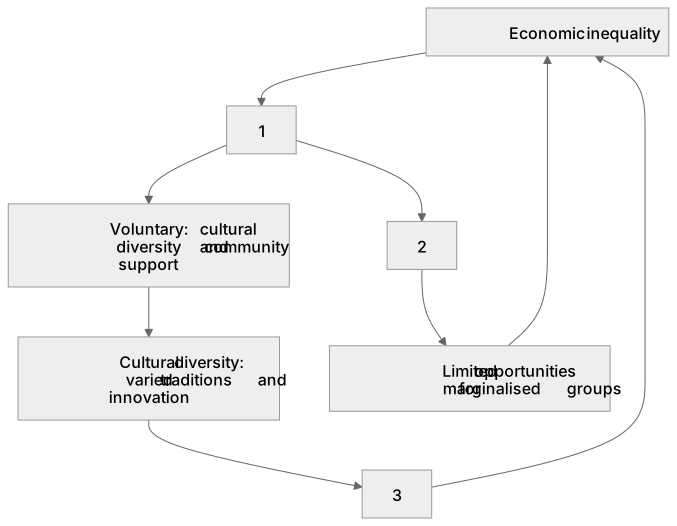
Some boxes have lost their names. Pick the right name for each number.
1Box 1
2Box 2
3Box 3
There is more to this lesson
The full lesson goes on to check your understanding and help you earn the marks. Create a free account to carry on, with your progress saved.
A week of Premium from your first lesson · Then the free plan continues · No card, no charge
Test your understanding of Social and economic issues associated with urbanisation: Issues associated with economic inequality, social segregation and cultural diversity in contrasting urban areas.
Active recall beats re-reading. Take an instant quiz now to test what you’ve learned and lock it into long-term memory.
A week of Premium from your first lesson · Then the free plan continues · No card, no charge