AQA · A-Level · Geography
Course version: 7037 · Version from Sept 2018
Impacts: primary/secondary, environmental, social, economic, political.…
Full specification wording
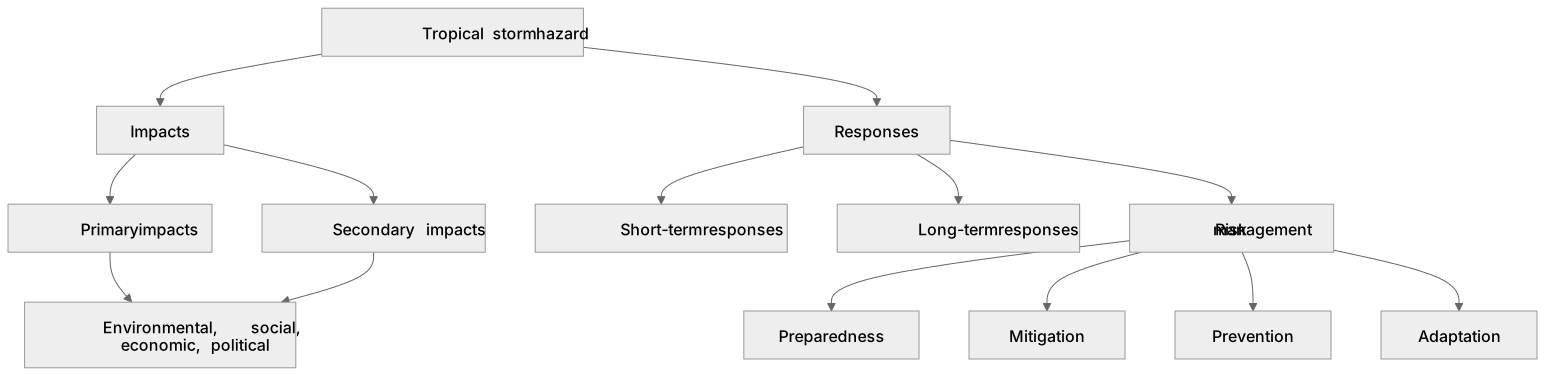
Storm hazards: Impacts: primary/secondary, environmental, social, economic, political. Short and long-term responses: risk management designed to reduce the impacts of the hazard through preparedness, mitigation, prevention and adaptation.
Tropical storms generate complex impacts requiring comprehensive risk management.
Checked against the AQA 7037 specification (opens in a new tab) on .
- Point 2 of 2
- 4 key terms
Study notes
From the checked teaching notes for this specification point.
The idea
Tropical storms generate complex impacts requiring comprehensive risk management. Primary impacts include immediate wind damage (economic) and loss of life (social). Secondary impacts emerge later, such as waterborne diseases (social), disrupted supply chains (economic), coastal erosion (environmental), and government criticism over relief efforts (political). Responses span short-term emergency aid and long-term rebuilding. Risk management reduces impacts through preparedness (evacuation drills), mitigation (building sea walls), prevention (restricting development in high-risk zones, as preventing the storm is impossible), and adaptation (changing building codes to live with the hazard).
What earns the marks
- Categorise impacts accurately into primary (immediate physical damage) and secondary (subsequent effects like disease or economic recession).
- Analyse impacts across all four dimensions: environmental, social, economic, and political, using specific case study examples.
- Distinguish between short-term responses (search and rescue, emergency shelter) and long-term responses (infrastructure reconstruction, policy changes).
- Evaluate the effectiveness of risk management strategies, specifically comparing preparedness, mitigation, prevention, and adaptation.
Common mistakes and how to put them right
Confusing mitigation with adaptation.
Put it right by defining mitigation as actions reducing the severity of the hazard's impact (e.g., sea walls), while adaptation involves adjusting lifestyles or systems to cope with the hazard (e.g., stilt houses).
Claiming that tropical storms can be prevented.
Put it right by clarifying that while the hazard event cannot be prevented, human vulnerability and exposure can be prevented through land-use zoning.
Failing to include political impacts.
Put it right: Explicitly discussing how poor disaster response can lead to civil unrest, changes in government, or geopolitical tensions over international aid.
Exam tips
- Always link a specific impact to its correct category (e.g., explicitly state that the destruction of a mangrove forest is a primary environmental impact).
- Use a contrasting case study (e.g., a high-income country vs. a low-income country) to evaluate how economic wealth influences the capacity for long-term adaptation and mitigation.
- When discussing risk management, explicitly use the terminology from the specification: preparedness, mitigation, prevention, and adaptation.
Try the lesson
The start of the Storm hazards: Impacts: primary/secondary, environmental, social, economic, political. Short and long-term responses: risk management designed to reduce the impacts of the hazard through preparedness, mitigation, prevention and adaptation. lesson, made from checked teaching notes for this specification point.
Have a go first
Which of the following is an example of a primary environmental impact caused by a tropical storm?
Listen
Tropical storms generate complex impacts requiring comprehensive risk management. Primary impacts include immediate wind damage (economic) and loss of life (social). Secondary impacts emerge later, such as waterborne diseases (social), disrupted supply chains (economic), coastal erosion (environmental), and government criticism over relief efforts (political). Responses span short-term emergency aid and long-term rebuilding. Risk management reduces impacts through preparedness (evacuation drills), mitigation (building sea walls), prevention (restricting development in high-risk zones, as preventing the storm is impossible), and adaptation (changing building codes to live with the hazard). A strong answer earns marks for these points. Categorise impacts accurately into primary (immediate physical damage) and secondary (subsequent effects like disease or economic recession). Analyse impacts across all four dimensions: environmental, social, economic, and political, using specific case study examples. Distinguish between short-term responses (search and rescue, emergency shelter) and long-term responses (infrastructure reconstruction, policy changes). Evaluate the effectiveness of risk management strategies, specifically comparing preparedness, mitigation, prevention, and adaptation. A common slip: Confusing mitigation with adaptation. Instead, defining mitigation as actions reducing the severity of the hazard's impact (e.g., sea walls), while adaptation involves adjusting lifestyles or systems to cope with the hazard (e.g., stilt houses). Exam tip: Always link a specific impact to its correct category (e.g., explicitly state that the destruction of a mangrove forest is a primary environmental impact).
See it
Key words
Say what each word means before you turn the card.
Risk management
Try answering aloud or in your head before turning the card.
Preparedness
Try answering aloud or in your head before turning the card.
Mitigation
Try answering aloud or in your head before turning the card.
Adaptation
Try answering aloud or in your head before turning the card.
See every definition
- Risk management
- Designed to reduce the impacts of the hazard through preparedness, mitigation, prevention and adaptation.
- Preparedness
- A form of risk management that reduces impacts, such as evacuation drills.
- Mitigation
- Actions reducing the severity of the hazard's impact, such as building sea walls.
- Adaptation
- Adjusting lifestyles or systems to cope with the hazard, such as changing building codes to live with it.
Label the diagram
Some boxes have lost their names. Pick the right name for each number.
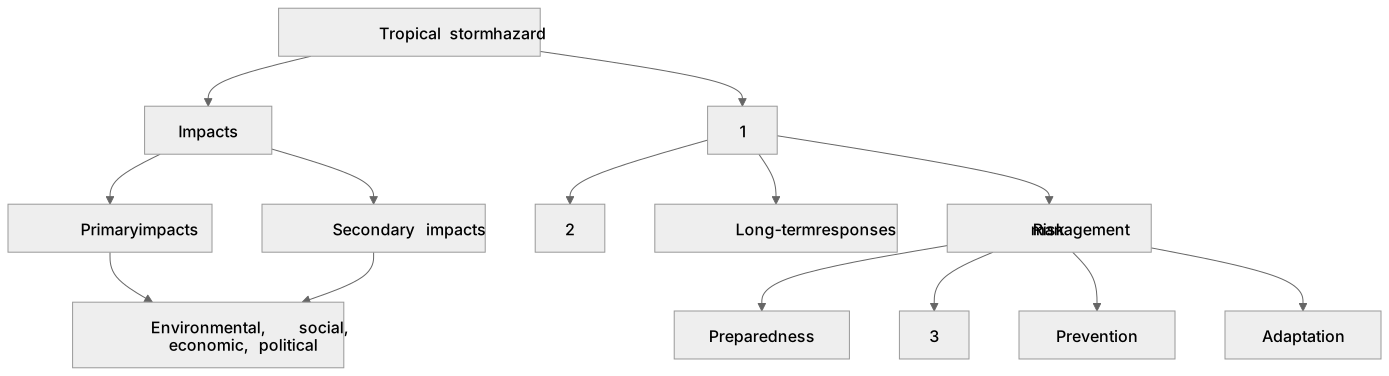
1Box 1
2Box 2
3Box 3
There is more to this lesson
The full lesson goes on to check your understanding and help you earn the marks. Create a free account to carry on, with your progress saved.
A week of Premium from your first lesson · Then the free plan continues · No card, no charge
Test your understanding of Storm hazards: Impacts: primary/secondary, environmental, social, economic, political. Short and long-term responses: risk management designed to reduce the impacts of the hazard through preparedness, mitigation, prevention and adaptation.
Active recall beats re-reading. Take an instant quiz now to test what you’ve learned and lock it into long-term memory.
A week of Premium from your first lesson · Then the free plan continues · No card, no charge