AQA · A-Level · Geography
Course version: 7037 · Version from Sept 2018
Strategies for developing more sustainable cities.
Full specification wording
Sustainable urban development: Strategies for developing more sustainable cities.
Strategies for sustainable urban development require multifaceted approaches targeting transport, waste, and energy.
Checked against the AQA 7037 specification (opens in a new tab) on .
- Point 2 of 2
- 4 key terms
Study notes
From the checked teaching notes for this specification point.
The idea
Strategies for sustainable urban development require multifaceted approaches targeting transport, waste, and energy. Transport strategies often focus on reducing reliance on private vehicles through integrated public transit systems, such as Curitiba's Bus Rapid Transit, and promoting active travel via dedicated cycling infrastructure. Waste management strategies emphasise the circular economy, moving away from landfill towards comprehensive recycling and energy recovery facilities. Energy strategies include mandating zero-carbon building standards and integrating renewable sources like solar arrays into urban design. Effective implementation requires strong urban governance and community engagement to ensure strategies are socially inclusive.
What earns the marks
- Describe specific transport strategies, such as integrated public transit networks or congestion charging zones.
- Explain waste management strategies that promote a circular urban economy, including recycling and energy recovery.
- Analyse energy and building strategies, such as retrofitting insulation or mandating green roofs in new developments.
- Evaluate the role of urban governance and policy frameworks in successfully implementing sustainability strategies.
Common mistakes and how to put them right
Providing generic strategies without specific examples.
Put it right: Name specific policies or infrastructure projects from studied case studies.
Ignoring the social aspect of strategies.
Put it right: Include strategies that address social sustainability, such as affordable housing quotas.
Assuming strategies work universally.
Put it right: Acknowledge that strategies must be adapted to the specific geographic and economic context of a city.
Exam tips
- Categorise strategies into environmental, economic, and social dimensions to ensure a comprehensive answer.
- Critically evaluate the success of a strategy by discussing its limitations or unintended consequences, such as eco-gentrification.
- Link specific strategies back to the core concept of reducing a city's ecological footprint.
Try the lesson
The start of the Sustainable urban development: Strategies for developing more sustainable cities. lesson, made from checked teaching notes for this specification point.
Have a go first
How does the implementation of a Bus Rapid Transit (BRT) system contribute to both the environmental and social sustainability of a city?
Listen
Strategies for sustainable urban development require multifaceted approaches targeting transport, waste, and energy. Transport strategies often focus on reducing reliance on private vehicles through integrated public transit systems, such as Curitiba's Bus Rapid Transit, and promoting active travel via dedicated cycling infrastructure. Waste management strategies emphasise the circular economy, moving away from landfill towards comprehensive recycling and energy recovery facilities. Energy strategies include mandating zero-carbon building standards and integrating renewable sources like solar arrays into urban design. Effective implementation requires strong urban governance and community engagement to ensure strategies are socially inclusive. A strong answer earns marks for these points. Describe specific transport strategies, such as integrated public transit networks or congestion charging zones. Explain waste management strategies that promote a circular urban economy, including recycling and energy recovery. Analyse energy and building strategies, such as retrofitting insulation or mandating green roofs in new developments. Evaluate the role of urban governance and policy frameworks in successfully implementing sustainability strategies. A common slip: Providing generic strategies without specific examples. Instead, name specific policies or infrastructure projects from studied case studies. Exam tip: Categorise strategies into environmental, economic, and social dimensions to ensure a comprehensive answer.
See it

Key words
Say what each word means before you turn the card.
Urban governance
Try answering aloud or in your head before turning the card.
Transport strategies
Try answering aloud or in your head before turning the card.
Waste management strategies
Try answering aloud or in your head before turning the card.
Energy strategies
Try answering aloud or in your head before turning the card.
See every definition
- Urban governance
- Strong urban governance and community engagement are required for effective implementation to ensure strategies are socially inclusive.
- Transport strategies
- These often focus on reducing reliance on private vehicles through integrated public transit systems and promoting active travel via dedicated cycling infrastructure.
- Waste management strategies
- These emphasise the circular economy, moving away from landfill towards comprehensive recycling and energy recovery facilities.
- Energy strategies
- These include mandating zero-carbon building standards and integrating renewable sources like solar arrays into urban design.
Label the diagram
Some boxes have lost their names. Pick the right name for each number.
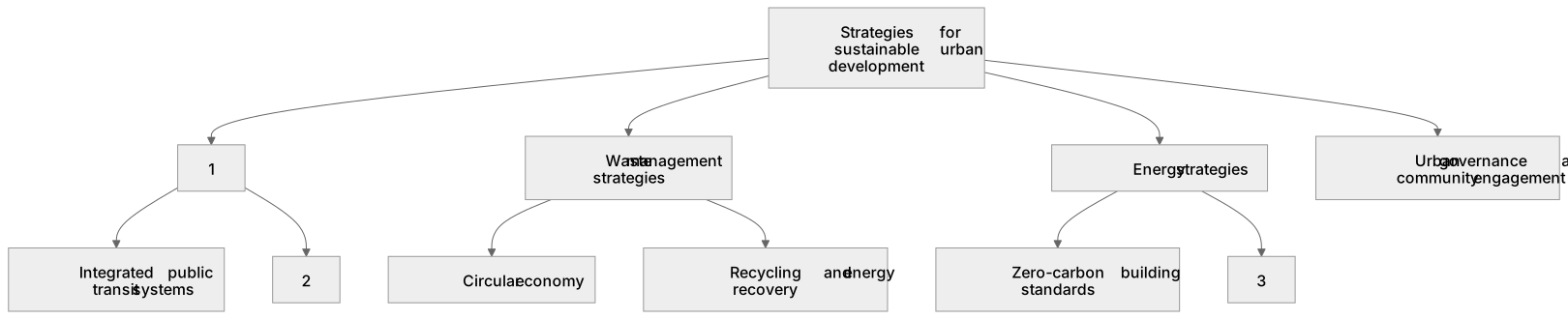
1Box 1
2Box 2
3Box 3
There is more to this lesson
The full lesson goes on to check your understanding and help you earn the marks. Create a free account to carry on, with your progress saved.
A week of Premium from your first lesson · Then the free plan continues · No card, no charge
Test your understanding of Sustainable urban development: Strategies for developing more sustainable cities.
Active recall beats re-reading. Take an instant quiz now to test what you’ve learned and lock it into long-term memory.
A week of Premium from your first lesson · Then the free plan continues · No card, no charge