AQA · A-Level · Geography
Course version: 7037 · Version from Sept 2018
Ablation and accumulation – historical patterns of ice advance and retreat.
Full specification wording
Systems and processes: Ablation and accumulation – historical patterns of ice advance and retreat.
The glacial system is driven by the balance between accumulation (inputs like snowfall and avalanches) and ablation (outputs like melting, sublimation, and calving).
Checked against the AQA 7037 specification (opens in a new tab) on .
- Point 2 of 6
- 3 key terms
Study notes
From the checked teaching notes for this specification point.
The idea
The glacial system is driven by the balance between accumulation (inputs like snowfall and avalanches) and ablation (outputs like melting, sublimation, and calving). When accumulation exceeds ablation, the glacial mass balance is positive, leading to ice advance. Conversely, a negative mass balance causes ice retreat. Historical patterns of advance and retreat are linked to long-term climate fluctuations, such as the Pleistocene epochs (characterised by extensive glacial advance) and the Holocene interglacial period (marked by widespread retreat).
For example: The Little Ice Age (roughly 1300 to 1850) saw significant glacial advance in the Alps, followed by rapid retreat as global temperatures rose during the industrial era.
What earns the marks
- Define accumulation as the addition of mass to a glacier, primarily through precipitation (snow), wind deposition, and avalanches.
- Define ablation as the loss of mass from a glacier, occurring via melting, sublimation, evaporation, and calving.
- Explain that a positive net mass balance results in glacial advance, while a negative net mass balance results in glacial retreat.
- Describe historical patterns of ice advance and retreat, referencing specific periods such as the Pleistocene glacials, the Holocene interglacial, or the Little Ice Age.
Common mistakes and how to put them right
Confusing glacial retreat with the ice physically moving backwards.
Put it right by explaining that the ice continues to flow downhill under gravity, but the snout melts faster than it is replenished.
Assuming ablation only means melting.
Put it right by including sublimation, evaporation, and calving as significant ablation processes.
Viewing historical patterns as short-term weather events.
Put it right by attributing historical advance and retreat to long-term climatic shifts like Milankovitch cycles.
Exam tips
- Use the mass balance equation to structure answers explaining why a glacier is advancing or retreating.
- Reference specific historical periods, such as the Little Ice Age, to provide concrete evidence for historical patterns of advance and retreat.
- Clearly distinguish between seasonal variations in mass balance and long-term historical trends.
Try the lesson
The start of the Systems and processes: Ablation and accumulation – historical patterns of ice advance and retreat. lesson, made from checked teaching notes for this specification point.
Have a go first
Which of the following best describes the relationship between accumulation, ablation, and historical glacial advance?
Listen
The glacial system is driven by the balance between accumulation (inputs like snowfall and avalanches) and ablation (outputs like melting, sublimation, and calving). When accumulation exceeds ablation, the glacial mass balance is positive, leading to ice advance. Conversely, a negative mass balance causes ice retreat. Historical patterns of advance and retreat are linked to long-term climate fluctuations, such as the Pleistocene epochs (characterised by extensive glacial advance) and the Holocene interglacial period (marked by widespread retreat). For example, the Little Ice Age (roughly 1300 to 1850) saw significant glacial advance in the Alps, followed by rapid retreat as global temperatures rose during the industrial era. A strong answer earns marks for these points. Define accumulation as the addition of mass to a glacier, primarily through precipitation (snow), wind deposition, and avalanches. Define ablation as the loss of mass from a glacier, occurring via melting, sublimation, evaporation, and calving. Explain that a positive net mass balance results in glacial advance, while a negative net mass balance results in glacial retreat. Describe historical patterns of ice advance and retreat, referencing specific periods such as the Pleistocene glacials, the Holocene interglacial, or the Little Ice Age. A common slip: Confusing glacial retreat with the ice physically moving backwards. Instead, explaining that the ice continues to flow downhill under gravity, but the snout melts faster than it is replenished. Exam tip: Use the mass balance equation to structure answers explaining why a glacier is advancing or retreating.
See it
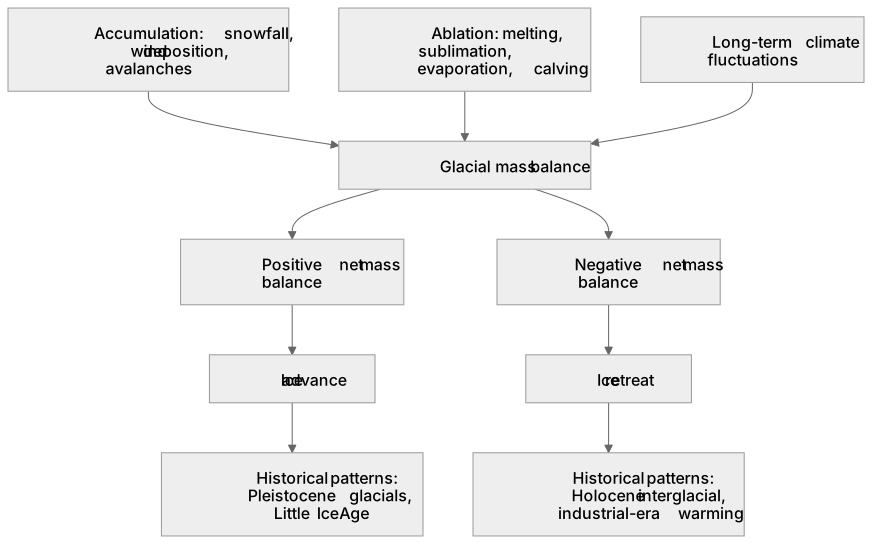
Key words
Say what each word means before you turn the card.
Accumulation
Try answering aloud or in your head before turning the card.
Ablation
Try answering aloud or in your head before turning the card.
Mass balance
Try answering aloud or in your head before turning the card.
See every definition
- Accumulation
- The addition of mass to a glacier, primarily through precipitation such as snow, wind deposition and avalanches.
- Ablation
- The loss of mass from a glacier, occurring via melting, sublimation, evaporation and calving.
- Mass balance
- The balance between accumulation as inputs and ablation as outputs, which is positive when accumulation exceeds ablation and negative when ablation exceeds accumulation.
Label the diagram
Some boxes have lost their names. Pick the right name for each number.
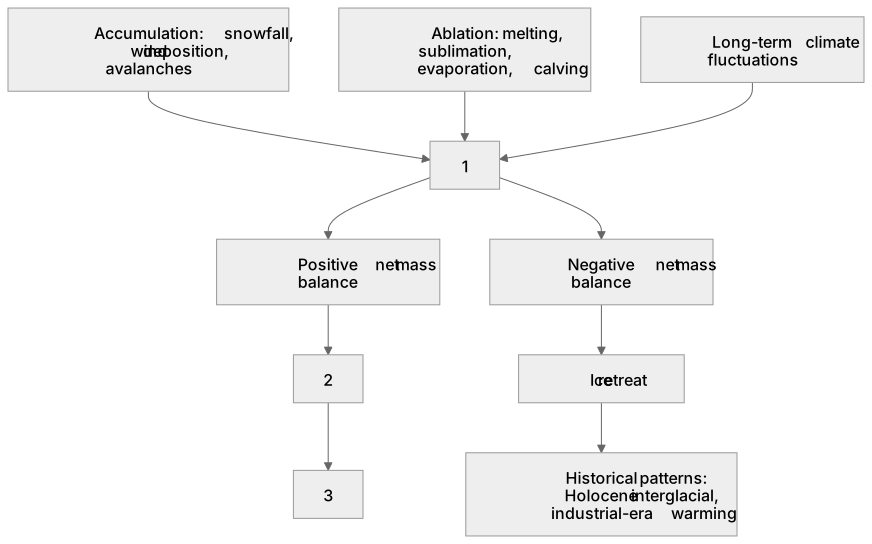
1Box 1
2Box 2
3Box 3
There is more to this lesson
The full lesson goes on to check your understanding and help you earn the marks. Create a free account to carry on, with your progress saved.
A week of Premium from your first lesson · Then the free plan continues · No card, no charge
Test your understanding of Systems and processes: Ablation and accumulation – historical patterns of ice advance and retreat.
Active recall beats re-reading. Take an instant quiz now to test what you’ve learned and lock it into long-term memory.
A week of Premium from your first lesson · Then the free plan continues · No card, no charge