AQA · A-Level · Geography
Course version: 7037 · Version from Sept 2018
Fluvioglacial processes: meltwater, erosion transportation and deposition.
Full specification wording
Systems and processes: Fluvioglacial processes: meltwater, erosion transportation and deposition.
Fluvioglacial processes are driven by the immense power of glacial meltwater, shaping landscapes during deglaciation or seasonal melting.
Checked against the AQA 7037 specification (opens in a new tab) on .
- Point 5 of 6
- 4 key terms
Study notes
From the checked teaching notes for this specification point.
The idea
Fluvioglacial processes are driven by the immense power of glacial meltwater, shaping landscapes during deglaciation or seasonal melting. Meltwater streams flow under high hydrostatic pressure within subglacial channels, giving them significant erosive power. Erosion occurs primarily through hydraulic action and abrasion of bedrock by a high suspended load. Meltwater transports vast quantities of sediment, rolling boulders via traction or carrying finer particles in suspension. As discharge decreases, the meltwater loses competence and capacity. This leads to the deposition of stratified, sorted, and rounded sediments, forming distinct fluvioglacial landforms such as eskers and outwash plains, contrasting with unsorted glacial till.
What earns the marks
- Explain the role of hydrostatic pressure in increasing the erosive power of subglacial meltwater streams.
- Describe how fluvioglacial erosion occurs through hydraulic action, abrasion, and attrition.
- Detail the transport mechanisms of meltwater, including traction, saltation, suspension, and solution.
- Explain how a decrease in meltwater discharge leads to the deposition of sorted, stratified, and rounded sediments.
Common mistakes and how to put them right
Confusing glacial till with fluvioglacial deposits.
Put it right by stating that fluvioglacial deposits are sorted and stratified, whereas till is unsorted.
Assuming meltwater only flows on the surface.
Put it right by explaining that subglacial and englacial channels carry significant volumes of meltwater under pressure.
Stating that meltwater erosion is identical to river erosion.
Put it right by highlighting the role of high hydrostatic pressure in subglacial environments.
Exam tips
- Emphasise the seasonal and diurnal variations in meltwater discharge when explaining depositional processes.
- Clearly distinguish between the characteristics of sediments deposited directly by ice and those deposited by meltwater.
- Use the concepts of competence and capacity to explain why meltwater deposits sediment as its energy decreases.
Try the lesson
The start of the Systems and processes: Fluvioglacial processes: meltwater, erosion transportation and deposition. lesson, made from checked teaching notes for this specification point.
Have a go first
Which characteristic is typical of sediments deposited by fluvioglacial meltwater streams?
Listen
Fluvioglacial processes are driven by the immense power of glacial meltwater, shaping landscapes during deglaciation or seasonal melting. Meltwater streams flow under high hydrostatic pressure within subglacial channels, giving them significant erosive power. Erosion occurs primarily through hydraulic action and abrasion of bedrock by a high suspended load. Meltwater transports vast quantities of sediment, rolling boulders via traction or carrying finer particles in suspension. As discharge decreases, the meltwater loses competence and capacity. This leads to the deposition of stratified, sorted, and rounded sediments, forming distinct fluvioglacial landforms such as eskers and outwash plains, contrasting with unsorted glacial till. A strong answer earns marks for these points. Explain the role of hydrostatic pressure in increasing the erosive power of subglacial meltwater streams. Describe how fluvioglacial erosion occurs through hydraulic action, abrasion, and attrition. Detail the transport mechanisms of meltwater, including traction, saltation, suspension, and solution. Explain how a decrease in meltwater discharge leads to the deposition of sorted, stratified, and rounded sediments. A common slip: Confusing glacial till with fluvioglacial deposits. Instead, stating that fluvioglacial deposits are sorted and stratified, whereas till is unsorted. Exam tip: Emphasise the seasonal and diurnal variations in meltwater discharge when explaining depositional processes.
See it
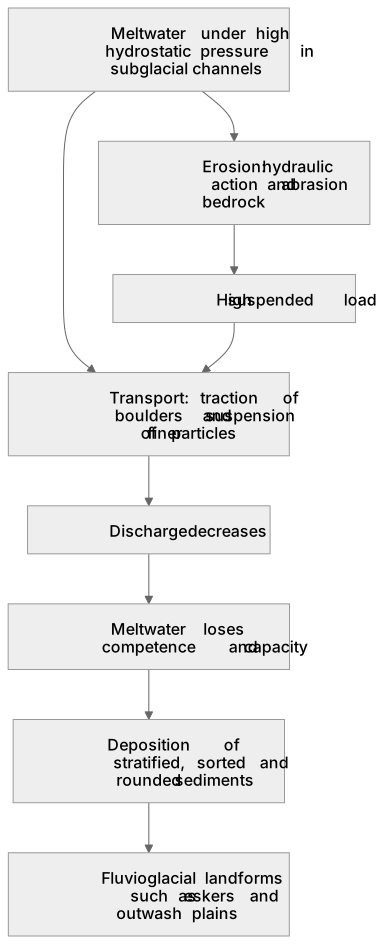
Key words
Say what each word means before you turn the card.
Meltwater dynamics
Try answering aloud or in your head before turning the card.
Fluvioglacial erosion
Try answering aloud or in your head before turning the card.
Sediment sorting and stratification
Try answering aloud or in your head before turning the card.
Hydrological processes in glaciated regions
Try answering aloud or in your head before turning the card.
See every definition
- Meltwater dynamics
- Meltwater streams flow under high hydrostatic pressure within subglacial channels, giving them significant erosive power.
- Fluvioglacial erosion
- Occurs primarily through hydraulic action and abrasion of bedrock by a high suspended load.
- Sediment sorting and stratification
- Deposition of stratified, sorted, and rounded sediments forms distinct fluvioglacial landforms, contrasting with unsorted glacial till.
- Hydrological processes in glaciated regions
- As discharge decreases, the meltwater loses competence and capacity, leading to deposition of sediment.
Label the diagram
Some boxes have lost their names. Pick the right name for each number.
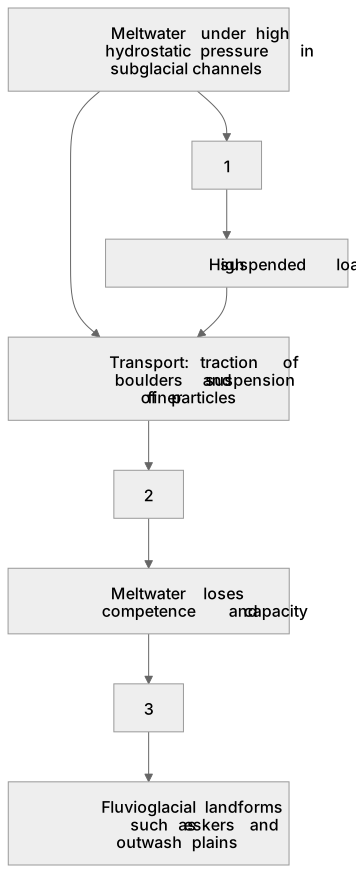
1Box 1
2Box 2
3Box 3
There is more to this lesson
The full lesson goes on to check your understanding and help you earn the marks. Create a free account to carry on, with your progress saved.
A week of Premium from your first lesson · Then the free plan continues · No card, no charge
Test your understanding of Systems and processes: Fluvioglacial processes: meltwater, erosion transportation and deposition.
Active recall beats re-reading. Take an instant quiz now to test what you’ve learned and lock it into long-term memory.
A week of Premium from your first lesson · Then the free plan continues · No card, no charge