AQA · A-Level · Geography
Course version: 7037 · Version from Sept 2018
Changes in the carbon cycle over time, to include natural variation…
Full specification wording
The carbon cycle: Changes in the carbon cycle over time, to include natural variation (including wild fires, volcanic activity) and human impact (including hydrocarbon fuel extraction and burning, farming practices, deforestation, land use changes).
The carbon cycle fluctuates over time through natural and anthropogenic drivers.
Checked against the AQA 7037 specification (opens in a new tab) on .
- Point 3 of 4
- 4 key terms
Study notes
From the checked teaching notes for this specification point.
The idea
The carbon cycle fluctuates over time through natural and anthropogenic drivers. Natural variations include volcanic activity, releasing lithospheric carbon dioxide, and wildfires, which rapidly transfer biospheric carbon to the atmosphere while reducing photosynthetic capacity. Human impacts significantly accelerate these changes. Hydrocarbon fuel extraction and burning shift vast quantities of fossilised carbon into the active cycle. Farming practices, such as cattle rearing and ploughing, release methane and oxidise soil carbon. Deforestation removes vital carbon sinks, and broader land use changes, like urbanisation, seal soils and alter natural fluxes, disrupting the long-term equilibrium of the global carbon cycle.
What earns the marks
- Explain how volcanic activity transfers carbon from the lithosphere to the atmosphere as carbon dioxide.
- Describe the dual impact of wildfires: immediate release of carbon dioxide and long-term reduction in the biosphere's capacity to sequester carbon.
- Analyse how hydrocarbon extraction and combustion move slow-cycle carbon into the fast cycle, creating an atmospheric surplus.
- Evaluate the impact of farming practices, such as methane emissions from livestock and carbon loss from soil ploughing.
- Assess how deforestation and land use changes (e.g., urbanisation) reduce biomass carbon storage and alter soil carbon fluxes.
Common mistakes and how to put them right
Stating that volcanic eruptions are the primary cause of recent atmospheric carbon increases.
Put it right: Clarify that human activities, particularly hydrocarbon burning, release significantly more carbon annually than volcanic activity.
Confusing the greenhouse effect with ozone depletion when discussing hydrocarbon burning.
Put it right: Explicitly link hydrocarbon combustion to the enhanced greenhouse effect and global warming, not the ozone hole.
Treating deforestation and land use change as identical processes.
Put it right: Distinguish deforestation (tree removal) from broader land use changes, which include urbanisation, afforestation, and agricultural conversion.
Exam tips
- Use specific data, such as gigatonnes of carbon (GtC), to compare the magnitude of natural versus human-induced carbon fluxes.
- When discussing wildfires, acknowledge that they can be both a natural variation and exacerbated by human-induced climate change.
- Structure essay answers by contrasting the timescales of natural variations (often geological) with the rapid pace of recent human impacts.
Try the lesson
The start of the The carbon cycle: Changes in the carbon cycle over time, to include natural variation (including wild fires, volcanic activity) and human impact (including hydrocarbon fuel extraction and burning, farming practices, deforestation, land use changes). lesson, made from checked teaching notes for this specification point.
Have a go first
Which of the following processes represents a natural cause of variation in the global carbon cycle over time?
Listen
The carbon cycle fluctuates over time through natural and anthropogenic drivers. Natural variations include volcanic activity, releasing lithospheric carbon dioxide, and wildfires, which rapidly transfer biospheric carbon to the atmosphere while reducing photosynthetic capacity. Human impacts significantly accelerate these changes. Hydrocarbon fuel extraction and burning shift vast quantities of fossilised carbon into the active cycle. Farming practices, such as cattle rearing and ploughing, release methane and oxidise soil carbon. Deforestation removes vital carbon sinks, and broader land use changes, like urbanisation, seal soils and alter natural fluxes, disrupting the long-term equilibrium of the global carbon cycle. A strong answer earns marks for these points. Explain how volcanic activity transfers carbon from the lithosphere to the atmosphere as carbon dioxide. Describe the dual impact of wildfires: immediate release of carbon dioxide and long-term reduction in the biosphere's capacity to sequester carbon. Analyse how hydrocarbon extraction and combustion move slow-cycle carbon into the fast cycle, creating an atmospheric surplus. Evaluate the impact of farming practices, such as methane emissions from livestock and carbon loss from soil ploughing. A common slip: Stating that volcanic eruptions are the primary cause of recent atmospheric carbon increases. Instead, Clarify that human activities, particularly hydrocarbon burning, release significantly more carbon annually than volcanic activity. Exam tip: Use specific data, such as gigatonnes of carbon (GtC), to compare the magnitude of natural versus human-induced carbon fluxes.
See it

Key words
Say what each word means before you turn the card.
Equilibrium and feedback
Try answering aloud or in your head before turning the card.
Human intervention
Try answering aloud or in your head before turning the card.
Timescales of change
Try answering aloud or in your head before turning the card.
Systems and cycles
Try answering aloud or in your head before turning the card.
See every definition
- Equilibrium and feedback
- The long-term balance of the global carbon cycle, which natural variations and human impacts disrupt.
- Human intervention
- Human impacts that significantly accelerate changes in the carbon cycle, including hydrocarbon fuel extraction and burning, farming practices, deforestation and land use changes.
- Timescales of change
- The contrast between natural variations and the rapid pace of recent human impacts on the carbon cycle.
- Systems and cycles
- The carbon cycle, which fluctuates over time through natural and anthropogenic drivers.
Label the diagram
Some boxes have lost their names. Pick the right name for each number.
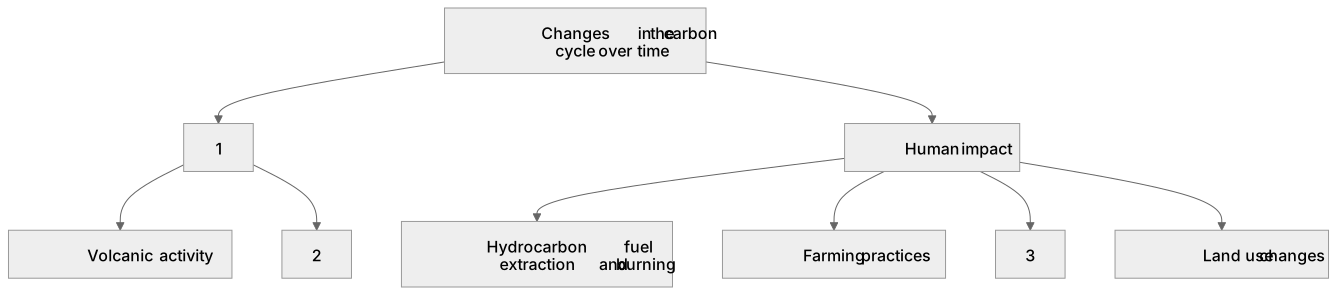
1Box 1
2Box 2
3Box 3
There is more to this lesson
The full lesson goes on to check your understanding and help you earn the marks. Create a free account to carry on, with your progress saved.
A week of Premium from your first lesson · Then the free plan continues · No card, no charge
Test your understanding of The carbon cycle: Changes in the carbon cycle over time, to include natural variation (including wild fires, volcanic activity) and human impact (including hydrocarbon fuel extraction and burning, farming practices, deforestation, land use changes).
Active recall beats re-reading. Take an instant quiz now to test what you’ve learned and lock it into long-term memory.
A week of Premium from your first lesson · Then the free plan continues · No card, no charge