AQA · A-Level · Geography
Course version: 7037 · Version from Sept 2018
Global distribution, and size of major stores of carbon – lithosphere,…
Full specification wording
The carbon cycle: Global distribution, and size of major stores of carbon – lithosphere, hydrosphere, cryosphere biosphere, atmosphere.
The global carbon cycle comprises five major stores of varying sizes and distributions.
Checked against the AQA 7037 specification (opens in a new tab) on .
- Point 1 of 4
- 4 key terms
Study notes
From the checked teaching notes for this specification point.
The idea
The global carbon cycle comprises five major stores of varying sizes and distributions. The lithosphere is the largest store, containing over 99.9% of global carbon (approximately 100,000,000 PgC), primarily in sedimentary rocks like limestone and fossil fuels. The hydrosphere is the second largest (approximately 38,000 PgC), with most carbon dissolved in the deep ocean. The biosphere (approximately 3,190 PgC) stores carbon in living vegetation, soils, and peat, distributed heavily in tropical rainforests and boreal forests. The cryosphere stores carbon in permafrost (approximately 1,400 PgC), mainly in tundra regions. The atmosphere is the smallest major store (approximately 750 PgC) but is highly active, distributing carbon globally.
What earns the marks
- Identify the lithosphere as the largest carbon store, containing sedimentary rocks and fossil fuels.
- Describe the hydrosphere's role, noting that the deep ocean stores significantly more carbon than the surface ocean.
- Explain the distribution of the biosphere, highlighting the concentration of terrestrial carbon in tropical and boreal biomes.
- Recognise the cryosphere as a significant store of frozen organic carbon in permafrost regions.
- Compare the relative sizes of the stores, noting the atmosphere is comparatively small but crucial for regulating global temperatures.
Common mistakes and how to put them right
Confusing the sizes of the biosphere and atmosphere.
Put it right: The biosphere is significantly larger than the atmosphere.
Ignoring the cryosphere as a distinct carbon store.
Put it right: Ensure permafrost is recognised as a major, vulnerable carbon reservoir.
Assuming the surface ocean holds the most marine carbon.
Put it right by stating the deep ocean holds the vast majority of dissolved inorganic carbon.
Exam tips
- Learn approximate values in petagrams of carbon (PgC) or gigatonnes of carbon (GtC) to support comparisons of store sizes.
- When discussing distribution, link specific stores to geographical biomes, such as the biosphere to tropical rainforests.
- Use the term 'store' or 'reservoir' rather than 'sink' when referring to the absolute amount of carbon held in these spheres.
Try the lesson
The start of the The carbon cycle: Global distribution, and size of major stores of carbon – lithosphere, hydrosphere, cryosphere biosphere, atmosphere. lesson, made from checked teaching notes for this specification point.
Have a go first
Which of the following represents the largest global store of carbon?
Listen
The global carbon cycle comprises five major stores of varying sizes and distributions. The lithosphere is the largest store, containing over 99.9% of global carbon (approximately 100,000,000 PgC), primarily in sedimentary rocks like limestone and fossil fuels. The hydrosphere is the second largest (approximately 38,000 PgC), with most carbon dissolved in the deep ocean. The biosphere (approximately 3,190 PgC) stores carbon in living vegetation, soils, and peat, distributed heavily in tropical rainforests and boreal forests. The cryosphere stores carbon in permafrost (approximately 1,400 PgC), mainly in tundra regions. The atmosphere is the smallest major store (approximately 750 PgC) but is highly active, distributing carbon globally. A strong answer earns marks for these points. Identify the lithosphere as the largest carbon store, containing sedimentary rocks and fossil fuels. Describe the hydrosphere's role, noting that the deep ocean stores significantly more carbon than the surface ocean. Explain the distribution of the biosphere, highlighting the concentration of terrestrial carbon in tropical and boreal biomes. Recognise the cryosphere as a significant store of frozen organic carbon in permafrost regions. A common slip: Assuming the surface ocean holds the most marine carbon. Instead, stating the deep ocean holds the vast majority of dissolved inorganic carbon. Exam tip: Learn approximate values in petagrams of carbon (PgC) or gigatonnes of carbon (GtC) to support comparisons of store sizes.
See it
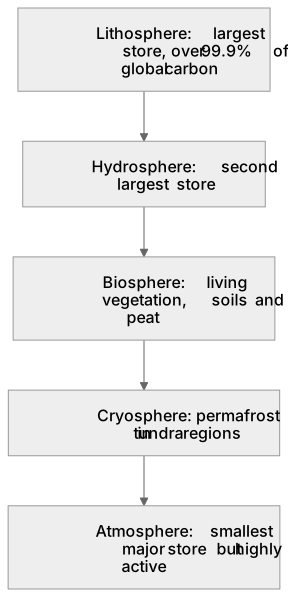
Put it in order
Put these steps in the order they happen.
- 1. Hydrosphere: second largest store
- 2. Biosphere: living vegetation, soils and peat
- 3. Lithosphere: largest store, over 99.9% of global carbon
- 4. Atmosphere: smallest major store but highly active
- 5. Cryosphere: permafrost in tundra regions
Key words
Say what each word means before you turn the card.
Carbon reservoirs
Try answering aloud or in your head before turning the card.
Lithosphere
Try answering aloud or in your head before turning the card.
Hydrosphere
Try answering aloud or in your head before turning the card.
Cryosphere
Try answering aloud or in your head before turning the card.
See every definition
- Carbon reservoirs
- Major stores of carbon of varying sizes and distributions, including the lithosphere, hydrosphere, cryosphere, biosphere and atmosphere.
- Lithosphere
- The largest store, containing over 99.9% of global carbon, primarily in sedimentary rocks like limestone and fossil fuels.
- Hydrosphere
- The second largest store, with most carbon dissolved in the deep ocean.
- Cryosphere
- A store of carbon in permafrost, mainly in tundra regions.
Label the diagram
Some boxes have lost their names. Pick the right name for each number.
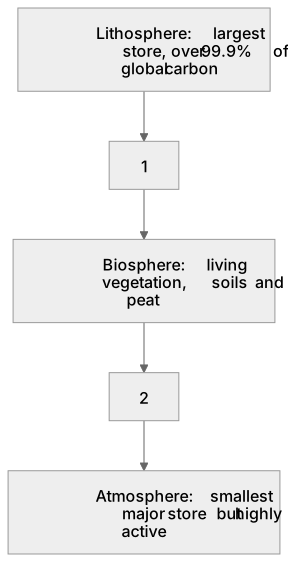
1Box 1
2Box 2
There is more to this lesson
The full lesson goes on to check your understanding and help you earn the marks. Create a free account to carry on, with your progress saved.
A week of Premium from your first lesson · Then the free plan continues · No card, no charge
Test your understanding of The carbon cycle: Global distribution, and size of major stores of carbon – lithosphere, hydrosphere, cryosphere biosphere, atmosphere.
Active recall beats re-reading. Take an instant quiz now to test what you’ve learned and lock it into long-term memory.
A week of Premium from your first lesson · Then the free plan continues · No card, no charge