AQA · A-Level · Geography
Course version: 7037 · Version from Sept 2018
Nature, forms and potential impacts of natural hazards (geophysical,…
Full specification wording
The concept of hazard in a geographical context: Nature, forms and potential impacts of natural hazards (geophysical, atmospheric and hydrological). Hazard perception and its economic and cultural determinants. Characteristic human responses – fatalism, prediction, adjustment/adaptation, mitigation, management, risk sharing – and their relationship to hazard incidence, intensity, magnitude, distribution and level of development. The Park model of human response to hazards. The Hazard Management Cycle.
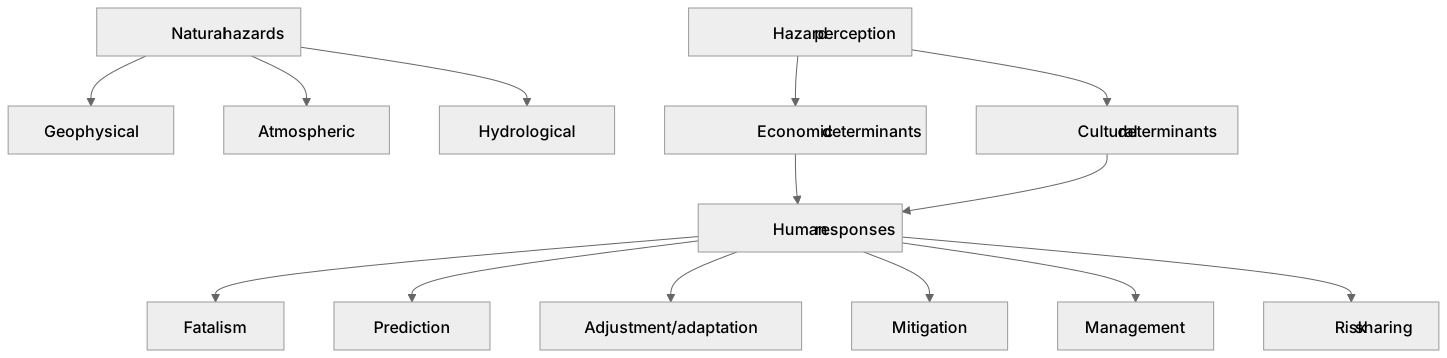
Natural hazards threaten populations, categorised as geophysical (earthquakes), atmospheric (storms), or hydrological (floods).
Checked against the AQA 7037 specification (opens in a new tab) on .
- 4 key terms
Study notes
From the checked teaching notes for this specification point.
The idea
Natural hazards threaten populations, categorised as geophysical (earthquakes), atmospheric (storms), or hydrological (floods). Their impacts vary by nature and form. Hazard perception is shaped by economic status (wealth enabling mobility) and cultural beliefs. Responses range from fatalism to proactive prediction, adjustment, adaptation, mitigation, management, and risk sharing (insurance). These depend on the hazard's incidence, intensity, magnitude, distribution, and the region's level of development. The Park model illustrates the decline and recovery of quality of life following an event, while the Hazard Management Cycle outlines ongoing phases of mitigation, preparedness, response, and recovery to minimise future impacts.
What earns the marks
- Define geophysical, atmospheric, and hydrological hazards with specific examples.
- Explain how economic and cultural factors influence an individual's or community's perception of hazard risk.
- Evaluate the effectiveness of different human responses, such as mitigation versus fatalism, in varying contexts of development.
- Apply the Park model to a specific hazard event to analyse the speed and extent of the recovery process.
- Describe the four stages of the Hazard Management Cycle and how they interrelate to reduce future vulnerability.
Common mistakes and how to put them right
Confusing the Park model with the Hazard Management Cycle.
Put it right: Use the Park model to show changes in quality of life over time, and the Hazard Management Cycle to describe the ongoing stages of managing a hazard.
Assuming fatalism only occurs in low-income countries.
Put it right: Recognise that fatalism can occur in any country, often influenced by cultural or religious beliefs rather than just economic status.
Using 'magnitude' and 'intensity' interchangeably.
Put it right: Define magnitude as the absolute energy released by a hazard, and intensity as the measurable impact on people and the built environment.
Exam tips
- Use specific, named examples of hazards to illustrate the different types of human response.
- When evaluating responses, explicitly link them to the hazard's magnitude, incidence, and the country's level of development.
- Practice drawing and annotating the Park model for different hazard events, showing how the curve varies based on preparedness and response.
Try the lesson
The start of the The concept of hazard in a geographical context: Nature, forms and potential impacts of natural hazards (geophysical, atmospheric and hydrological). Hazard perception and its economic and cultural determinants. Characteristic human responses – fatalism, prediction, adjustment/adaptation, mitigation, management, risk sharing – and their relationship to hazard incidence, intensity, magnitude, distribution and level of development. The Park model of human response to hazards. The Hazard Management Cycle. lesson, made from checked teaching notes for this specification point.
Have a go first
Which term describes a human response to natural hazards where individuals believe that such events are inevitable and that nothing can be done to prevent or mitigate their impacts?
Listen
Natural hazards threaten populations, categorised as geophysical (earthquakes), atmospheric (storms), or hydrological (floods). Their impacts vary by nature and form. Hazard perception is shaped by economic status (wealth enabling mobility) and cultural beliefs. Responses range from fatalism to proactive prediction, adjustment, adaptation, mitigation, management, and risk sharing (insurance). These depend on the hazard's incidence, intensity, magnitude, distribution, and the region's level of development. The Park model illustrates the decline and recovery of quality of life following an event, while the Hazard Management Cycle outlines ongoing phases of mitigation, preparedness, response, and recovery to minimise future impacts. A strong answer earns marks for these points. Define geophysical, atmospheric, and hydrological hazards with specific examples. Explain how economic and cultural factors influence an individual's or community's perception of hazard risk. Evaluate the effectiveness of different human responses, such as mitigation versus fatalism, in varying contexts of development. Apply the Park model to a specific hazard event to analyse the speed and extent of the recovery process. A common slip: Confusing the Park model with the Hazard Management Cycle. Instead, Use the Park model to show changes in quality of life over time, and the Hazard Management Cycle to describe the ongoing stages of managing a hazard. Exam tip: Use specific, named examples of hazards to illustrate the different types of human response.
See it
Key words
Say what each word means before you turn the card.
Hazard perception
Try answering aloud or in your head before turning the card.
Mitigation
Try answering aloud or in your head before turning the card.
Adaptation
Try answering aloud or in your head before turning the card.
Risk sharing
Try answering aloud or in your head before turning the card.
See every definition
- Hazard perception
- Shaped by economic and cultural determinants, this influences how an individual or community views hazard risk.
- Mitigation
- A characteristic human response that, together with management, forms part of the Hazard Management Cycle's ongoing phases.
- Adaptation
- A characteristic human response, alongside adjustment, prediction and fatalism, related to hazard incidence, intensity, magnitude, distribution and level of development.
- Risk sharing
- A characteristic human response to hazards, listed alongside fatalism, prediction, adjustment, adaptation, mitigation and management.
Label the diagram
Some boxes have lost their names. Pick the right name for each number.
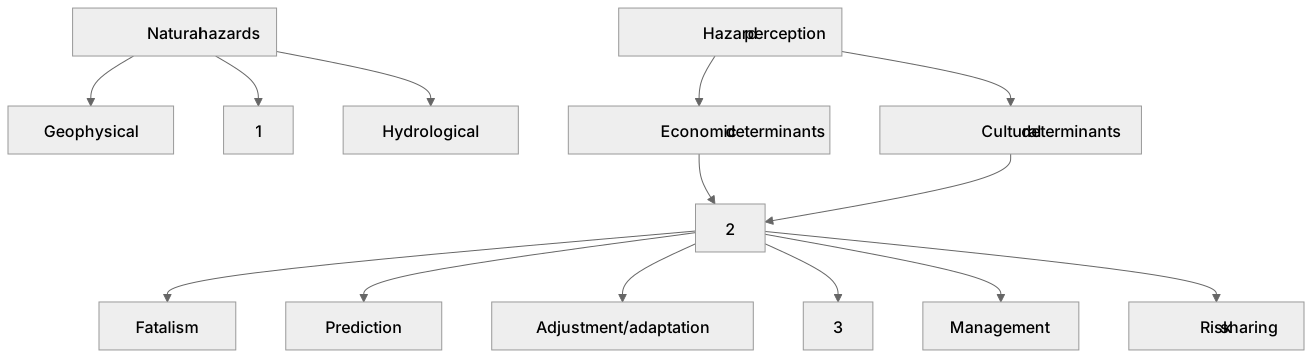
1Box 1
2Box 2
3Box 3
There is more to this lesson
The full lesson goes on to check your understanding and help you earn the marks. Create a free account to carry on, with your progress saved.
A week of Premium from your first lesson · Then the free plan continues · No card, no charge
Test your understanding of The concept of hazard in a geographical context: Nature, forms and potential impacts of natural hazards (geophysical, atmospheric and hydrological). Hazard perception and its economic and cultural determinants. Characteristic human responses – fatalism, prediction, adjustment/adaptation, mitigation, management, risk sharing – and their relationship to hazard incidence, intensity, magnitude, distribution and level of development. The Park model of human response to hazards. The Hazard Management Cycle.
Active recall beats re-reading. Take an instant quiz now to test what you’ve learned and lock it into long-term memory.
A week of Premium from your first lesson · Then the free plan continues · No card, no charge