AQA · A-Level · Geography
Course version: 7037 · Version from Sept 2018
The concept of the ‘global commons’. The rights of all to the benefits of…
Full specification wording
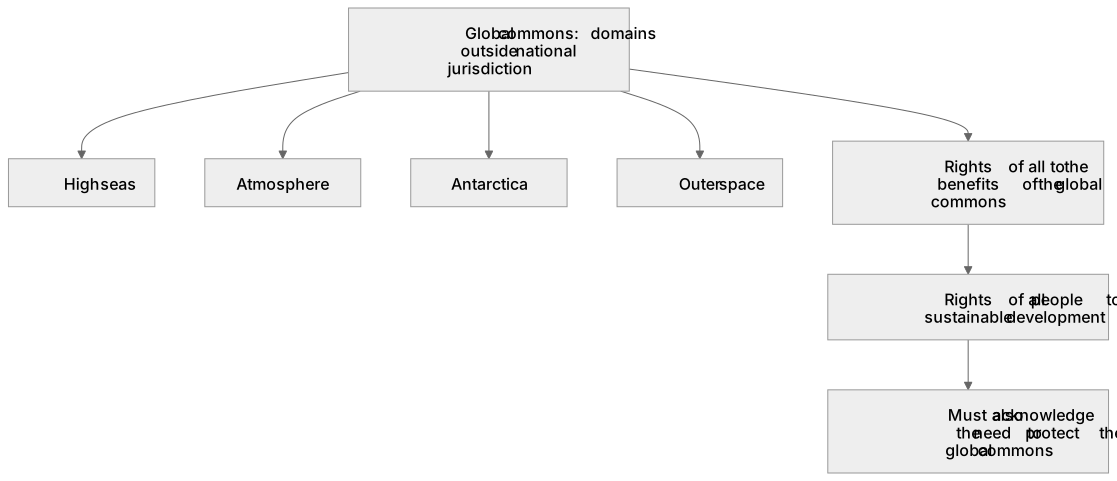
The 'global commons': The concept of the ‘global commons’. The rights of all to the benefits of the global commons. Acknowledgement that the rights of all people to sustainable development must also acknowledge the need to protect the global commons.
The 'global commons' refers to resource domains outside the political reach of any single nation, namely the high seas, the atmosphere, Antarctica, and outer space.
Checked against the AQA 7037 specification (opens in a new tab) on .
- 3 key terms
Study notes
From the checked teaching notes for this specification point.
The idea
The 'global commons' refers to resource domains outside the political reach of any single nation, namely the high seas, the atmosphere, Antarctica, and outer space. International law establishes the rights of all humanity to share the benefits of these commons, such as scientific research or marine resources. However, acknowledging the rights of all people to sustainable development requires balancing economic progress with environmental stewardship. To ensure future generations can achieve sustainable development, global governance frameworks, like the Antarctic Treaty System, must strictly protect the global commons from irreversible degradation, preventing the tragedy of the commons where shared resources are overexploited.
What earns the marks
- Define the global commons as the four domains outside national jurisdiction: the high seas, the atmosphere, Antarctica, and outer space.
- Explain the principle of the 'common heritage of mankind', which asserts that the benefits of the global commons belong to all people.
- Discuss the tension between the right to sustainable development and the risk of overexploiting shared global resources.
- Evaluate the necessity of international treaties and governance frameworks in protecting the global commons for future generations.
Common mistakes and how to put them right
Confusing the global commons with general global resources like rainforests.
Put it right: Restrict the definition to the four specific domains outside national borders (high seas, atmosphere, Antarctica, outer space).
Assuming sustainable development only applies to national territories.
Put it right: Recognise that sustainable development relies heavily on the health and protection of the global commons.
Misunderstanding the 'tragedy of the commons'.
Put it right: Explain it as the depletion of a shared resource by individuals acting in their own self-interest, rather than just general pollution.
Exam tips
- Memorise the four global commons and use them as concrete examples when discussing international protection efforts.
- Link the concept of the global commons to the 'tragedy of the commons' to explain why governance and protection are essential.
- Use the Antarctic Treaty System or the UN Convention on the Law of the Sea (UNCLOS) to illustrate how the rights to benefits are balanced with protection.
Try the lesson
The start of the The 'global commons': The concept of the ‘global commons’. The rights of all to the benefits of the global commons. Acknowledgement that the rights of all people to sustainable development must also acknowledge the need to protect the global commons. lesson, made from checked teaching notes for this specification point.
Have a go first
Which of the following areas is officially recognised in international law as part of the 'global commons'?
Listen
The 'global commons' refers to resource domains outside the political reach of any single nation, namely the high seas, the atmosphere, Antarctica, and outer space. International law establishes the rights of all humanity to share the benefits of these commons, such as scientific research or marine resources. However, acknowledging the rights of all people to sustainable development requires balancing economic progress with environmental stewardship. To ensure future generations can achieve sustainable development, global governance frameworks, like the Antarctic Treaty System, must strictly protect the global commons from irreversible degradation, preventing the tragedy of the commons where shared resources are overexploited. A strong answer earns marks for these points. Define the global commons as the four domains outside national jurisdiction: the high seas, the atmosphere, Antarctica, and outer space. Explain the principle of the 'common heritage of mankind', which asserts that the benefits of the global commons belong to all people. Discuss the tension between the right to sustainable development and the risk of overexploiting shared global resources. Evaluate the necessity of international treaties and governance frameworks in protecting the global commons for future generations. A common slip: Confusing the global commons with general global resources like rainforests. Instead, restrict the definition to the four specific domains outside national borders (high seas, atmosphere, Antarctica, outer space). Exam tip: Memorise the four global commons and use them as concrete examples when discussing international protection efforts.
See it
Key words
Say what each word means before you turn the card.
The tragedy of the commons
Try answering aloud or in your head before turning the card.
International law and treaties
Try answering aloud or in your head before turning the card.
Sustainability and conservation
Try answering aloud or in your head before turning the card.
See every definition
- The tragedy of the commons
- The depletion of a shared resource by individuals acting in their own self-interest, where shared resources are overexploited.
- International law and treaties
- Frameworks that establish the rights of all humanity to share the benefits of the global commons, such as scientific research or marine resources.
- Sustainability and conservation
- Balancing economic progress with environmental stewardship so that future generations can achieve sustainable development.
Label the diagram
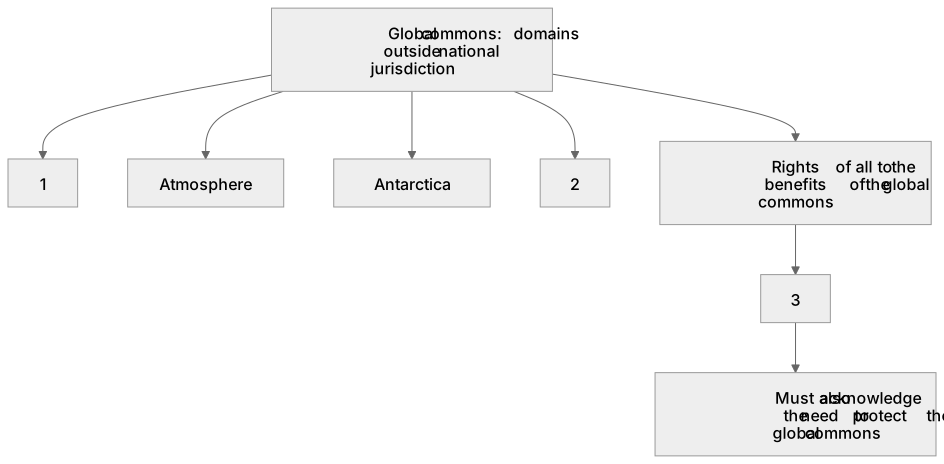
Some boxes have lost their names. Pick the right name for each number.
1Box 1
2Box 2
3Box 3
There is more to this lesson
The full lesson goes on to check your understanding and help you earn the marks. Create a free account to carry on, with your progress saved.
A week of Premium from your first lesson · Then the free plan continues · No card, no charge
Test your understanding of The 'global commons': The concept of the ‘global commons’. The rights of all to the benefits of the global commons. Acknowledgement that the rights of all people to sustainable development must also acknowledge the need to protect the global commons.
Active recall beats re-reading. Take an instant quiz now to test what you’ve learned and lock it into long-term memory.
A week of Premium from your first lesson · Then the free plan continues · No card, no charge