AQA · A-Level · Geography
Course version: 7037 · Version from Sept 2018
The global distribution of cold environments.
Full specification wording
The nature and distribution of cold environments: The global distribution of cold environments.
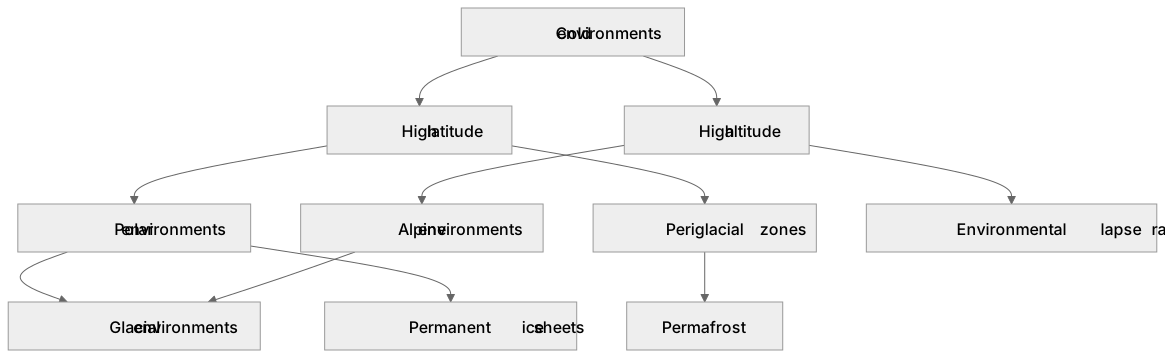
Cold environments are globally distributed across high latitudes and high altitudes, encompassing polar, periglacial, alpine, and glacial regions.
Checked against the AQA 7037 specification (opens in a new tab) on .
- Point 1 of 3
- 3 key terms
Study notes
From the checked teaching notes for this specification point.
The idea
Cold environments are globally distributed across high latitudes and high altitudes, encompassing polar, periglacial, alpine, and glacial regions. Polar environments, such as Antarctica and Greenland, dominate latitudes above 66.5° north and south, characterised by permanent ice sheets. Periglacial zones, featuring permafrost, fringe these polar regions across northern Canada, Alaska, and Siberia. Alpine environments are found at high altitudes regardless of latitude, such as the Himalayas, Andes, and Alps, where temperature decreases with elevation (the environmental lapse rate). Glacial environments exist within both polar and alpine regions where snow accumulation exceeds ablation, forming moving ice masses.
What earns the marks
- Identify high latitude locations (above 66.5° north and south) as the primary zones for polar and periglacial environments.
- Identify high altitude locations, such as the Andes or Himalayas, as the primary zones for alpine environments.
- Explain the role of latitude in reducing insolation intensity, which creates the climatic conditions necessary for polar cold environments.
- Explain the role of altitude and the environmental lapse rate in creating cold environments at lower latitudes, including near the equator.
Common mistakes and how to put them right
Assuming cold environments only exist at the poles.
Put it right: Recognise that alpine cold environments exist at all latitudes, including the equator, due to high altitude.
Confusing glacial and periglacial distributions.
Put it right: Glacial environments are covered by permanent ice, whereas periglacial environments are found on the fringes of ice masses and are characterised by permafrost rather than surface ice.
Stating that Antarctica is a periglacial environment.
Put it right: Antarctica is primarily a glacial and polar environment covered by an ice sheet; periglacial environments are mostly found in the northern hemisphere, such as in Siberia.
Exam tips
- Use specific geographical examples, such as the Himalayas for alpine or Siberia for periglacial, when describing global distributions.
- Link the distribution of cold environments to physical drivers like the angle of solar incidence and the environmental lapse rate to add depth to your answers.
- Be prepared to annotate or interpret global maps showing the extent of permafrost, ice sheets, or major mountain ranges.
Try the lesson
The start of the The nature and distribution of cold environments: The global distribution of cold environments. lesson, made from checked teaching notes for this specification point.
Have a go first
Which of the following best describes the primary global distribution of periglacial environments?
Listen
Cold environments are globally distributed across high latitudes and high altitudes, encompassing polar, periglacial, alpine, and glacial regions. Polar environments, such as Antarctica and Greenland, dominate latitudes above 66.5° north and south, characterised by permanent ice sheets. Periglacial zones, featuring permafrost, fringe these polar regions across northern Canada, Alaska, and Siberia. Alpine environments are found at high altitudes regardless of latitude, such as the Himalayas, Andes, and Alps, where temperature decreases with elevation (the environmental lapse rate). Glacial environments exist within both polar and alpine regions where snow accumulation exceeds ablation, forming moving ice masses. A strong answer earns marks for these points. Identify high latitude locations (above 66.5° north and south) as the primary zones for polar and periglacial environments. Identify high altitude locations, such as the Andes or Himalayas, as the primary zones for alpine environments. Explain the role of latitude in reducing insolation intensity, which creates the climatic conditions necessary for polar cold environments. Explain the role of altitude and the environmental lapse rate in creating cold environments at lower latitudes, including near the equator. A common slip: Assuming cold environments only exist at the poles. Instead, Recognise that alpine cold environments exist at all latitudes, including the equator, due to high altitude. Exam tip: Use specific geographical examples, such as the Himalayas for alpine or Siberia for periglacial, when describing global distributions.
See it
Key words
Say what each word means before you turn the card.
Spatial distribution
Try answering aloud or in your head before turning the card.
Latitude and altitude
Try answering aloud or in your head before turning the card.
Environmental classification
Try answering aloud or in your head before turning the card.
See every definition
- Spatial distribution
- The global spread of polar, periglacial, alpine and glacial environments across high latitudes and high altitudes.
- Latitude and altitude
- The two physical factors determining where cold environments are located, with polar and periglacial zones at high latitudes and alpine zones at high altitudes.
- Environmental classification
- The division of cold environments into polar, periglacial, alpine and glacial regions according to their defining features.
Label the diagram
Some boxes have lost their names. Pick the right name for each number.
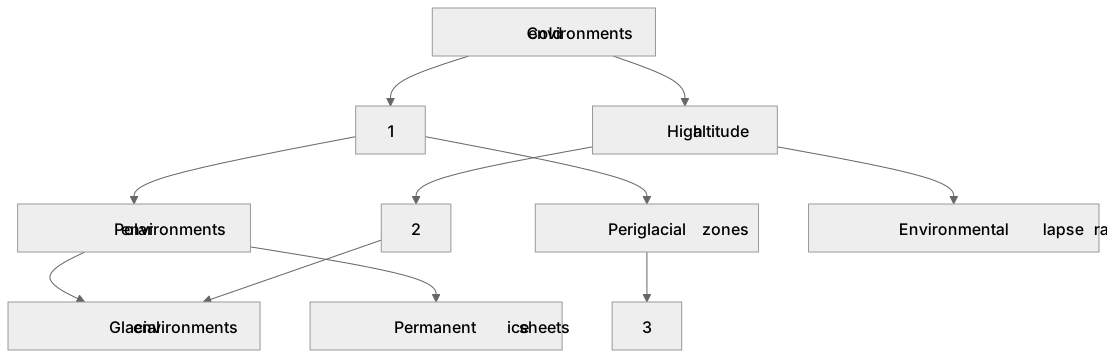
1Box 1
2Box 2
3Box 3
There is more to this lesson
The full lesson goes on to check your understanding and help you earn the marks. Create a free account to carry on, with your progress saved.
A week of Premium from your first lesson · Then the free plan continues · No card, no charge
Test your understanding of The nature and distribution of cold environments: The global distribution of cold environments.
Active recall beats re-reading. Take an instant quiz now to test what you’ve learned and lock it into long-term memory.
A week of Premium from your first lesson · Then the free plan continues · No card, no charge