AQA · A-Level · Geography
Course version: 7037 · Version from Sept 2018
New urban landscapes: town centre mixed developments, cultural and…
Full specification wording
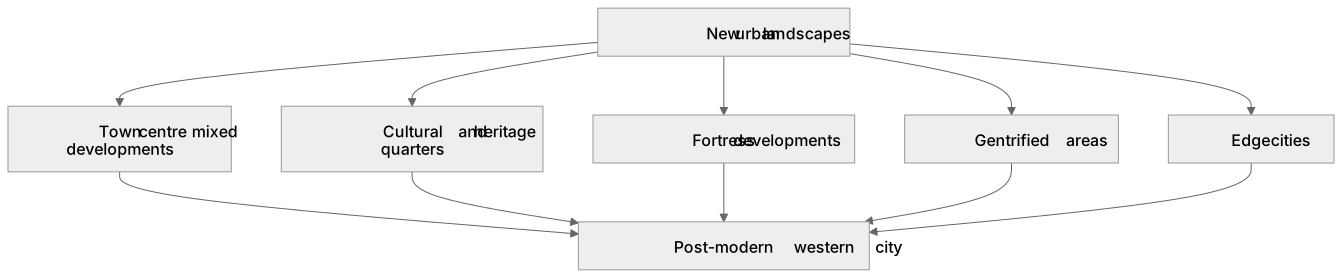
Urban forms: New urban landscapes: town centre mixed developments, cultural and heritage quarters, fortress developments, gentrified areas, edge cities. The concept of the post-modern western city.
Contemporary urban landscapes reflect shifting priorities.
Checked against the AQA 7037 specification (opens in a new tab) on .
- Point 2 of 2
- 2 key terms
Study notes
From the checked teaching notes for this specification point.
The idea
Contemporary urban landscapes reflect shifting priorities. Town centre mixed developments blend residential, commercial, and leisure spaces to revitalise cores. Cultural and heritage quarters use arts and history to attract investment. Fortress developments employ defensive architecture to create secure, exclusive spaces. Gentrified areas see affluent groups displace lower-income residents, upgrading housing but reducing affordability. Edge cities are decentralised hubs of retail and office space on urban fringes, like Century City, LA. These elements culminate in the post-modern western city, characterised by fragmented urban forms, eclectic architecture, and a focus on consumption and services rather than industrial production.
What earns the marks
- Define and identify characteristics of town centre mixed developments and cultural or heritage quarters as urban regeneration strategies.
- Explain the socio-economic impacts of gentrification, including physical upgrading and the displacement of original residents.
- Describe the features of fortress developments, such as gated communities and CCTV, and their role in social segregation.
- Outline the formation of edge cities as a result of decentralisation and car-dependent urban sprawl.
- Analyse the characteristics of a post-modern western city, including fragmented urban structure, eclectic architecture, and consumption-driven economies.
Common mistakes and how to put them right
Confusing edge cities with standard suburbs.
Put it right: Edge cities contain substantial commercial and retail functions, not just housing.
Assuming gentrification is universally beneficial.
Put it right: It often leads to the displacement of low-income communities and loss of local culture.
Treating post-modernism merely as an architectural style.
Put it right: It also encompasses the economic shift towards services and the fragmentation of urban social structures.
Exam tips
- Use specific, named examples for each type of new urban landscape to support your explanations.
- When discussing fortress developments, evaluate their impact on social cohesion and spatial polarisation.
- Link the concept of the post-modern city to broader processes of deindustrialisation and globalisation.
Try the lesson
The start of the Urban forms: New urban landscapes: town centre mixed developments, cultural and heritage quarters, fortress developments, gentrified areas, edge cities. The concept of the post-modern western city. lesson, made from checked teaching notes for this specification point.
Have a go first
What is the defining characteristic of an 'edge city' in a new urban landscape?
Listen
Contemporary urban landscapes reflect shifting priorities. Town centre mixed developments blend residential, commercial, and leisure spaces to revitalise cores. Cultural and heritage quarters use arts and history to attract investment. Fortress developments employ defensive architecture to create secure, exclusive spaces. Gentrified areas see affluent groups displace lower-income residents, upgrading housing but reducing affordability. Edge cities are decentralised hubs of retail and office space on urban fringes, like Century City, LA. These elements culminate in the post-modern western city, characterised by fragmented urban forms, eclectic architecture, and a focus on consumption and services rather than industrial production. A strong answer earns marks for these points. Define and identify characteristics of town centre mixed developments and cultural or heritage quarters as urban regeneration strategies. Explain the socio-economic impacts of gentrification, including physical upgrading and the displacement of original residents. Describe the features of fortress developments, such as gated communities and CCTV, and their role in social segregation. Outline the formation of edge cities as a result of decentralisation and car-dependent urban sprawl. Exam tip: Use specific, named examples for each type of new urban landscape to support your explanations.
See it
Key words
Say what each word means before you turn the card.
Urban regeneration
Try answering aloud or in your head before turning the card.
Post-modernism
Try answering aloud or in your head before turning the card.
See every definition
- Urban regeneration
- Strategies such as town centre mixed developments and cultural or heritage quarters that blend spaces or use arts and history to attract investment and revitalise cores.
- Post-modernism
- More than an architectural style, it encompasses the economic shift towards services and the fragmentation of urban social structures.
Label the diagram
Some boxes have lost their names. Pick the right name for each number.
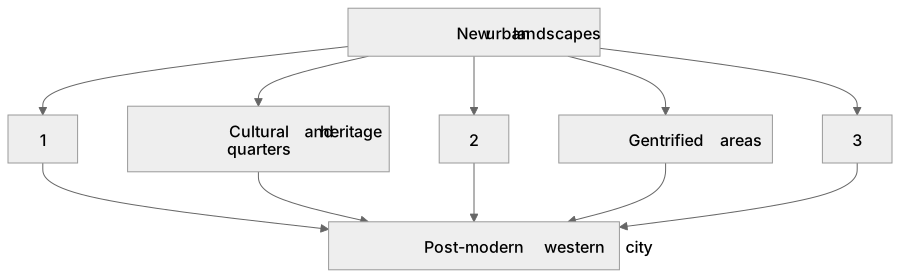
1Box 1
2Box 2
3Box 3
There is more to this lesson
The full lesson goes on to check your understanding and help you earn the marks. Create a free account to carry on, with your progress saved.
A week of Premium from your first lesson · Then the free plan continues · No card, no charge
Test your understanding of Urban forms: New urban landscapes: town centre mixed developments, cultural and heritage quarters, fortress developments, gentrified areas, edge cities. The concept of the post-modern western city.
Active recall beats re-reading. Take an instant quiz now to test what you’ve learned and lock it into long-term memory.
A week of Premium from your first lesson · Then the free plan continues · No card, no charge