AQA · A-Level · Geography
Course version: 7037 · Version from Sept 2018
Urbanisation and its importance in human affairs. Global patterns of…
Full specification wording
Urbanisation: Urbanisation and its importance in human affairs. Global patterns of urbanisation since 1945. Urbanisation, suburbanisation, counter-urbanisation, urban resurgence. The emergence of megacities and world cities and their role in global and regional economies.
Urbanisation profoundly shapes human affairs, driving economic growth and social change.
Checked against the AQA 7037 specification (opens in a new tab) on .
- Point 1 of 4
- 4 key terms
Study notes
From the checked teaching notes for this specification point.
The idea
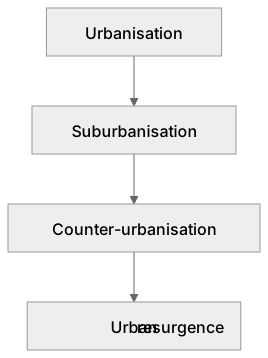
Urbanisation profoundly shapes human affairs, driving economic growth and social change. Since 1945, global patterns of urbanisation have shifted; while developed nations experienced early growth, recent rapid urbanisation is concentrated in emerging economies. The urban cycle encompasses initial urbanisation, followed by suburbanisation as populations decentralise, counter-urbanisation as people seek rural lifestyles, and urban resurgence driven by inner-city regeneration. This era is defined by the emergence of megacities (populations exceeding ten million) and world cities (hubs of global finance and politics). Both play critical roles in global and regional economies by acting as command centres for trade, innovation, and transnational corporations.
What earns the marks
- Explain the distinct phases of the urban cycle: urbanisation, suburbanisation, counter-urbanisation, and urban resurgence, using specific case studies.
- Analyse the shift in global patterns of urbanisation since 1945, contrasting the stabilised rates in HICs with the rapid urban growth in LICs and NEEs.
- Distinguish between megacities (defined by a population over 10 million) and world cities (defined by their global economic and political influence).
- Evaluate the role of world cities as command and control centres in the global economy, focusing on their concentration of financial services and transnational corporations.
Common mistakes and how to put them right
Using the terms megacity and world city interchangeably.
Put it right: Define megacities by their population size (over 10 million) and world cities by their global economic and political influence, noting that a city can be one without being the other.
Confusing suburbanisation with counter-urbanisation.
Put it right: Specify that suburbanisation is the outward growth of a city into its fringes, whereas counter-urbanisation involves migration beyond the rural-urban fringe into distinct rural settlements.
Assuming urbanisation rates are currently highest in HICs.
Put it right: State that while HICs are highly urbanised, the fastest rates of urbanisation since 1945 are occurring in LICs and NEEs.
Exam tips
- Use specific examples of urban resurgence, such as the regeneration of East London or Manchester, to illustrate how deindustrialised areas attract new investment and populations.
- When discussing the importance of urbanisation in human affairs, link demographic shifts to economic development, social inequality, and environmental challenges.
- Clearly articulate how world cities drive regional economies by acting as hubs for foreign direct investment, transport networks, and skilled labour migration.
Try the lesson
The start of the Urbanisation: Urbanisation and its importance in human affairs. Global patterns of urbanisation since 1945. Urbanisation, suburbanisation, counter-urbanisation, urban resurgence. The emergence of megacities and world cities and their role in global and regional economies. lesson, made from checked teaching notes for this specification point.
Have a go first
Which of the following best describes the process of counter-urbanisation?
Listen
Urbanisation profoundly shapes human affairs, driving economic growth and social change. Since 1945, global patterns of urbanisation have shifted; while developed nations experienced early growth, recent rapid urbanisation is concentrated in emerging economies. The urban cycle encompasses initial urbanisation, followed by suburbanisation as populations decentralise, counter-urbanisation as people seek rural lifestyles, and urban resurgence driven by inner-city regeneration. This era is defined by the emergence of megacities (populations exceeding ten million) and world cities (hubs of global finance and politics). Both play critical roles in global and regional economies by acting as command centres for trade, innovation, and transnational corporations. A strong answer earns marks for these points. Explain the distinct phases of the urban cycle: urbanisation, suburbanisation, counter-urbanisation, and urban resurgence, using specific case studies. Analyse the shift in global patterns of urbanisation since 1945, contrasting the stabilised rates in HICs with the rapid urban growth in LICs and NEEs. Distinguish between megacities (defined by a population over 10 million) and world cities (defined by their global economic and political influence). Evaluate the role of world cities as command and control centres in the global economy, focusing on their concentration of financial services and transnational corporations. A common slip: Using the terms megacity and world city interchangeably. Instead, define megacities by their population size (over 10 million) and world cities by their global economic and political influence, noting that a city can be one without being the other. Exam tip: Use specific examples of urban resurgence, such as the regeneration of East London or Manchester, to illustrate how deindustrialised areas attract new investment and populations.
See it
Put it in order
Put these steps in the order they happen.
- 1. Counter-urbanisation
- 2. Urban resurgence
- 3. Suburbanisation
- 4. Urbanisation
Key words
Say what each word means before you turn the card.
Urbanisation
Try answering aloud or in your head before turning the card.
Suburbanisation
Try answering aloud or in your head before turning the card.
Counter-urbanisation
Try answering aloud or in your head before turning the card.
Urban resurgence
Try answering aloud or in your head before turning the card.
See every definition
- Urbanisation
- The initial phase of the urban cycle, in which populations concentrate in cities and which profoundly shapes human affairs by driving economic growth and social change.
- Suburbanisation
- The phase of the urban cycle in which populations decentralise through the outward growth of a city into its fringes.
- Counter-urbanisation
- The phase of the urban cycle in which people migrate beyond the rural-urban fringe into distinct rural settlements, seeking rural lifestyles.
- Urban resurgence
- The phase of the urban cycle driven by inner-city regeneration, in which deindustrialised areas attract new investment and populations.
Label the diagram
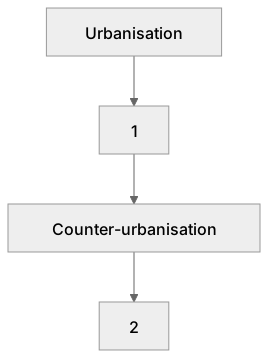
Some boxes have lost their names. Pick the right name for each number.
1Box 1
2Box 2
There is more to this lesson
The full lesson goes on to check your understanding and help you earn the marks. Create a free account to carry on, with your progress saved.
A week of Premium from your first lesson · Then the free plan continues · No card, no charge
Test your understanding of Urbanisation: Urbanisation and its importance in human affairs. Global patterns of urbanisation since 1945. Urbanisation, suburbanisation, counter-urbanisation, urban resurgence. The emergence of megacities and world cities and their role in global and regional economies.
Active recall beats re-reading. Take an instant quiz now to test what you’ve learned and lock it into long-term memory.
A week of Premium from your first lesson · Then the free plan continues · No card, no charge