AQA · A-Level · Geography
Course version: 7037 · Version from Sept 2018
Strategies to increase water supply to include catchment, diversion,…
Full specification wording
Water security: Strategies to increase water supply to include catchment, diversion, storage and water transfers and desalination.
To combat water insecurity, various strategies are employed to increase supply.
Checked against the AQA 7037 specification (opens in a new tab) on .
- Point 2 of 6
- 4 key terms
Study notes
From the checked teaching notes for this specification point.
The idea
To combat water insecurity, various strategies are employed to increase supply. Catchment involves collecting precipitation directly, often through rooftop harvesting or land contouring. Diversion redirects surface water from rivers to agricultural or urban areas, while storage utilises dams and reservoirs to hold water during surplus periods for use during deficits. Water transfers operate on a larger scale, moving water from basins with a surplus to those with a deficit, such as China's South-North Water Transfer Project. Desalination removes dissolved salts from seawater using reverse osmosis, providing a climate-independent freshwater source for arid, coastal nations, though it requires significant energy inputs and produces hypersaline brine.
What earns the marks
- Describe catchment strategies, such as rainwater harvesting, which collect precipitation before it becomes surface runoff.
- Explain how diversion and storage systems, including dams and reservoirs, manage seasonal variations in water availability.
- Evaluate the socio-economic and environmental impacts of large-scale water transfer schemes moving water from surplus to deficit basins.
- Analyse the process of desalination, highlighting its role in providing climate-independent water supplies alongside its high energy costs.
Common mistakes and how to put them right
Confusing water diversion with water transfer.
Put it right: Diversion typically redirects water locally for immediate use, whereas transfers move water between entirely different drainage basins.
Assuming desalination is a universal solution; failing to acknowledge that its high energy cost and coastal requirement limit its viability for landlocked or low-income countries.
Overlooking the environmental impacts of storage; students often forget that dams disrupt sediment transport and aquatic ecosystems.
Exam tips
- Memorise a specific, named example for a large-scale water transfer scheme, such as the Lesotho Highlands Water Project, to support your evaluation.
- When discussing desalination, explicitly mention reverse osmosis and the environmental challenge of disposing of hypersaline brine.
- Compare the sustainability of different strategies, contrasting the low environmental impact of local catchment with the high ecological footprint of mega-dams.
Try the lesson
The start of the Water security: Strategies to increase water supply to include catchment, diversion, storage and water transfers and desalination. lesson, made from checked teaching notes for this specification point.
Have a go first
Which strategy to increase water supply involves the removal of dissolved salts and minerals from seawater to produce fresh water?
Listen
To combat water insecurity, various strategies are employed to increase supply. Catchment involves collecting precipitation directly, often through rooftop harvesting or land contouring. Diversion redirects surface water from rivers to agricultural or urban areas, while storage utilises dams and reservoirs to hold water during surplus periods for use during deficits. Water transfers operate on a larger scale, moving water from basins with a surplus to those with a deficit, such as China's South-North Water Transfer Project. Desalination removes dissolved salts from seawater using reverse osmosis, providing a climate-independent freshwater source for arid, coastal nations, though it requires significant energy inputs and produces hypersaline brine. A strong answer earns marks for these points. Describe catchment strategies, such as rainwater harvesting, which collect precipitation before it becomes surface runoff. Explain how diversion and storage systems, including dams and reservoirs, manage seasonal variations in water availability. Evaluate the socio-economic and environmental impacts of large-scale water transfer schemes moving water from surplus to deficit basins. Analyse the process of desalination, highlighting its role in providing climate-independent water supplies alongside its high energy costs. Exam tip: Memorise a specific, named example for a large-scale water transfer scheme, such as the Lesotho Highlands Water Project, to support your evaluation.
See it

Key words
Say what each word means before you turn the card.
Catchment
Try answering aloud or in your head before turning the card.
Diversion
Try answering aloud or in your head before turning the card.
Water transfers
Try answering aloud or in your head before turning the card.
Desalination
Try answering aloud or in your head before turning the card.
See every definition
- Catchment
- Collecting precipitation directly, often through rooftop harvesting or land contouring, before it becomes surface runoff.
- Diversion
- Redirecting surface water from rivers to agricultural or urban areas for immediate local use.
- Water transfers
- Moving water on a larger scale from basins with a surplus to those with a deficit.
- Desalination
- Removing dissolved salts from seawater using reverse osmosis to provide a climate-independent freshwater source for arid, coastal nations.
Label the diagram
Some boxes have lost their names. Pick the right name for each number.
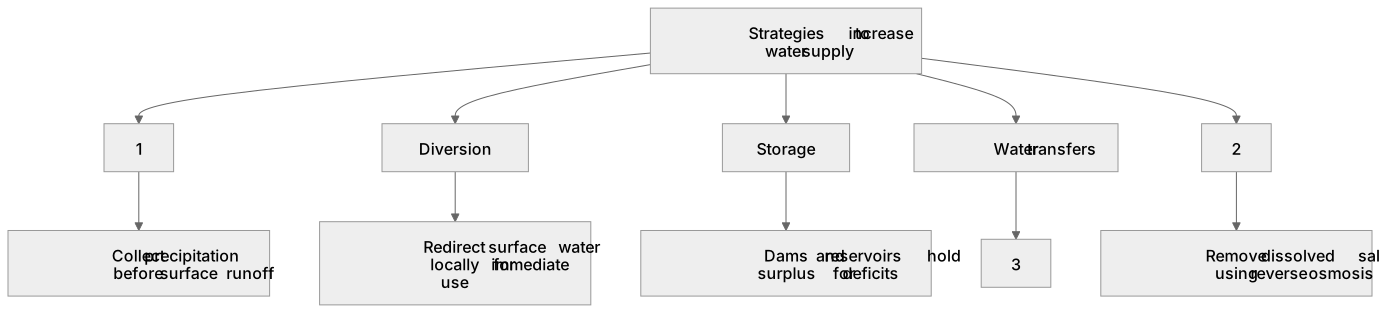
1Box 1
2Box 2
3Box 3
There is more to this lesson
The full lesson goes on to check your understanding and help you earn the marks. Create a free account to carry on, with your progress saved.
A week of Premium from your first lesson · Then the free plan continues · No card, no charge
Test your understanding of Water security: Strategies to increase water supply to include catchment, diversion, storage and water transfers and desalination.
Active recall beats re-reading. Take an instant quiz now to test what you’ve learned and lock it into long-term memory.
A week of Premium from your first lesson · Then the free plan continues · No card, no charge