AQA · A-Level · Geography
Course version: 7037 · Version from Sept 2018
Environmental impacts of a major water supply scheme incorporating a major…
Full specification wording
Water security: Environmental impacts of a major water supply scheme incorporating a major dam and/or barrage and associated distribution networks.
Major water supply schemes, such as the Lesotho Highlands Water Project, involve constructing large dams or barrages and extensive distribution networks like tunnels and canals.
Checked against the AQA 7037 specification (opens in a new tab) on .
- Point 3 of 6
Study notes
From the checked teaching notes for this specification point.
The idea
Major water supply schemes, such as the Lesotho Highlands Water Project, involve constructing large dams or barrages and extensive distribution networks like tunnels and canals. These structures generate significant environmental impacts. Upstream, flooding behind the dam destroys terrestrial habitats and displaces wildlife, while decomposing submerged vegetation releases methane. Downstream, altered flow regimes and reduced sediment loads disrupt aquatic ecosystems and increase riverbed erosion. Furthermore, constructing the associated distribution networks fragments habitats and scars landscapes. The sheer mass of stored water can even trigger reservoir-induced seismicity, highlighting the profound ecological footprint of such large-scale engineering.
What earns the marks
- Identify specific upstream impacts, such as habitat loss due to reservoir flooding and greenhouse gas emissions from decaying vegetation.
- Explain downstream impacts, including altered hydrological regimes, reduced sediment transport, and subsequent coastal or riverbank erosion.
- Evaluate the ecological disruption caused by associated distribution networks, such as habitat fragmentation from canals and pipelines.
- Assess broader environmental consequences, such as changes to local microclimates or reservoir-induced seismicity.
Common mistakes and how to put them right
Focusing solely on human or economic impacts (e.g., displacement of people) instead of the required environmental impacts.
Put it right: Ensure answers explicitly address ecological and physical changes.
Ignoring the 'associated distribution networks' clause.
Put it right: To discuss the environmental footprint of the canals, pipelines, or tunnels that transport the water.
Assuming all environmental impacts are upstream of the dam.
Put it right by evaluating downstream effects like reduced sediment yield and altered flow regimes.
Exam tips
- Use a specific, named case study (e.g., Three Gorges Dam or Lesotho Highlands Water Project) to provide concrete evidence of environmental impacts.
- Categorise impacts spatially (upstream, downstream, and along distribution routes) to structure your evaluation logically.
- Link physical changes in the river system, such as reduced discharge, directly to ecological consequences like the loss of aquatic biodiversity.
Try the lesson
The start of the Water security: Environmental impacts of a major water supply scheme incorporating a major dam and/or barrage and associated distribution networks. lesson, made from checked teaching notes for this specification point.
Have a go first
Which of the following is a direct environmental impact of constructing a major dam on a river system?
Listen
Major water supply schemes, such as the Lesotho Highlands Water Project, involve constructing large dams or barrages and extensive distribution networks like tunnels and canals. These structures generate significant environmental impacts. Upstream, flooding behind the dam destroys terrestrial habitats and displaces wildlife, while decomposing submerged vegetation releases methane. Downstream, altered flow regimes and reduced sediment loads disrupt aquatic ecosystems and increase riverbed erosion. Furthermore, constructing the associated distribution networks fragments habitats and scars landscapes. The sheer mass of stored water can even trigger reservoir-induced seismicity, highlighting the profound ecological footprint of such large-scale engineering. A strong answer earns marks for these points. Identify specific upstream impacts, such as habitat loss due to reservoir flooding and greenhouse gas emissions from decaying vegetation. Explain downstream impacts, including altered hydrological regimes, reduced sediment transport, and subsequent coastal or riverbank erosion. Evaluate the ecological disruption caused by associated distribution networks, such as habitat fragmentation from canals and pipelines. Assess broader environmental consequences, such as changes to local microclimates or reservoir-induced seismicity. A common slip: Assuming all environmental impacts are upstream of the dam. Instead, evaluating downstream effects like reduced sediment yield and altered flow regimes. Exam tip: Use a specific, named case study (e.g., Three Gorges Dam or Lesotho Highlands Water Project) to provide concrete evidence of environmental impacts.
See it
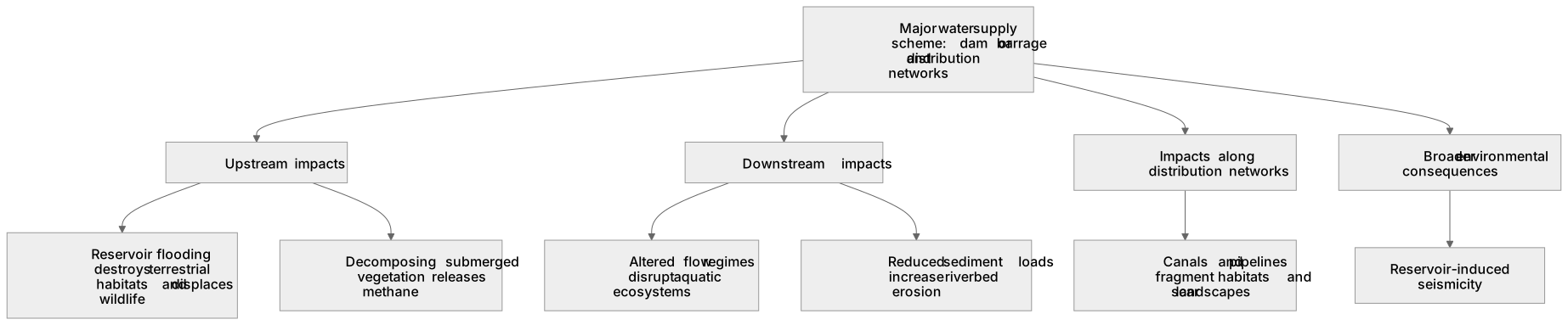
Label the diagram
Some boxes have lost their names. Pick the right name for each number.
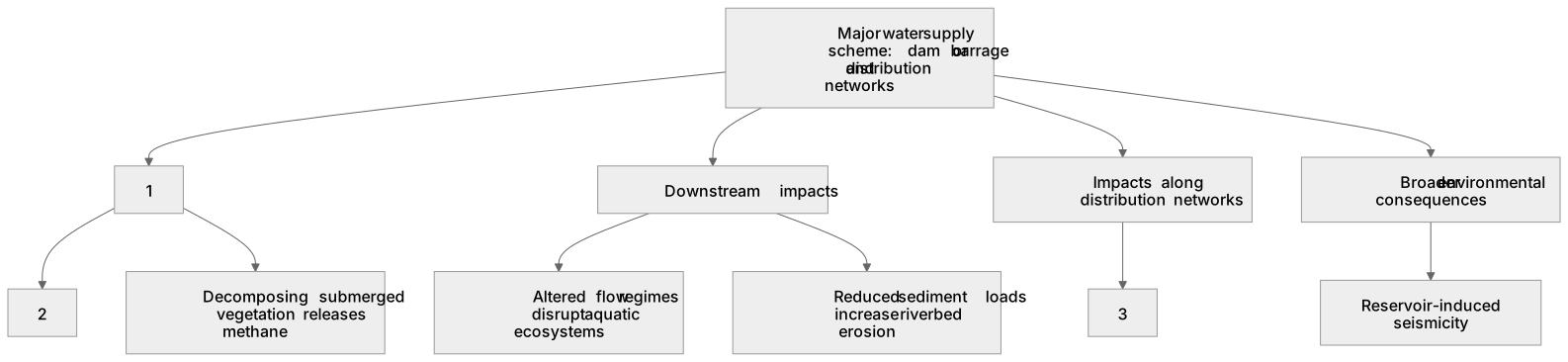
1Box 1
2Box 2
3Box 3
There is more to this lesson
The full lesson goes on to check your understanding and help you earn the marks. Create a free account to carry on, with your progress saved.
A week of Premium from your first lesson · Then the free plan continues · No card, no charge
Test your understanding of Water security: Environmental impacts of a major water supply scheme incorporating a major dam and/or barrage and associated distribution networks.
Active recall beats re-reading. Take an instant quiz now to test what you’ve learned and lock it into long-term memory.
A week of Premium from your first lesson · Then the free plan continues · No card, no charge