AQA · A-Level · Geography
Course version: 7037 · Version from Sept 2018
Strategies to manage water consumption (including reducing demand).
Full specification wording
Water security: Strategies to manage water consumption (including reducing demand).
Managing water consumption is critical for achieving water security and involves strategies that actively reduce demand across domestic, agricultural, and industrial sectors.
Checked against the AQA 7037 specification (opens in a new tab) on .
- Point 4 of 6
Study notes
From the checked teaching notes for this specification point.
The idea
Managing water consumption is critical for achieving water security and involves strategies that actively reduce demand across domestic, agricultural, and industrial sectors. Domestic demand reduction includes installing smart water meters, which financially incentivise conservation, and promoting water-efficient appliances like dual-flush toilets. In agriculture, which accounts for the vast majority of global freshwater use, switching from wasteful flood irrigation to precise drip irrigation significantly lowers consumption. Industrial strategies involve recycling wastewater for cooling processes. Public education campaigns further manage consumption by shifting cultural attitudes towards water use, ensuring long-term behavioural changes that reduce overall extraction.
What earns the marks
- Detail domestic strategies for reducing demand, such as the installation of smart meters and water-efficient household appliances.
- Explain agricultural water management techniques, contrasting inefficient flood irrigation with targeted drip irrigation systems.
- Describe industrial approaches to managing consumption, including the recycling of greywater and closed-loop cooling systems.
- Evaluate the role of governance and education, such as tiered pricing structures and public awareness campaigns, in driving behavioural change.
Common mistakes and how to put them right
Confusing managing consumption with increasing supply (e.g., building desalination plants).
Put it right: Ensure the focus remains strictly on reducing demand and managing use.
Overlooking agricultural and industrial water use.
Put it right by discussing strategies across all sectors, not just domestic household consumption.
Providing generic solutions without specific mechanisms.
Put it right: Of saying 'use less water', specify 'implementing progressive water tariffs to discourage excessive use'.
Exam tips
- Structure your answer by sector (domestic, agricultural, industrial) to ensure comprehensive coverage of consumption management strategies.
- Use specific examples of technologies or policies, such as Singapore's NEWater public education or Israel's drip irrigation innovations.
- Critically evaluate the feasibility of these strategies, noting that cost or cultural resistance can limit the effectiveness of demand reduction initiatives.
Try the lesson
The start of the Water security: Strategies to manage water consumption (including reducing demand). lesson, made from checked teaching notes for this specification point.
Have a go first
Which of the following is a primary strategy used by water companies to directly reduce domestic water consumption?
Listen
Managing water consumption is critical for achieving water security and involves strategies that actively reduce demand across domestic, agricultural, and industrial sectors. Domestic demand reduction includes installing smart water meters, which financially incentivise conservation, and promoting water-efficient appliances like dual-flush toilets. In agriculture, which accounts for the vast majority of global freshwater use, switching from wasteful flood irrigation to precise drip irrigation significantly lowers consumption. Industrial strategies involve recycling wastewater for cooling processes. Public education campaigns further manage consumption by shifting cultural attitudes towards water use, ensuring long-term behavioural changes that reduce overall extraction. A strong answer earns marks for these points. Detail domestic strategies for reducing demand, such as the installation of smart meters and water-efficient household appliances. Explain agricultural water management techniques, contrasting inefficient flood irrigation with targeted drip irrigation systems. Describe industrial approaches to managing consumption, including the recycling of greywater and closed-loop cooling systems. Evaluate the role of governance and education, such as tiered pricing structures and public awareness campaigns, in driving behavioural change. A common slip: Overlooking agricultural and industrial water use. Instead, discussing strategies across all sectors, not just domestic household consumption. Exam tip: Structure your answer by sector (domestic, agricultural, industrial) to ensure comprehensive coverage of consumption management strategies.
See it

Label the diagram
Some boxes have lost their names. Pick the right name for each number.
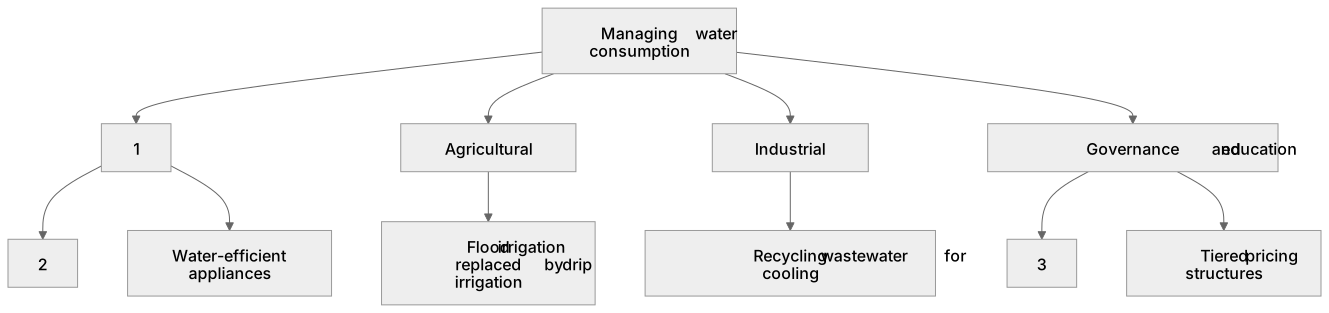
1Box 1
2Box 2
3Box 3
There is more to this lesson
The full lesson goes on to check your understanding and help you earn the marks. Create a free account to carry on, with your progress saved.
A week of Premium from your first lesson · Then the free plan continues · No card, no charge
Test your understanding of Water security: Strategies to manage water consumption (including reducing demand).
Active recall beats re-reading. Take an instant quiz now to test what you’ve learned and lock it into long-term memory.
A week of Premium from your first lesson · Then the free plan continues · No card, no charge