Pearson Edexcel · GCSE · Geography
A range of strategies has been used to try to address uneven development
This study guide unpacks the essential strategies used globally and locally to reduce the development gap between HICs and LICs. You will master the distinction between top-down and bottom-up projects, and evaluate the role of international aid and inter-governmental agreements.
- 5 min read
- 3 worked examples
- 5 practice questions
- 6 key terms
Study Notes
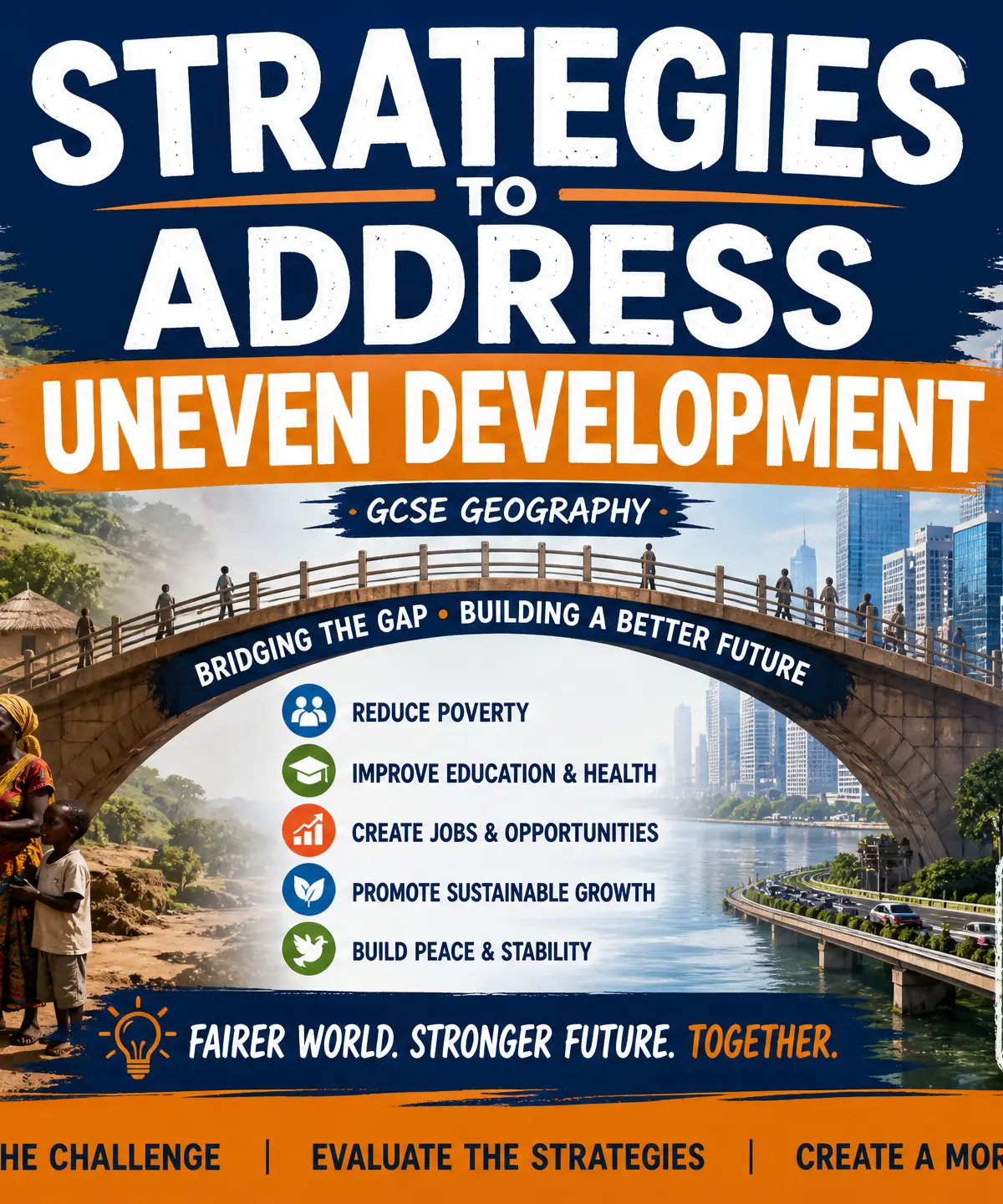
Overview
Uneven development is one of the most pressing challenges of the 21st century. The stark contrast in wealth, health, and living standards between High Income Countries (HICs) and Low Income Countries (LICs) has prompted numerous strategies to try and 'bridge the gap'. Examiners expect candidates to not only describe these strategies but to critically evaluate them, weighing up their advantages and limitations using specific named examples.
This guide covers the two main approaches: international strategies (like aid and inter-governmental agreements) and development projects (top-down vs bottom-up). You will learn how to apply these concepts to exam questions, ensuring you hit the highest mark bands by demonstrating clear, evaluative understanding.
Listen to the podcast episode for a deep dive into these concepts:

International Strategies
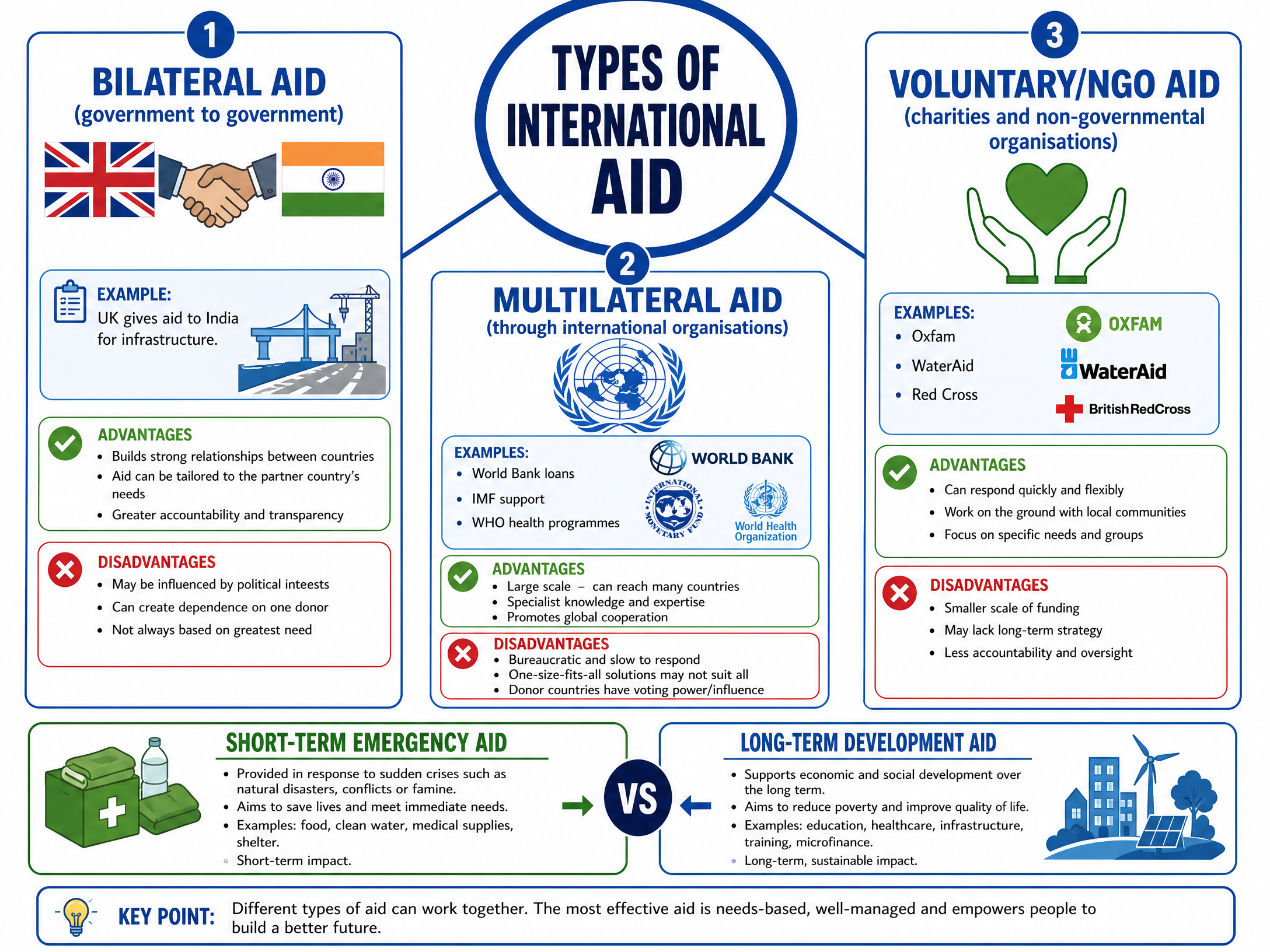
International Aid
What it is: The transfer of resources (money, food, equipment, expertise) from one country or organisation to another.
Types of Aid:
- Bilateral Aid: Government to government (e.g., the UK's Department for International Development giving aid to Pakistan).
- Multilateral Aid: Channeled through international organisations (e.g., the World Bank or United Nations).
- Voluntary/NGO Aid: Provided by charities (e.g., Oxfam, WaterAid).
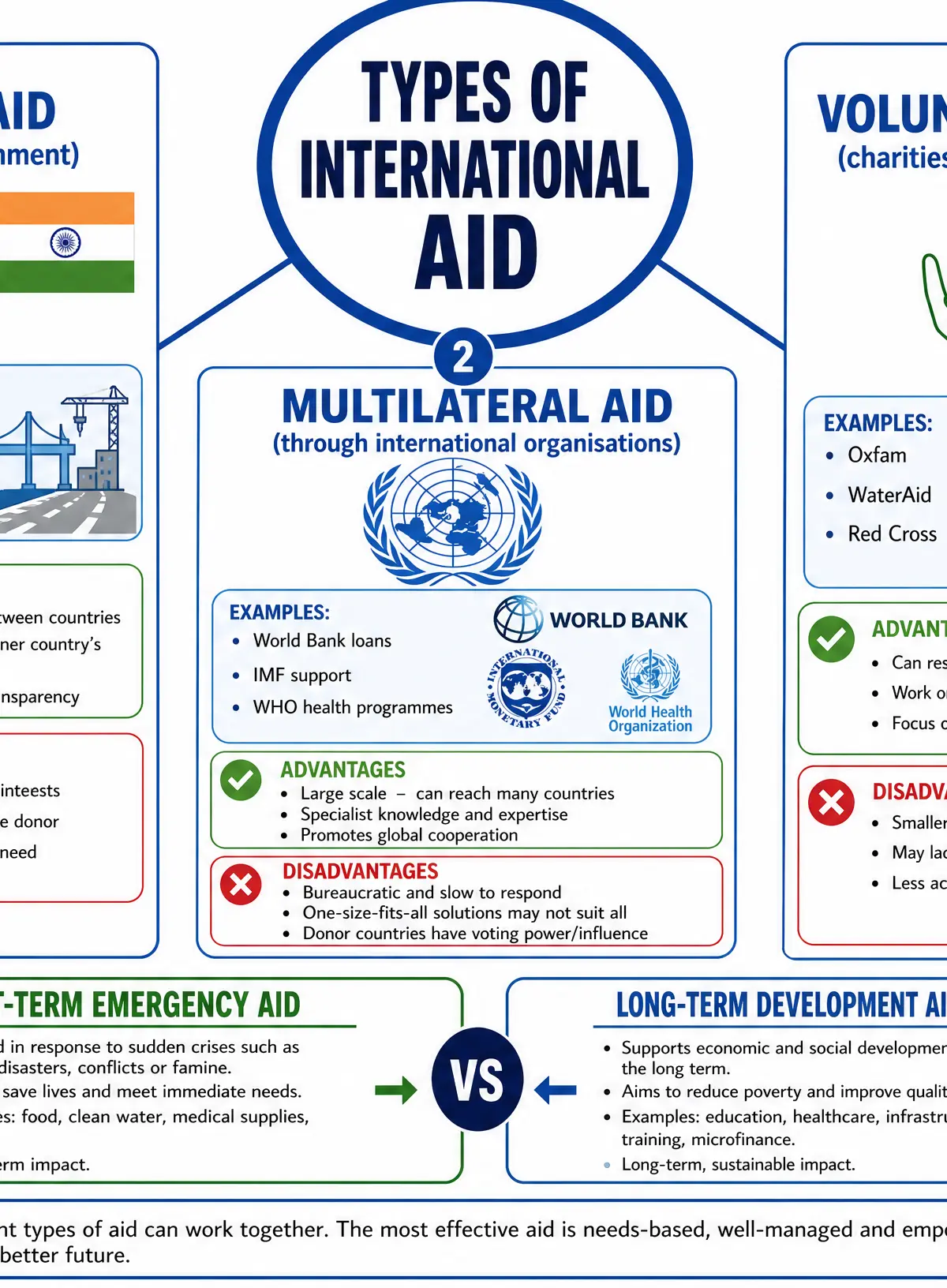
Short-term vs Long-term:
- Short-term emergency aid responds to crises (like the 2010 Haiti earthquake) to save lives.
- Long-term development aid aims to build sustainable infrastructure and services (like funding a new school or hospital).
Evaluation:
- Advantages: Can save lives in emergencies, helps build essential infrastructure, and can improve health and education.
- Limitations: Can create dependency (where a country relies on aid rather than developing its own economy), can be tied to political conditions, and sometimes fails to reach the poorest due to corruption.
Inter-governmental Agreements
What they are: Agreements between nations to work together towards common goals.
Key Example: The United Nations Sustainable Development Goals (SDGs). Agreed in 2015, these 17 goals set targets for 2030, including 'No Poverty', 'Zero Hunger', and 'Quality Education'.
Evaluation:
- Advantages: Provides a unified global target, encourages cooperation, and holds governments accountable.
- Limitations: Targets are not legally binding, and progress has been uneven, often hampered by conflict or economic crises.
Development Projects: Top-Down vs Bottom-Up
Examiners frequently ask candidates to distinguish between and evaluate these two approaches.
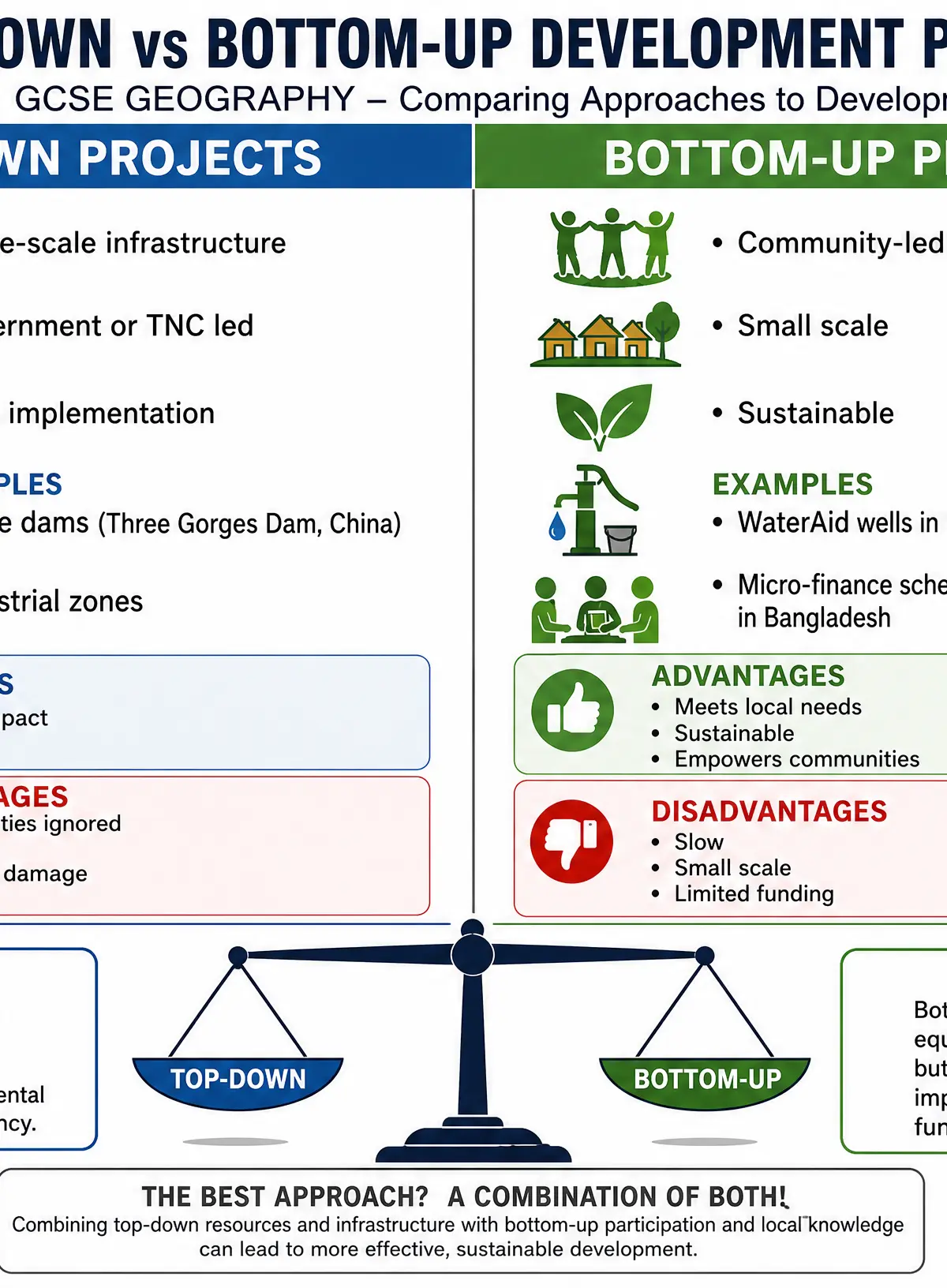
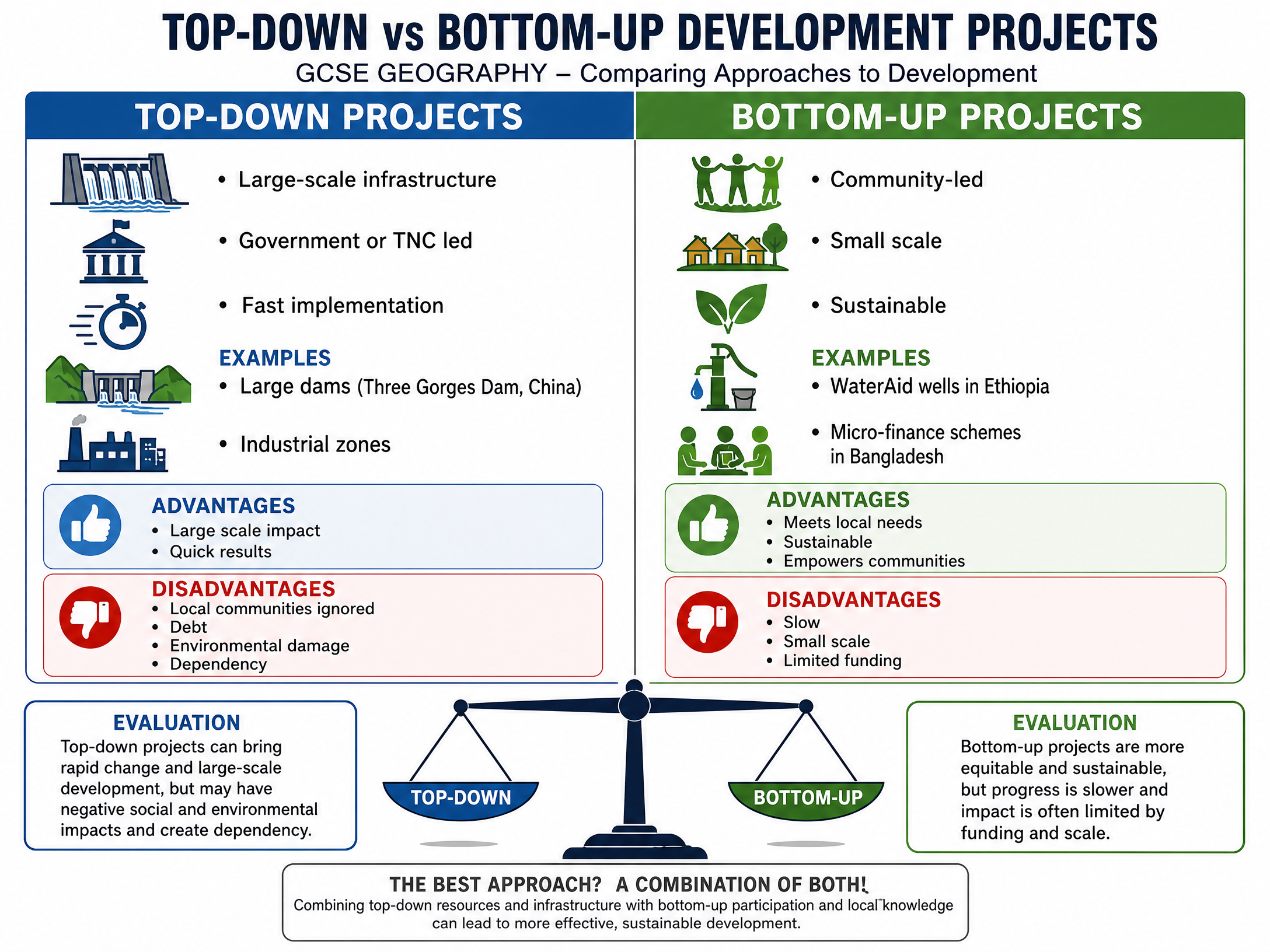
Top-Down Projects
What they are: Large-scale, expensive projects driven by national governments, Transnational Corporations (TNCs), or international organisations like the World Bank. Decisions are made at the 'top' and implemented downwards.
Specific Example: The Three Gorges Dam, China.
- Facts: Completed in 2012, it is the world's largest hydroelectric power station, generating over 22,000 MW of electricity.
Evaluation:
- Advantages: Can generate significant economic growth, provides large-scale infrastructure (like national power grids), and can happen relatively quickly if funding is secured.
- Limitations: Often ignores the needs of local communities (over 1.3 million people were displaced for the Three Gorges Dam), can cause severe environmental damage, and often relies on massive loans, leading to national debt.
Bottom-Up Projects
What they are: Small-scale, community-led initiatives designed to meet local needs. Decisions are made by the people who will directly benefit.
Specific Example: Grameen Bank Micro-finance, Bangladesh.
- Facts: Provides small loans to poor individuals (often women) to start small businesses. Has lent to over 9 million borrowers with excellent repayment rates.
Another Example: WaterAid projects in Ethiopia, where local people are trained to build and maintain hand-pumped wells.
Evaluation:
- Advantages: Highly sustainable as they use appropriate technology, empower local communities (especially women), and directly target the poorest people.
- Limitations: Small scale means they cannot tackle national infrastructure issues (like building a national road network), and they rely heavily on NGO funding which can be inconsistent.
Visual Resources
2 diagrams and illustrations
Interactive Diagrams
1 interactive diagram to visualise key concepts
Conceptual Flow Outline
Overview of Development Strategies
Worked Examples
3 worked examples — open one to explore the question and available guidance.
Practice Questions
Test your understanding — click to reveal model answers
State one characteristic of a bottom-up development project. (1 mark)
Hint: Think about who runs the project or the scale of it.
Explain one disadvantage of top-down development strategies. (2 marks)
Hint: Make a point, then explain the consequence of that point.
Explain how micro-finance can help to reduce the development gap. (4 marks)
Hint: Use the Grameen Bank as an example. How does a small loan lead to long-term change?
Evaluate the use of large-scale infrastructure projects in promoting development. (6 marks)
Hint: Large-scale infrastructure = top-down. Give pros, cons, and a mini-conclusion.
Assess the effectiveness of international aid in improving quality of life in Low Income Countries (LICs). (9 marks)
Hint: Consider short-term vs long-term aid, and bilateral vs voluntary aid.