Pearson Edexcel · GCSE · Geography
Changing geopolitics and technology impact on the chosen developing or emerging country
This study guide explores how India's rapid development is driven by its complex geopolitical relationships and cutting-edge technology. Understanding these forces is crucial for examiners, as it demonstrates how global connections shape inequality and economic growth in an emerging superpower.
- 6 min read
- 3 worked examples
- 5 practice questions
- 6 key terms
Study Notes
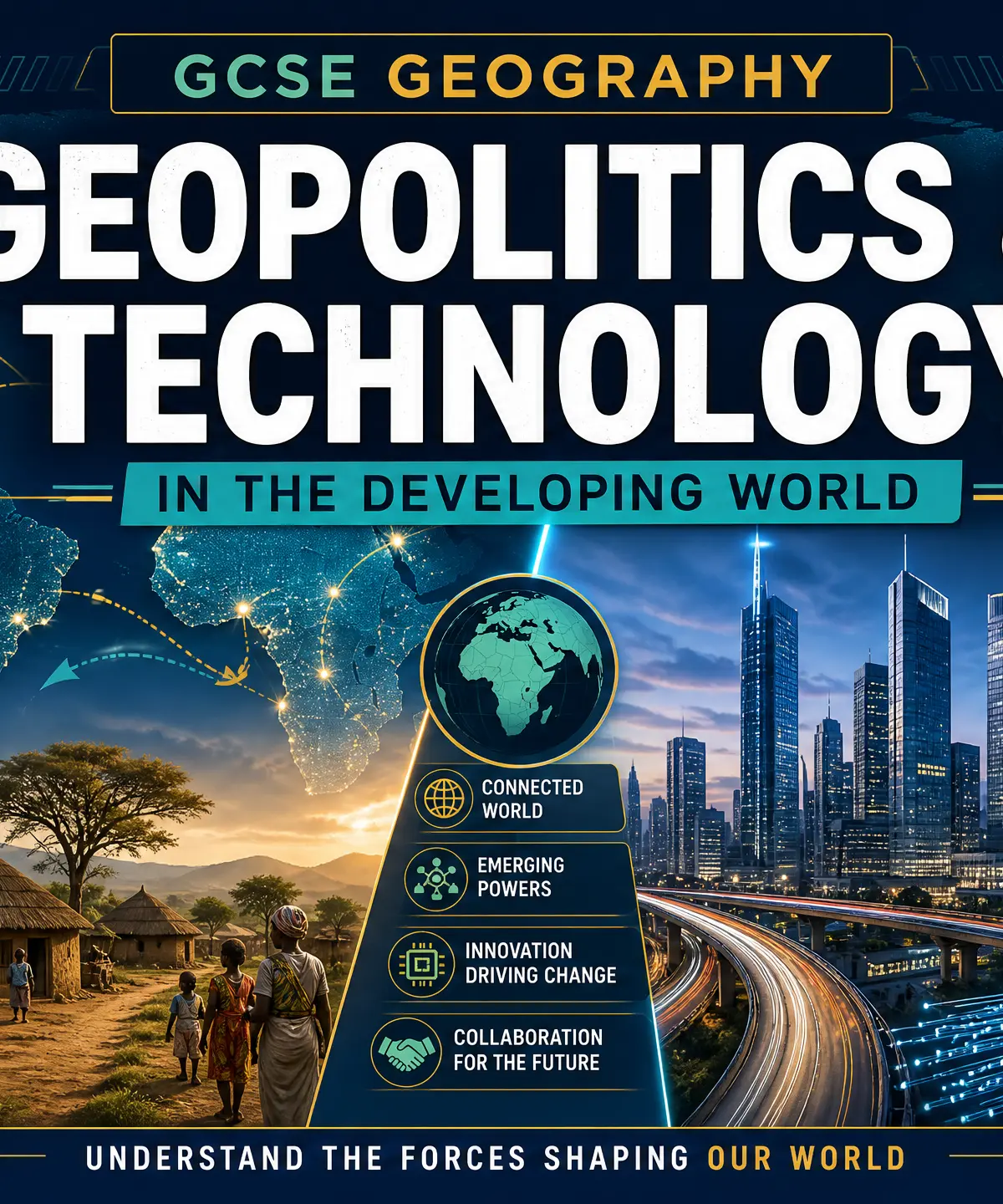
Overview
This study guide examines the profound impact of changing geopolitics and technological advancement on the development of India, a rapidly emerging economy and BRICS nation. For GCSE Geography, examiners expect candidates to move beyond generic descriptions of 'development' and instead explain the specific mechanisms—the 'how'—by which international relationships and digital innovations improve quality of life or, conversely, exacerbate inequalities.
India presents a fascinating case study. With a population exceeding 1.4 billion and a GDP of approximately $3.7 trillion as of 2024, it is an economic powerhouse. However, development remains highly uneven. While urban tech hubs like Bangalore thrive, rural states such as Bihar face significant challenges. Candidates must demonstrate an understanding of these spatial and social inequalities, evaluating how geopolitical tensions (such as the Kashmir dispute) and technological leaps (like the Digital India initiative) impact different groups of people.
Geopolitical Relationships and Development
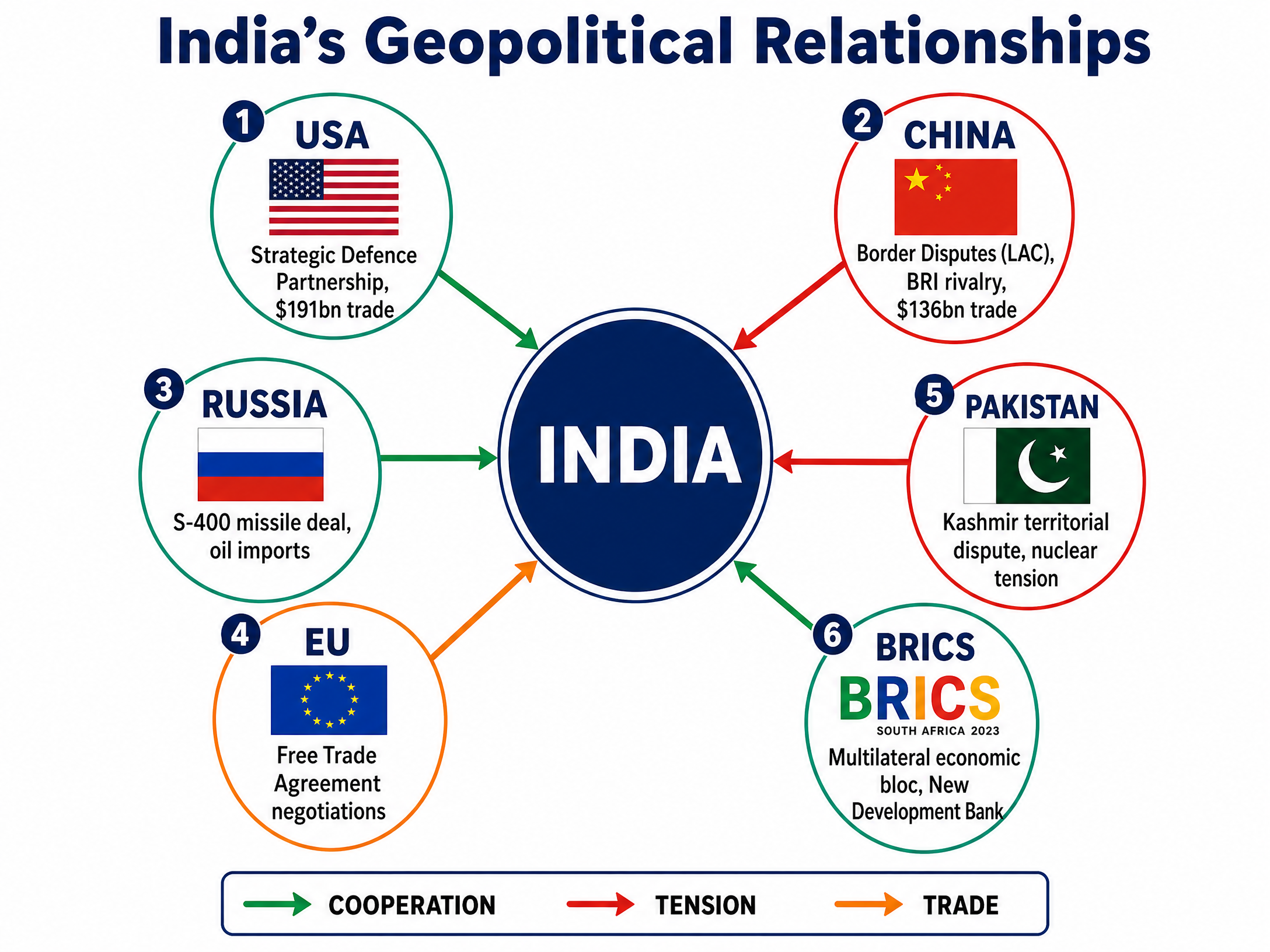
Geopolitics refers to how geography, power, and international relationships influence global affairs. India's strategic autonomy allows it to navigate complex partnerships that directly impact its economic trajectory.
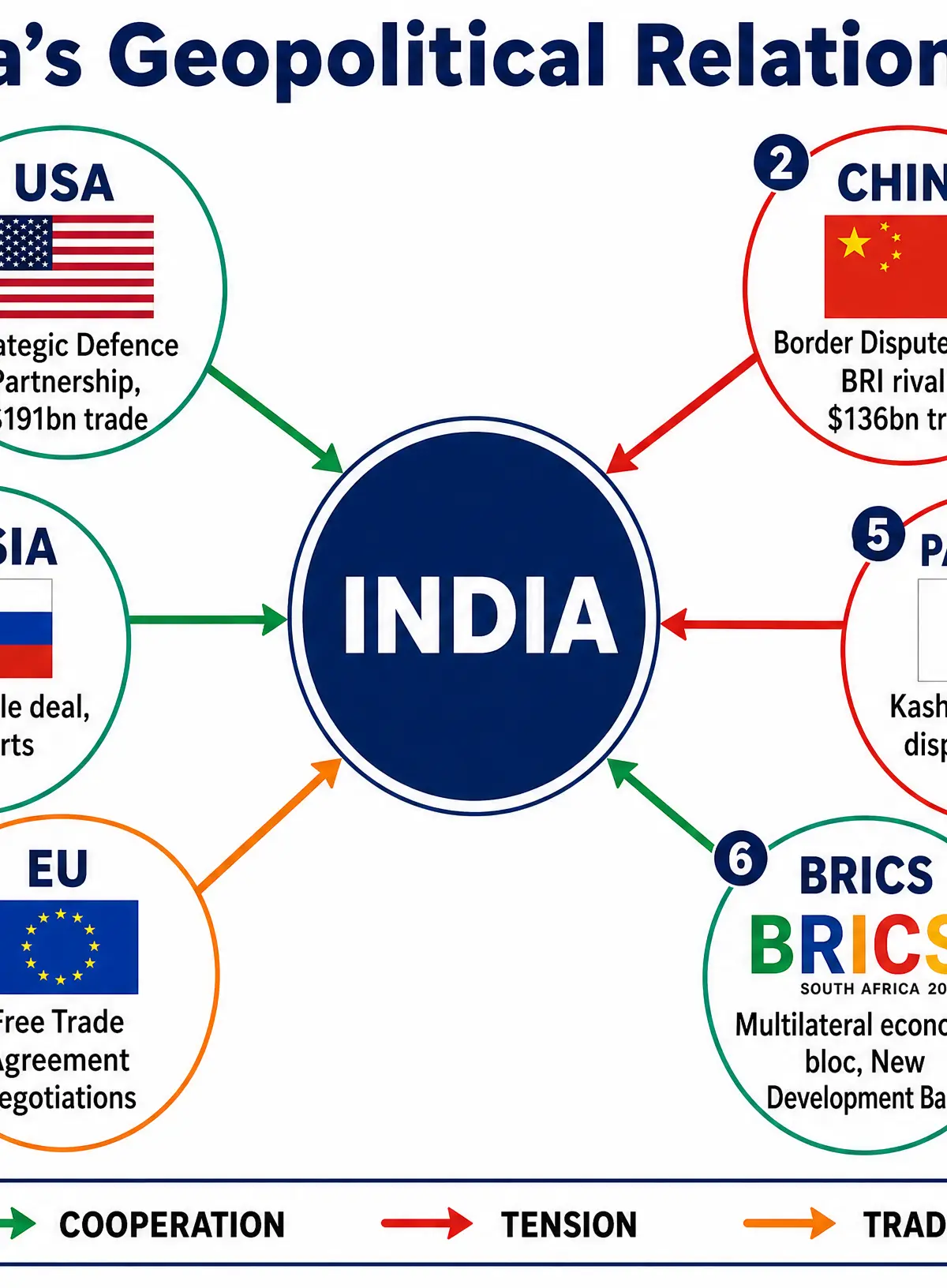
The United States: Strategic Partnership
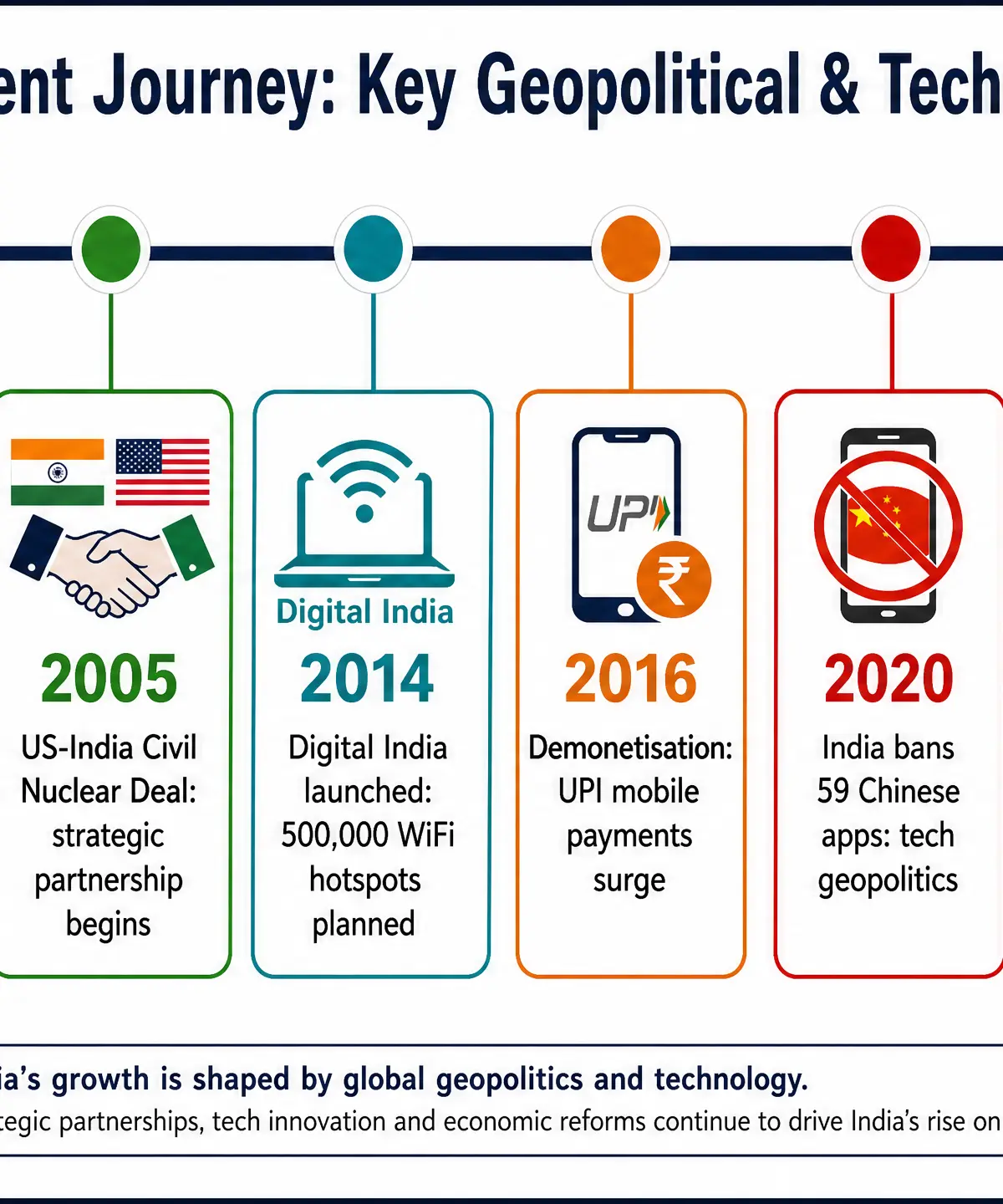
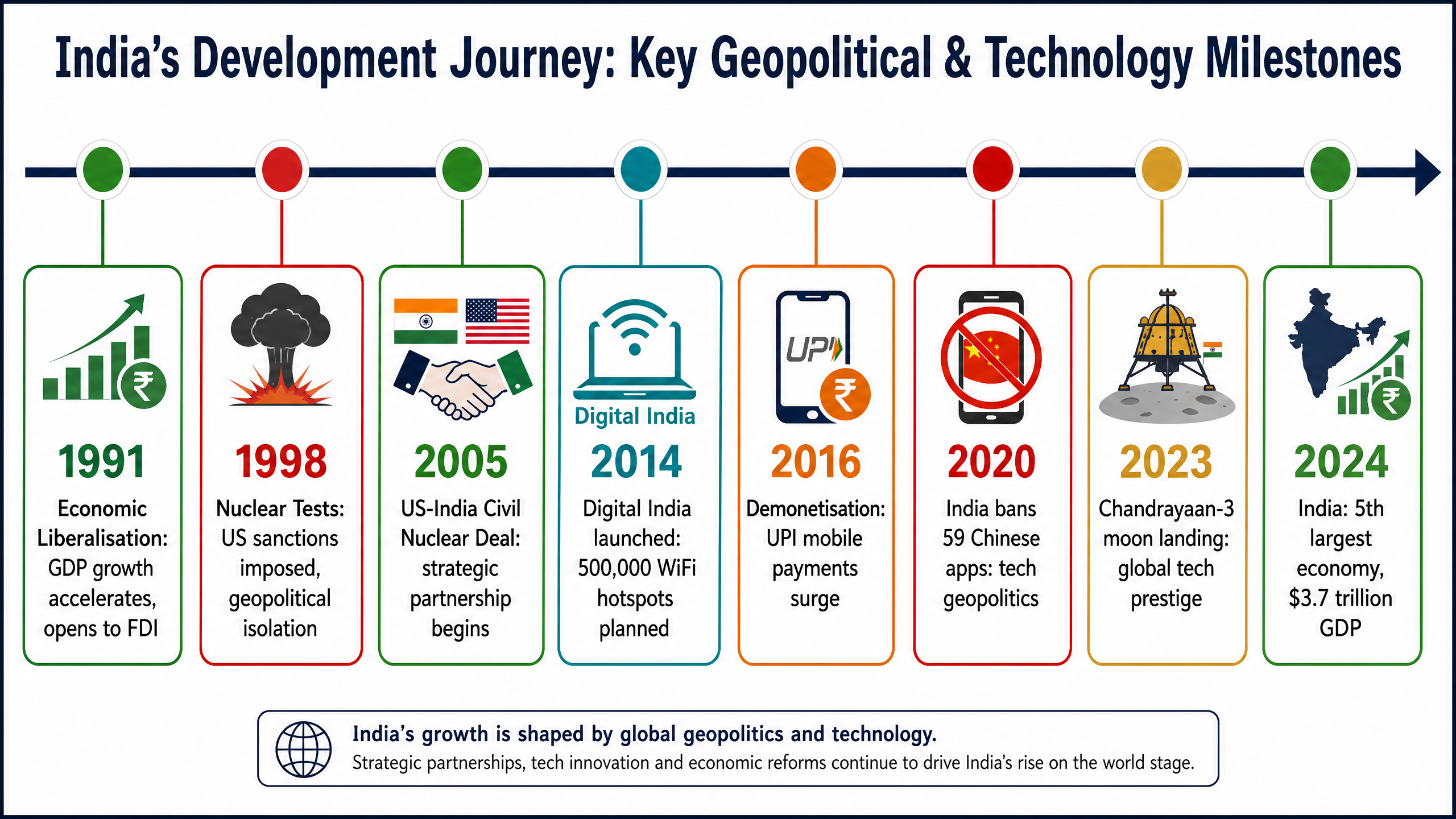
Key Actions: In 2005, the US and India signed the landmark Civil Nuclear Deal, ending decades of isolation following India's 1998 nuclear tests. The US is now India's largest trading partner, with bilateral trade reaching $191 billion in 2023.
Development Impact: This relationship has been transformative. Access to civilian nuclear technology addressed chronic energy shortages, powering industrial expansion. Massive foreign direct investment (FDI) from American tech giants (Google, Microsoft, Apple) has created hundreds of thousands of skilled jobs, expanding the urban middle class and driving economic growth.
China: Trade and Tension
Key Actions: China is India's second-largest trading partner ($136 billion in 2023), but relations are fraught with tension over the disputed Line of Actual Control (LAC), culminating in deadly clashes in the Galwan Valley in 2020.
Development Impact: This geopolitical rivalry has direct economic consequences. Following the 2020 clashes, India banned 59 Chinese apps (including TikTok), citing national security. While this protected domestic data, it disrupted the digital economy. Furthermore, China's Belt and Road Initiative (BRI) in neighbouring countries forces India to divert capital into competing regional infrastructure projects rather than domestic social development.
Russia: Strategic Autonomy
Key Actions: India maintains historic ties with Russia, controversially purchasing the S-400 missile defence system in 2018 and continuing to buy discounted Russian oil following the 2022 invasion of Ukraine.
Development Impact: By refusing to align entirely with Western sanctions, India saved billions of dollars on energy imports. These savings can be reinvested into domestic infrastructure and social programs, demonstrating how strategic non-alignment can yield direct developmental dividends.
Pakistan: The Cost of Conflict
Key Actions: The ongoing territorial dispute over Kashmir has caused persistent instability since 1947.
Development Impact: This geopolitical tension severely hinders development. India spends approximately 2.4% of its GDP on defence. This massive military expenditure represents an opportunity cost—funds that could otherwise be invested in education, healthcare, and infrastructure. Border instability also deters foreign investment in northern regions.
Technology as a Driver of Development
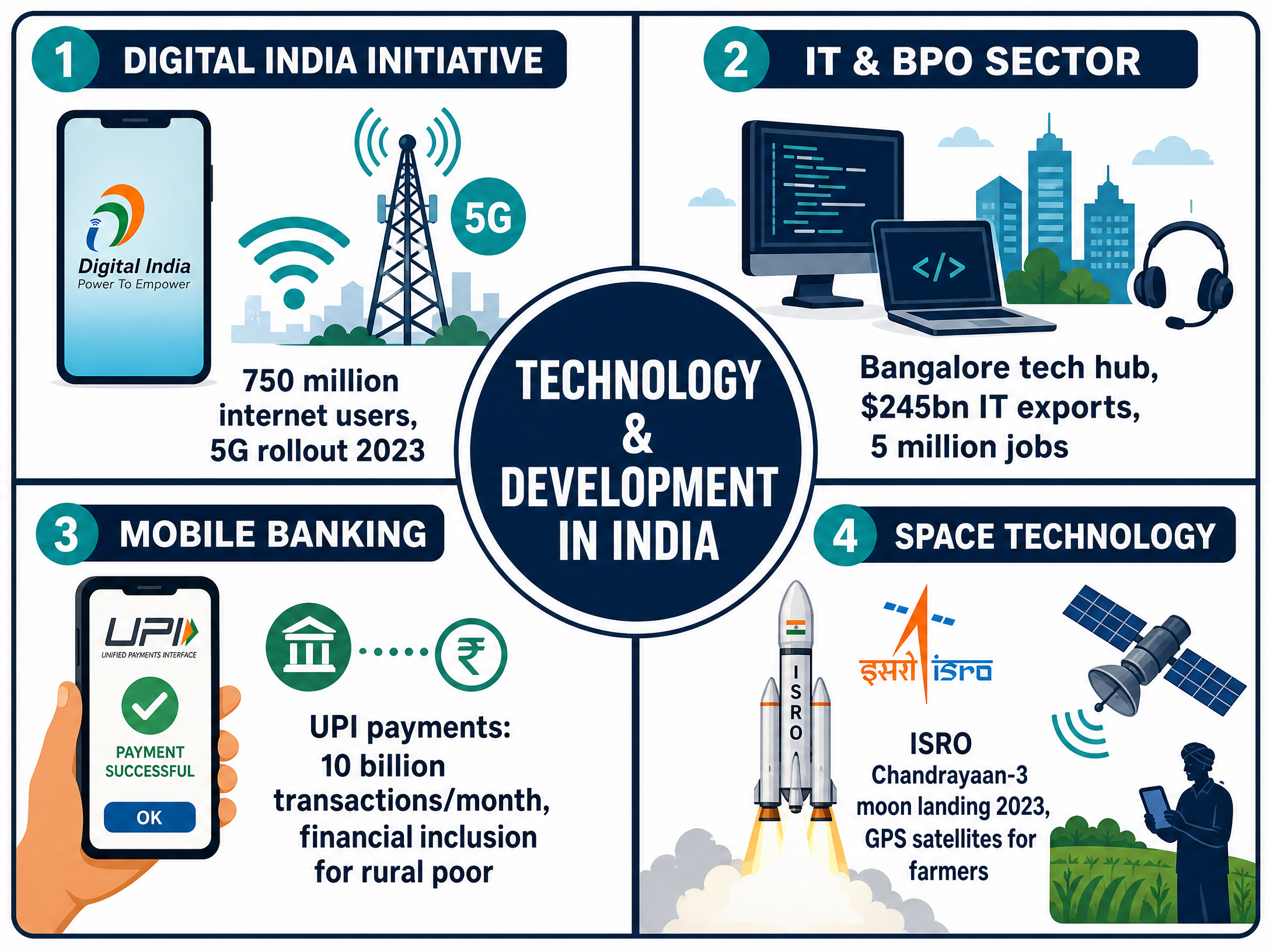
Technology is central to India's development strategy, leapfrogging traditional infrastructure to provide services directly to citizens.
The Digital India Initiative
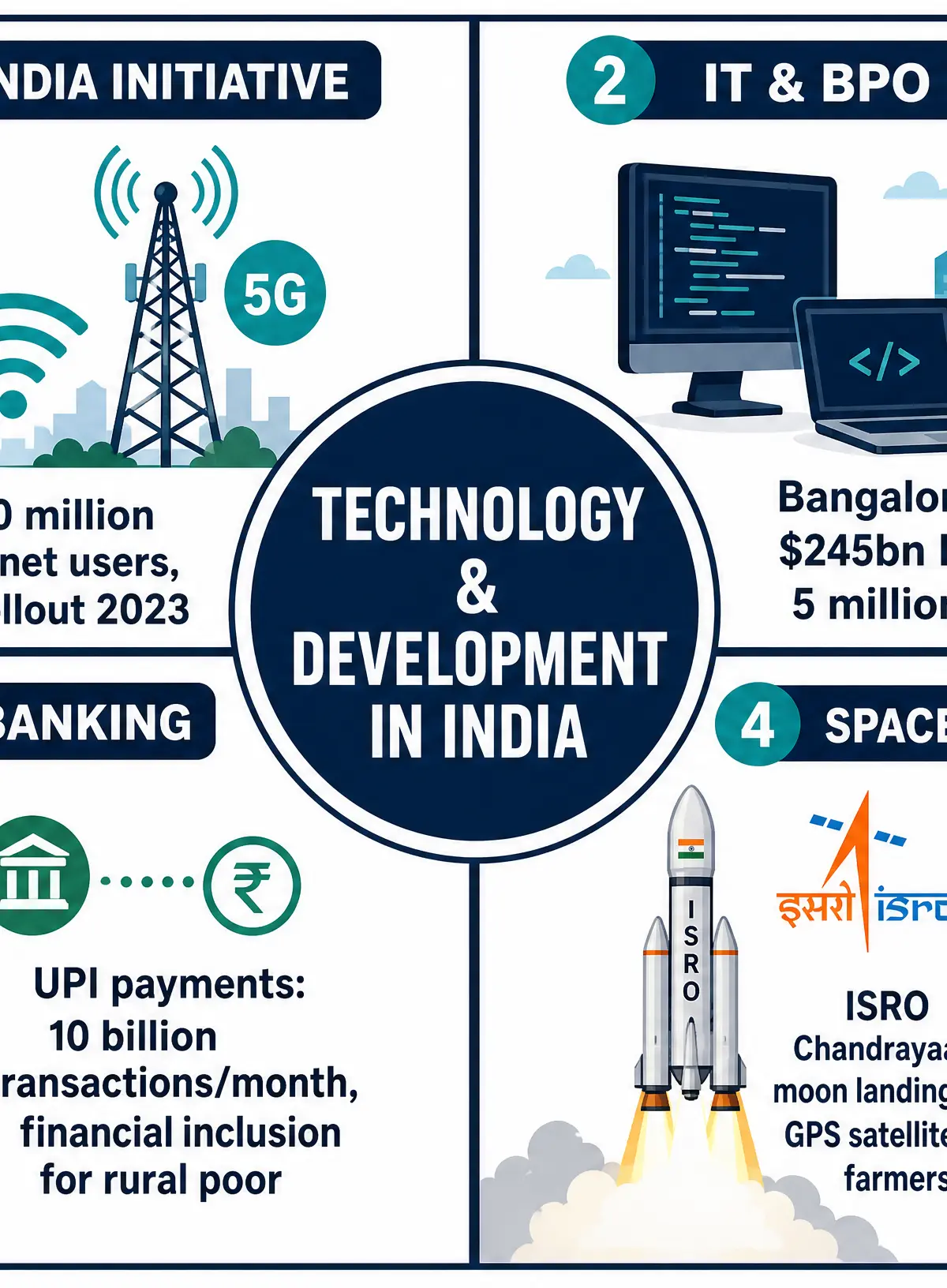
Launched in 2014, this government program aimed to transform India into a digitally empowered society. By 2024, India boasted over 750 million internet users. The rollout of 500,000 WiFi hotspots, particularly in rural areas, has democratised access to information. Farmers can check real-time crop prices, bypassing exploitative middlemen to increase their incomes. However, the 'digital divide' persists; rural women still have significantly lower internet access than urban men.
The IT and BPO Sector
Centred in Bangalore (the 'Silicon Valley of India'), the Information Technology (IT) and Business Process Outsourcing (BPO) sectors are vital economic engines. Generating $245 billion in exports in 2023 and employing 5 million people directly, this sector has created a wealthy, educated middle class. Yet, examiners note that these benefits are highly concentrated in southern and western urban centres, exacerbating regional inequality.
Mobile Banking and Financial Inclusion
India's Unified Payments Interface (UPI) processed over 10 billion transactions per month in 2024. This technology has revolutionised financial inclusion. Millions of unbanked citizens in rural communities can now receive direct government transfers, save money securely, and access micro-credit. This empowers women and small business owners, directly reducing poverty levels.
Space Technology and Agriculture
Beyond the global prestige of the Chandrayaan-3 moon landing in 2023, the Indian Space Research Organisation (ISRO) provides practical developmental tools. The NavIC satellite navigation system supports precision agriculture, while advanced weather satellites predict monsoon patterns, reducing the risk of catastrophic crop failures for millions of subsistence farmers.
Podcast Revision Lesson
Listen to our comprehensive 10-minute audio guide covering all key concepts, mechanisms, and exam techniques for this topic.

Visual Resources
3 diagrams and illustrations
Interactive Diagrams
1 interactive diagram to visualise key concepts
Conceptual Flow Outline
Flowchart showing the mechanism of geopolitical cooperation leading to development
Worked Examples
3 worked examples — open one to explore the question and available guidance.
Practice Questions
Test your understanding — click to reveal model answers
Explain two ways that technology can improve quality of life in a developing or emerging country. (4 marks)
Hint: Identify two distinct technologies (e.g., mobile banking, agricultural apps) and explain how each specifically helps people.
Assess the impact of geopolitical relationships on the economic development of a named developing or emerging country. (9 marks)
Hint: Use India. Discuss at least one positive relationship (e.g., USA) and one negative relationship (e.g., Pakistan or China), providing specific data for both before reaching a conclusion.
State one reason why the benefits of the IT sector in India are not experienced equally across the country. (1 mark)
Hint: Think about where these companies are located and what skills are required.
Explain how membership in international organisations can support the development of emerging economies. (4 marks)
Hint: Use BRICS as your example. How does it help financially?
'Technological advancement is more important than geopolitical relationships for the development of emerging countries.' To what extent do you agree? Use a named country in your answer. (9 marks)
Hint: This requires a balanced argument. Argue for technology, then argue for geopolitics, then show how they are interlinked in your conclusion.