Pearson Edexcel · GCSE · Geography
Definitions of development vary as do attempts to measure it
This study explores how we define and measure global development, highlighting the differences between economic and social indicators. It is crucial for understanding the stark inequalities between and within countries, and evaluating the strategies used to address the global development gap.
- 5 min read
- 3 worked examples
- 5 practice questions
- 7 key terms
Study Notes
Overview
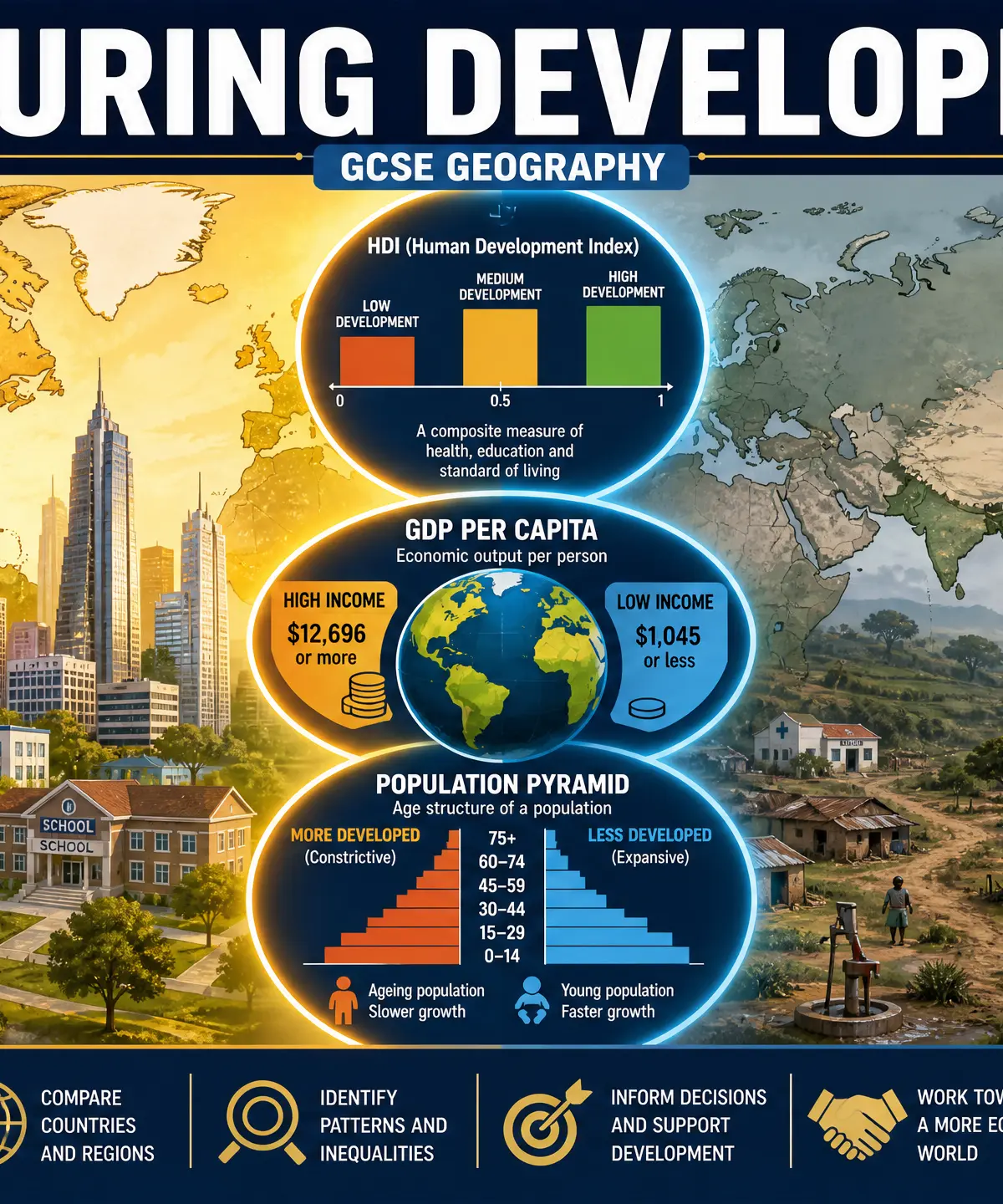
Development is a multi-dimensional concept that goes beyond simply getting richer; it is fundamentally about improving the quality of life and wellbeing of people. Examiners expect candidates to understand that development encompasses economic, social, and political dimensions. This topic covers the various ways development is measured, from single economic indicators like Gross Domestic Product (GDP) per capita to composite measures like the Human Development Index (HDI). You will also explore the global patterns of uneven development, often simplified by the Brandt Line, and investigate the physical, historical, and economic causes behind these inequalities. Finally, the topic evaluates different strategies to reduce the development gap, contrasting top-down government projects with bottom-up community-led initiatives.
Key Concepts in Development
Economic vs Social Development
Economic Development: Focuses on wealth and the standard of living, typically measured by indicators such as GDP per capita or Gross National Income (GNI).
Social Development: Focuses on improvements in human wellbeing, including access to education, healthcare, clean water, and political freedoms.
Why it matters: Examiners often ask candidates to evaluate the limitations of purely economic measures. A country may have high economic wealth but poor social development (e.g., high inequality, lack of women's rights), proving that economic growth alone does not equal true development.
Measuring Development
Single Indicators
GDP per capita: The total value of goods and services produced by a country in a year, divided by its population. It is a useful economic snapshot but hides internal inequality.
Life Expectancy: The average age a person can expect to live. This is a strong indicator of the quality of healthcare, sanitation, and nutrition in a country.
Literacy Rate: The percentage of adults who can read and write. This indicates the quality and accessibility of the education system.
Composite Indicators: The Human Development Index (HDI)
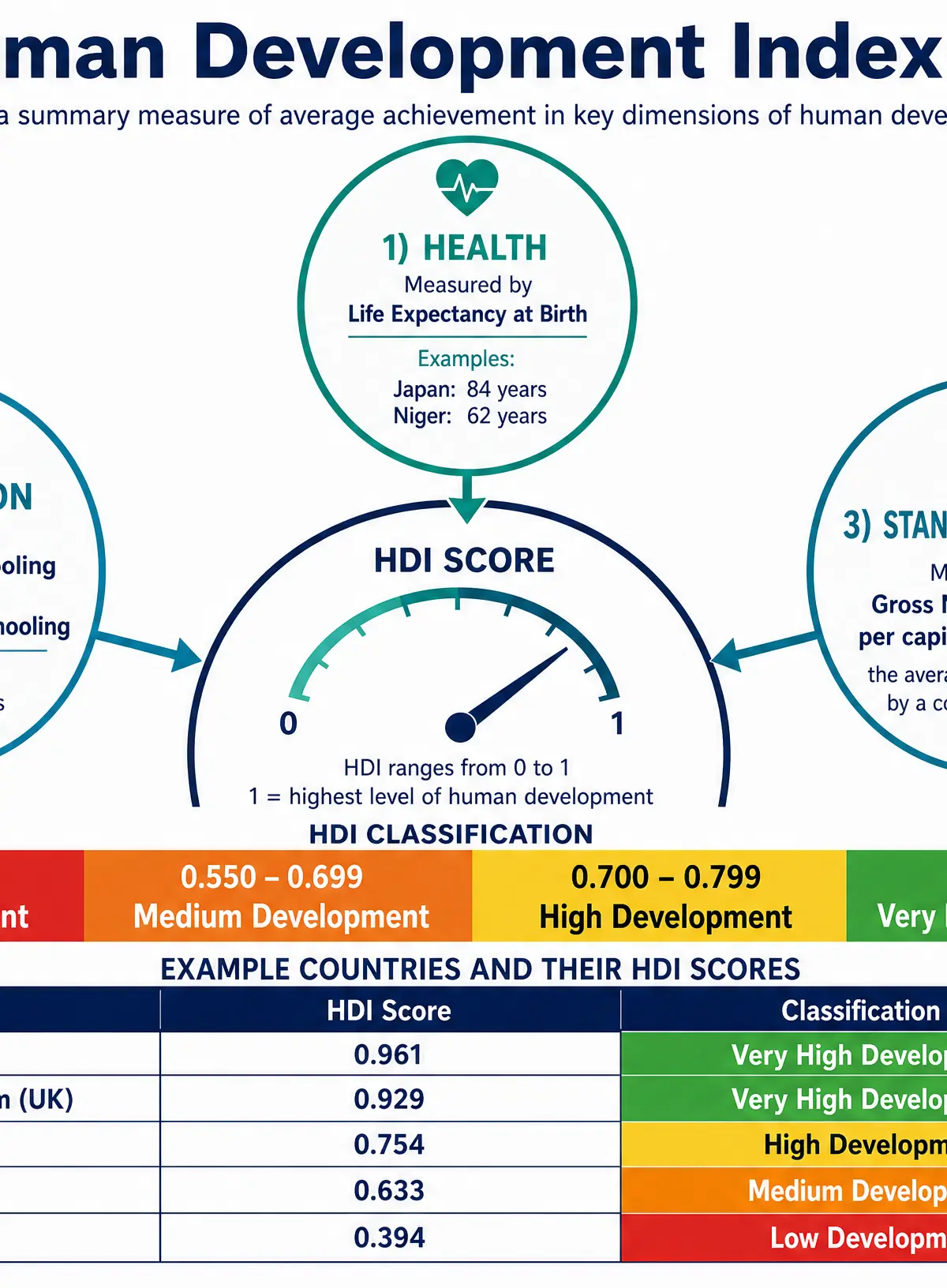
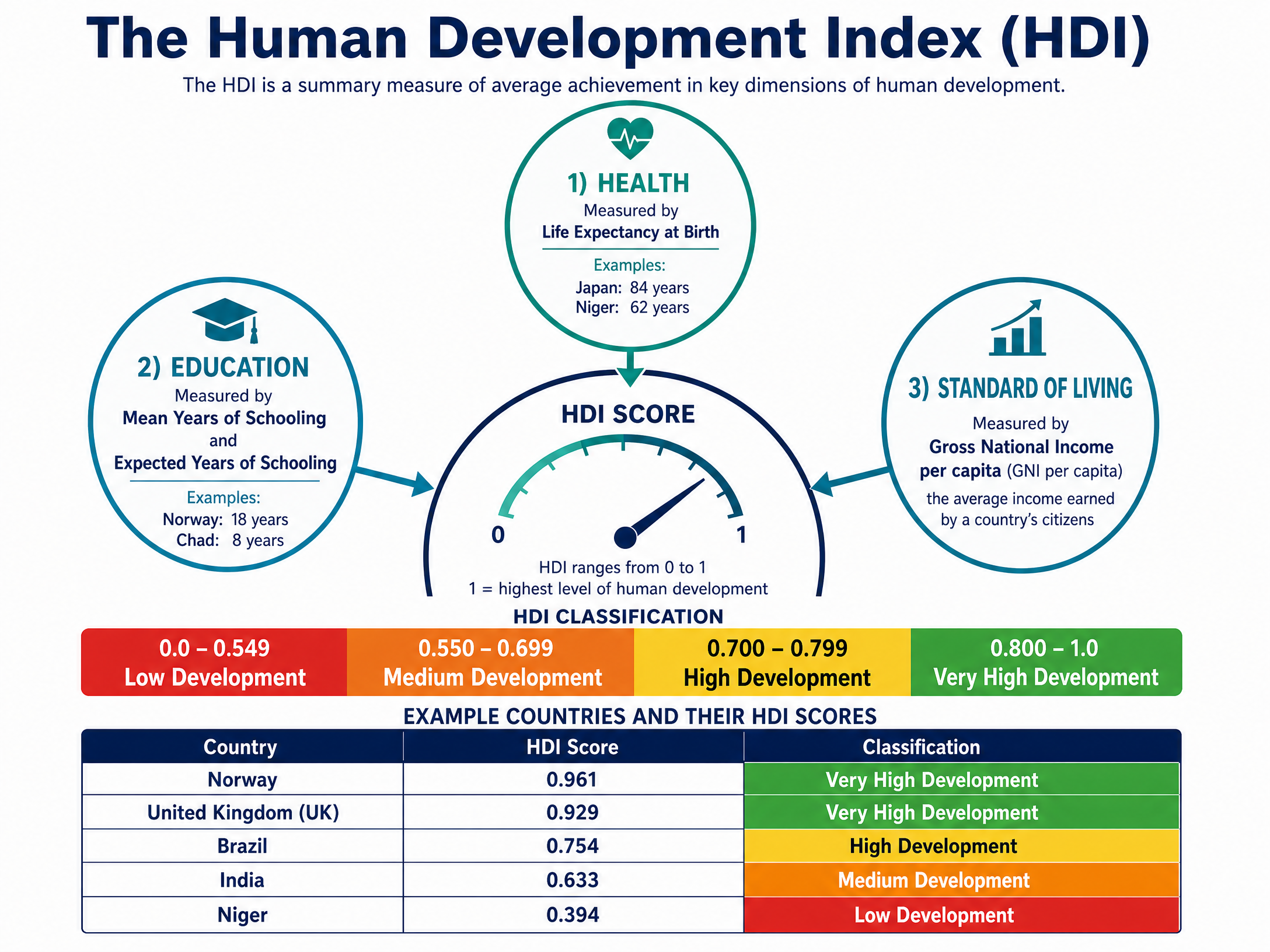
The HDI, created by the United Nations, is the most important measure to know. It combines three dimensions into a score between 0 and 1:
- Health: Measured by life expectancy at birth.
- Education: Measured by mean years of schooling and expected years of schooling.
- Standard of Living: Measured by GNI per capita.
Significance: The HDI is considered more reliable than GDP because it provides a broader picture of human wellbeing, though it still fails to measure political freedom or environmental sustainability.
Global Patterns of Uneven Development
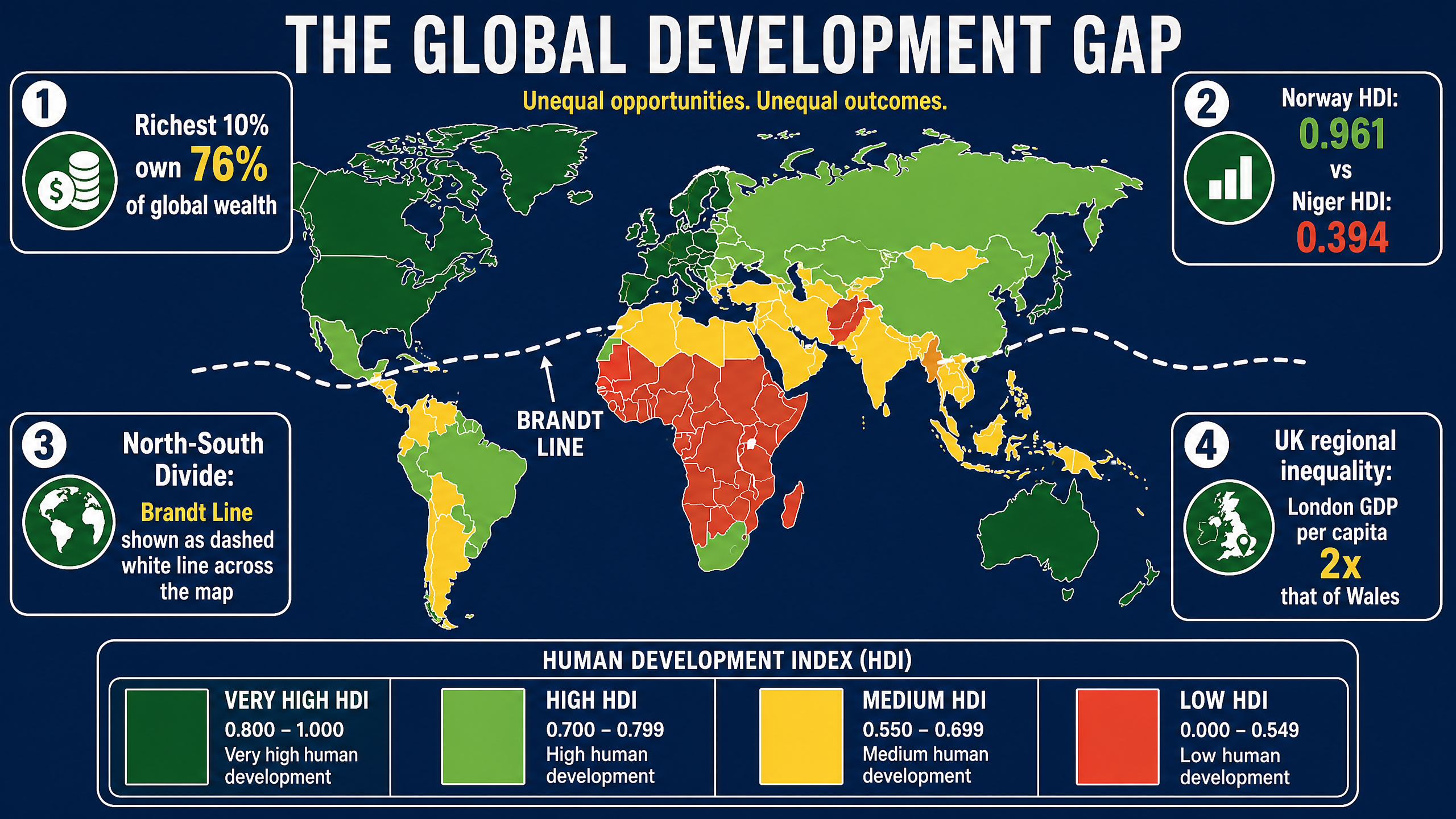
The North-South Divide
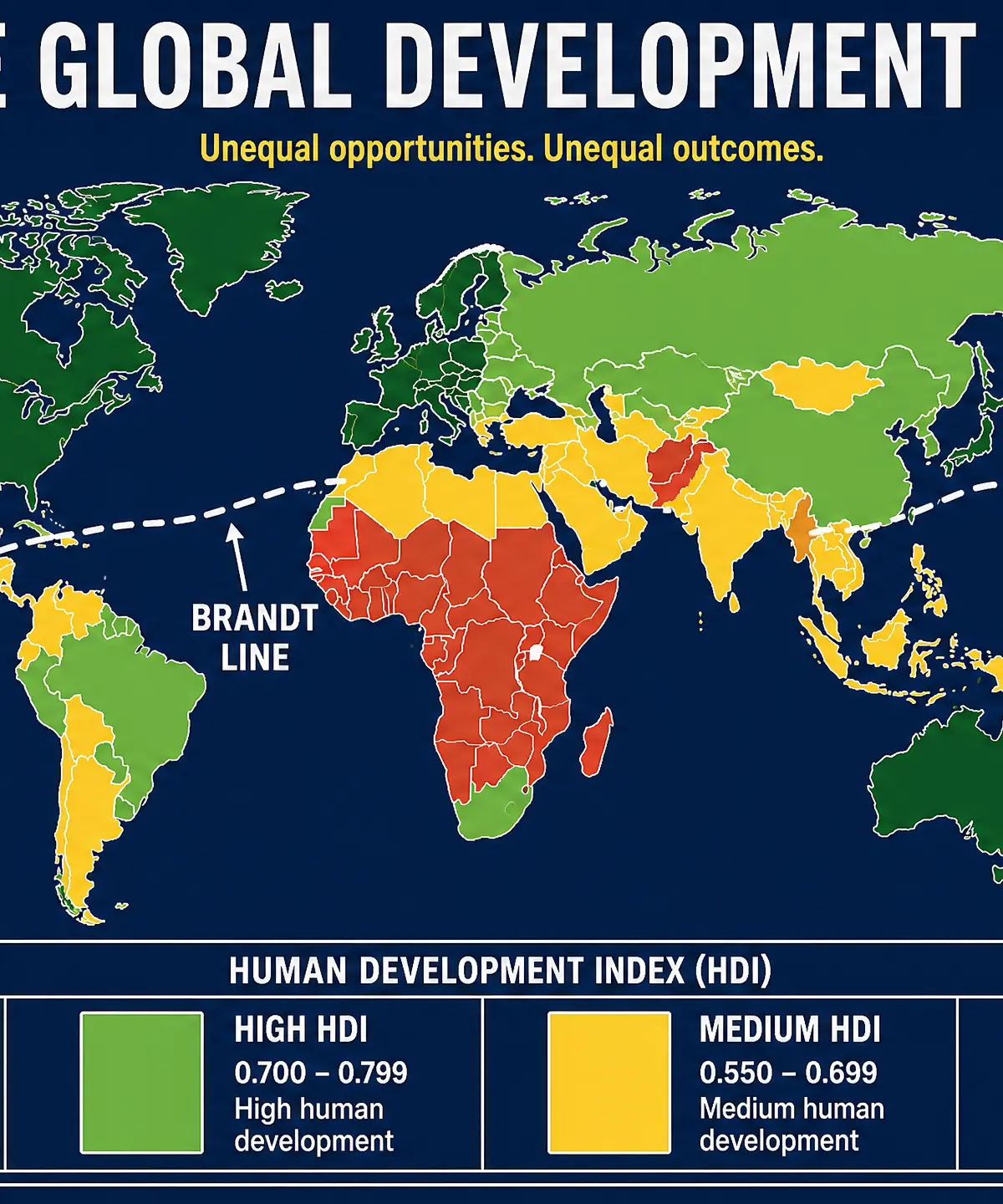
The Brandt Line (drawn in 1980) visually separated the more developed 'Global North' from the less developed 'Global South'. While outdated (as countries like China and India have rapidly developed), it remains a foundational concept for describing global inequality.
Core-Periphery Model
Development is also uneven within countries. The Core (usually capital cities or major ports, e.g., London) is wealthy, well-connected, and attracts investment. The Periphery (rural or former industrial areas, e.g., North East England or Wales) suffers from lack of investment, lower wages, and out-migration.
Causes of Uneven Development
Physical Factors
- Climate: Tropical climates often suffer from unreliable rainfall (droughts) and tropical diseases (malaria), hindering agriculture and productivity.
- Location: Landlocked countries face higher trade and transport costs.
Historical Factors
- Colonialism: European powers extracted wealth and resources from colonies in Africa, Asia, and the Americas, leaving them with weak economies and arbitrary borders upon independence.
Economic Factors
- Debt: Many developing nations took out large loans in the 1970s/80s. High interest repayments mean less money is available to invest in domestic healthcare and education.
Strategies to Reduce the Development Gap
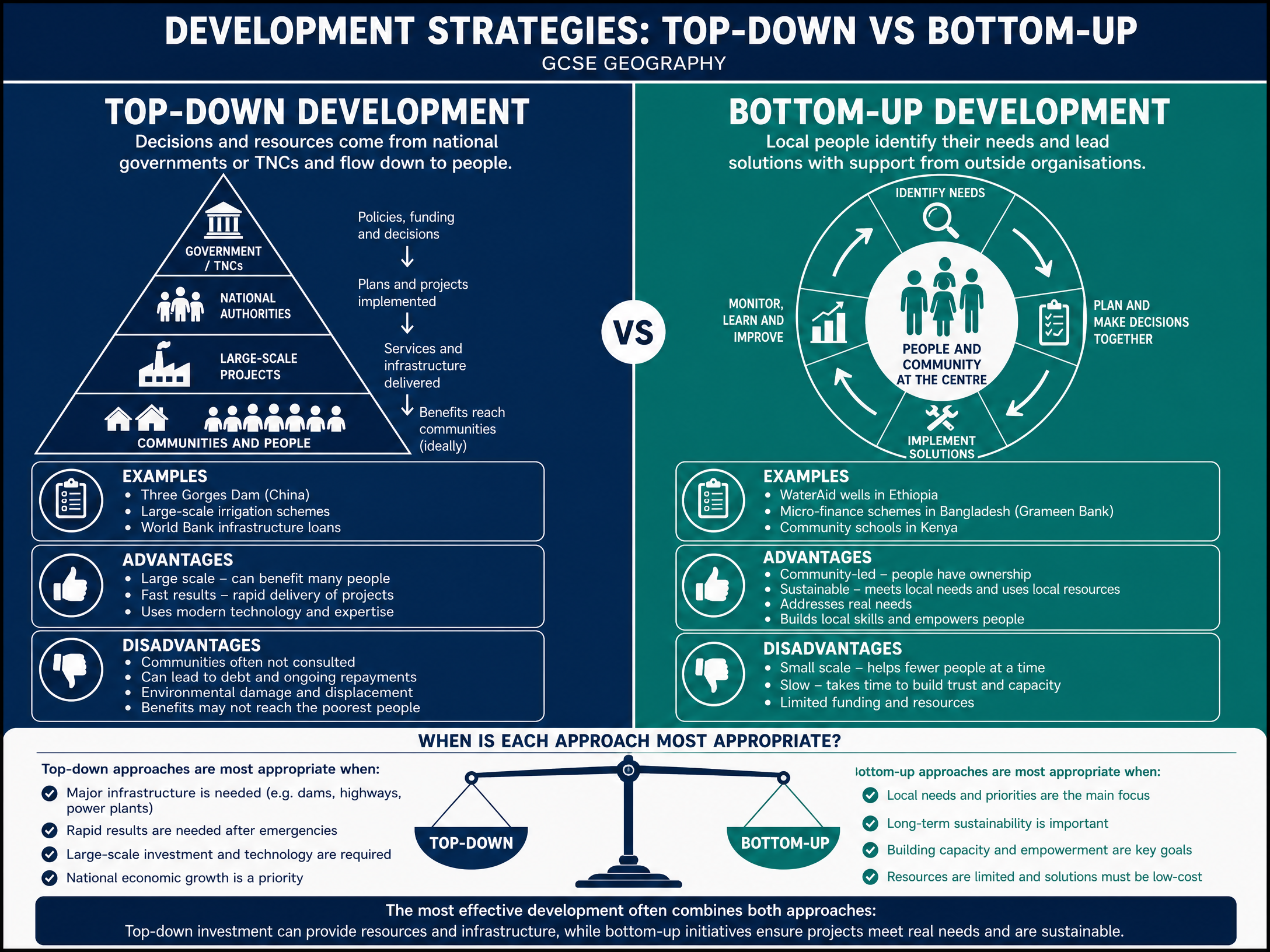
Top-Down Development
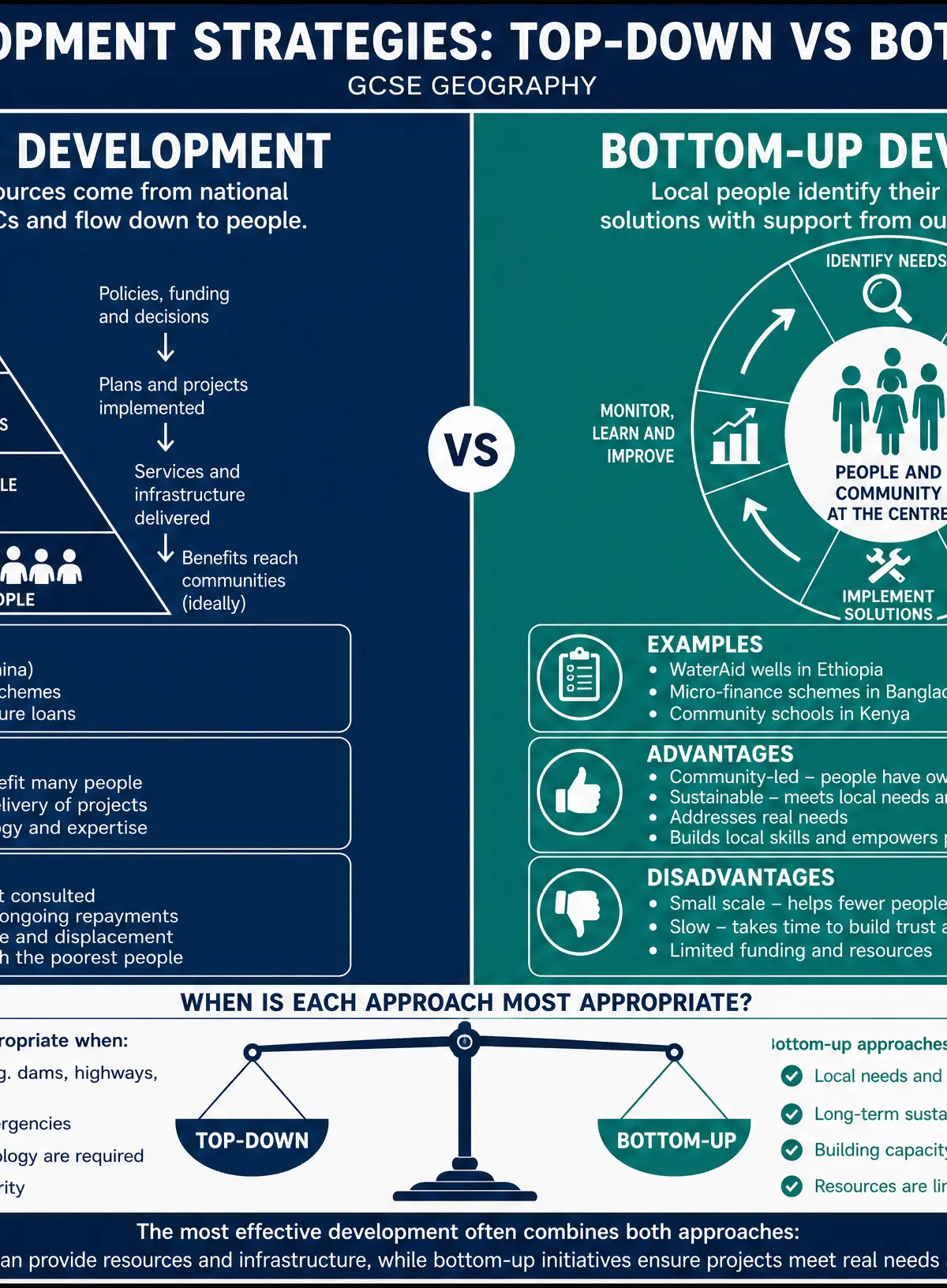
Large-scale, expensive projects funded and managed by governments or international organizations (e.g., the World Bank).
- Example: The Three Gorges Dam, China.
- Advantages: Can benefit millions quickly; uses advanced technology.
- Disadvantages: Often ignores local needs; can cause environmental damage; may plunge the country into debt.
Bottom-Up Development
Small-scale, community-led projects funded by NGOs or charities.
- Example: WaterAid wells in Ethiopia; Grameen Bank micro-finance in Bangladesh.
- Advantages: Sustainable; uses appropriate technology; empowers local people.
- Disadvantages: Small scale (helps fewer people); relies on unreliable charitable donations.
Audio Revision
Listen to this 10-minute podcast covering all the key concepts, common exam mistakes, and a quick-fire recall quiz.

Visual Resources
3 diagrams and illustrations
Interactive Diagrams
1 interactive diagram to visualise key concepts
Conceptual Flow Outline
Factors contributing to the global development gap
Worked Examples
3 worked examples — open one to explore the question and available guidance.
Practice Questions
Test your understanding — click to reveal model answers
Study the HDI data provided. Compare the level of development of Norway (HDI 0.961) and Niger (HDI 0.394). (3 marks)
Hint: Use comparative language and quote the data provided in the question.
Explain how physical factors can cause uneven development. (4 marks)
Hint: Choose two distinct physical factors (e.g., climate, landlocked location) and explain the economic consequence of each.
State two components used to calculate the Human Development Index (HDI). (2 marks)
Hint: Think of the acronym H.E.S.
Evaluate the use of top-down strategies in promoting development. (6 marks)
Hint: You need to discuss both the positives and negatives of top-down projects, using a named example.
Explain why development is often uneven within a single country. (4 marks)
Hint: Think about the core-periphery model and why cities attract more wealth than rural areas.