Pearson Edexcel · GCSE · Geography
Management and sustainable use of energy resources are required at a range of spatial scales from local to international
Master the complexities of global energy management. This guide explores the tension between economic growth and environmental protection across local, national, and international scales, providing the precise case study evidence examiners demand.
- 7 min read
- 3 worked examples
- 5 practice questions
- 6 key terms
Study Notes
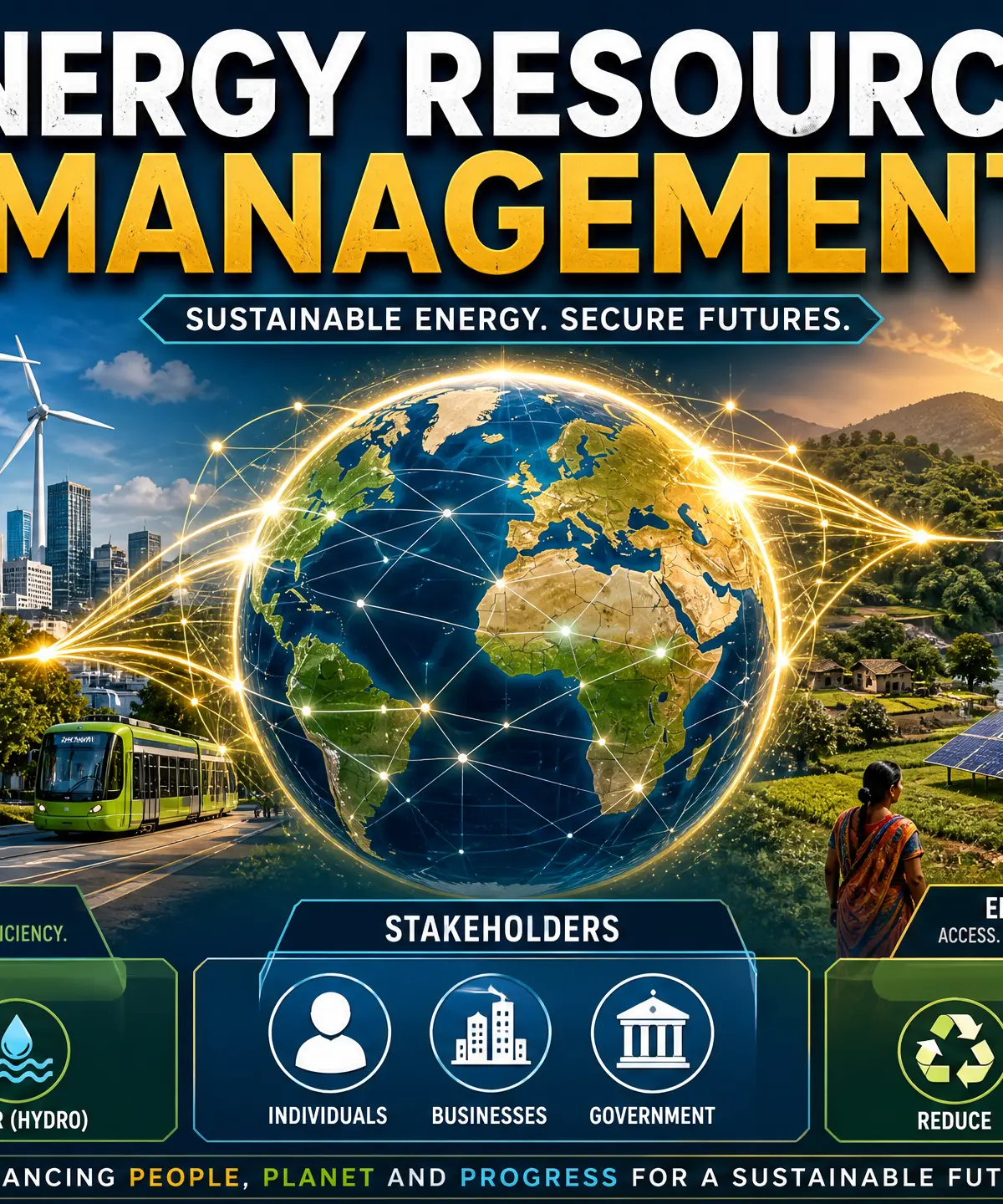
Overview
The management of energy resources is one of the most pressing geographical challenges of the 21st century. Examiners expect candidates to move beyond simply describing renewable and non-renewable energy sources; you must evaluate how these resources are managed sustainably. This requires an understanding of the Brundtland definition of sustainability: "meeting the needs of the present without compromising the ability of future generations to meet their own needs."
This topic requires you to analyse energy management across a range of spatial scales (from local community projects to global climate agreements) and understand the conflicting perspectives of different stakeholders (individuals, organisations, and governments). Most importantly, you must be able to deploy specific, data-rich case studies from both a developed country and an emerging/developing country to evaluate the success of their management strategies.
Listen to the Podcast
Get a comprehensive overview of this topic with our expert tutor podcast:

Key Concepts: Sustainability and Spatial Scales
The Concept of Sustainable Management
Sustainable energy management is not just about using renewable energy; it is about balancing three core pillars:
- Economic: Ensuring energy is affordable and supports industrial growth.
- Social: Providing reliable energy access to all, reducing 'energy poverty'.
- Environmental: Minimising greenhouse gas emissions and ecological damage.
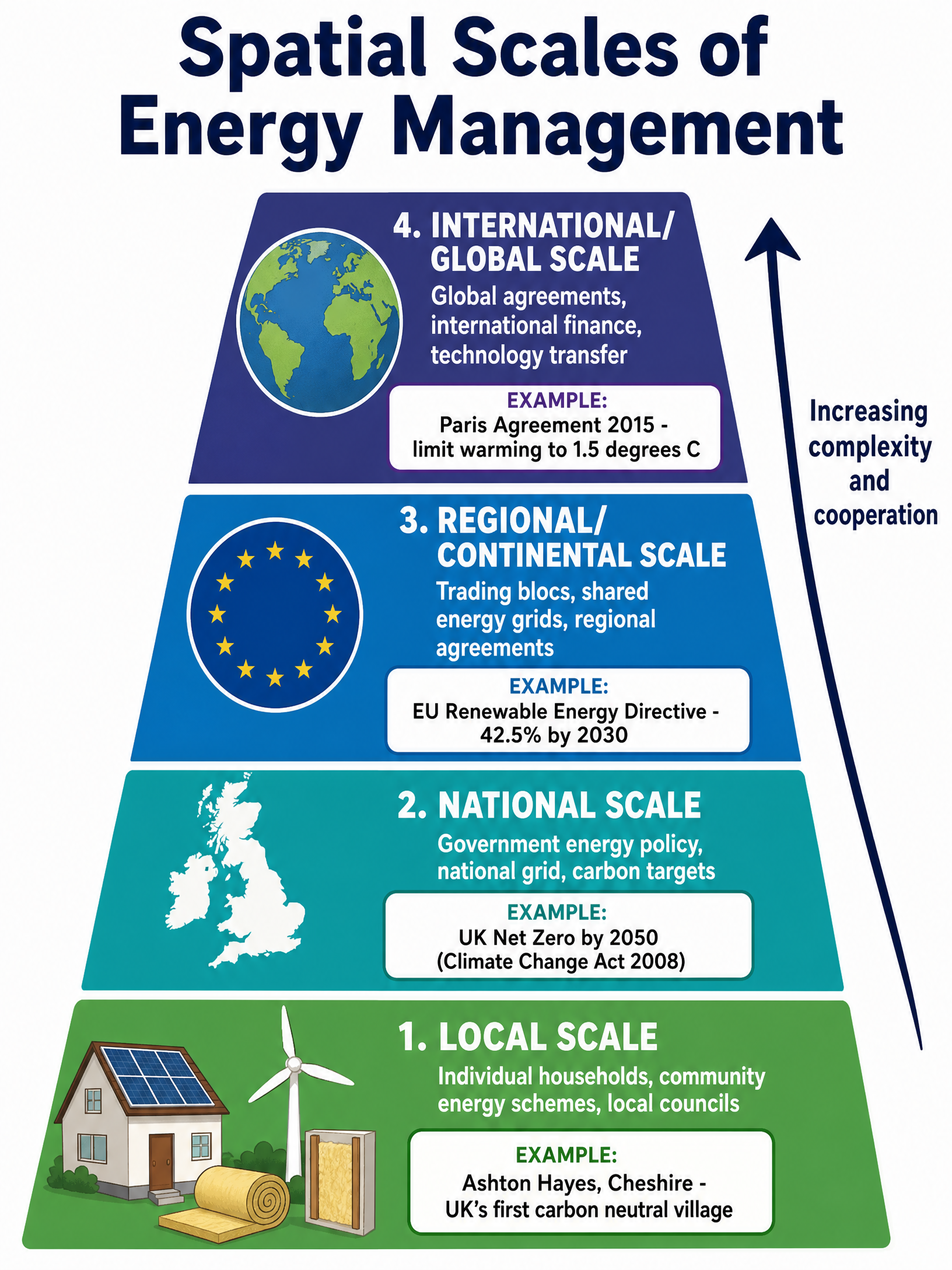
Spatial Scales of Management
Examiners frequently penalise candidates who only discuss national policies. You must demonstrate how management operates at different levels:
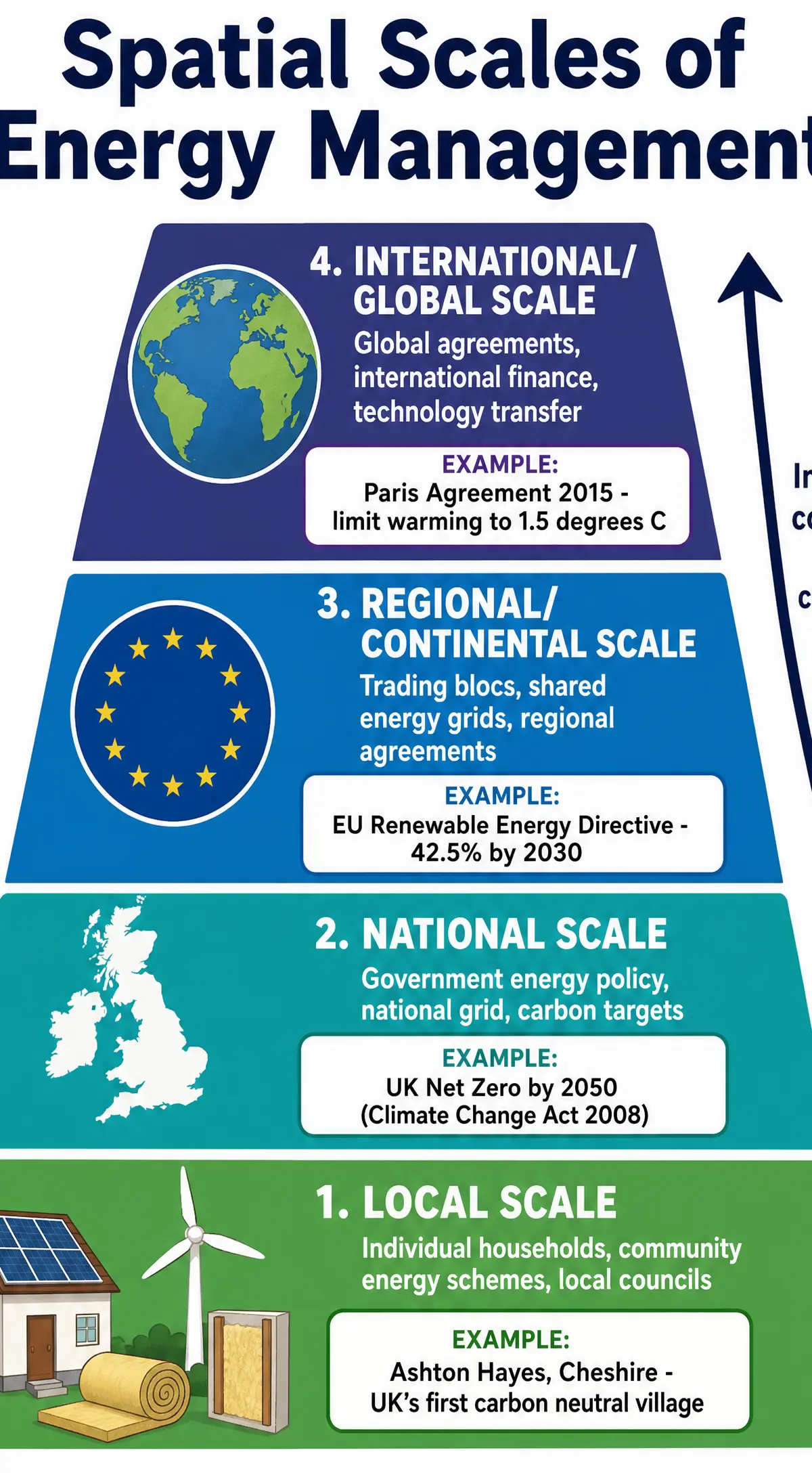
1. Local Scale
- What it involves: Community energy schemes, household insulation, local council planning regulations.
- Specific Knowledge: Ashton Hayes, Cheshire became England's first community aiming for carbon neutrality, with residents voluntarily reducing their carbon footprint by 30%.
2. National Scale
- What it involves: Government energy policy, national grid infrastructure, subsidies and taxation.
- Specific Knowledge: The UK's Climate Change Act (2008) legally binding target to reach Net Zero by 2050.
3. Regional/Continental Scale
- What it involves: Transnational energy grids, trading blocs setting shared targets.
- Specific Knowledge: The EU Renewable Energy Directive targets 42.5% renewable energy across the bloc by 2030.
4. International/Global Scale
- What it involves: Global climate treaties, international technology transfer, and climate finance.
- Specific Knowledge: The Paris Agreement (2015), where 196 countries committed to limiting global warming to 1.5°C above pre-industrial levels.
Stakeholder Perspectives and Conflicts
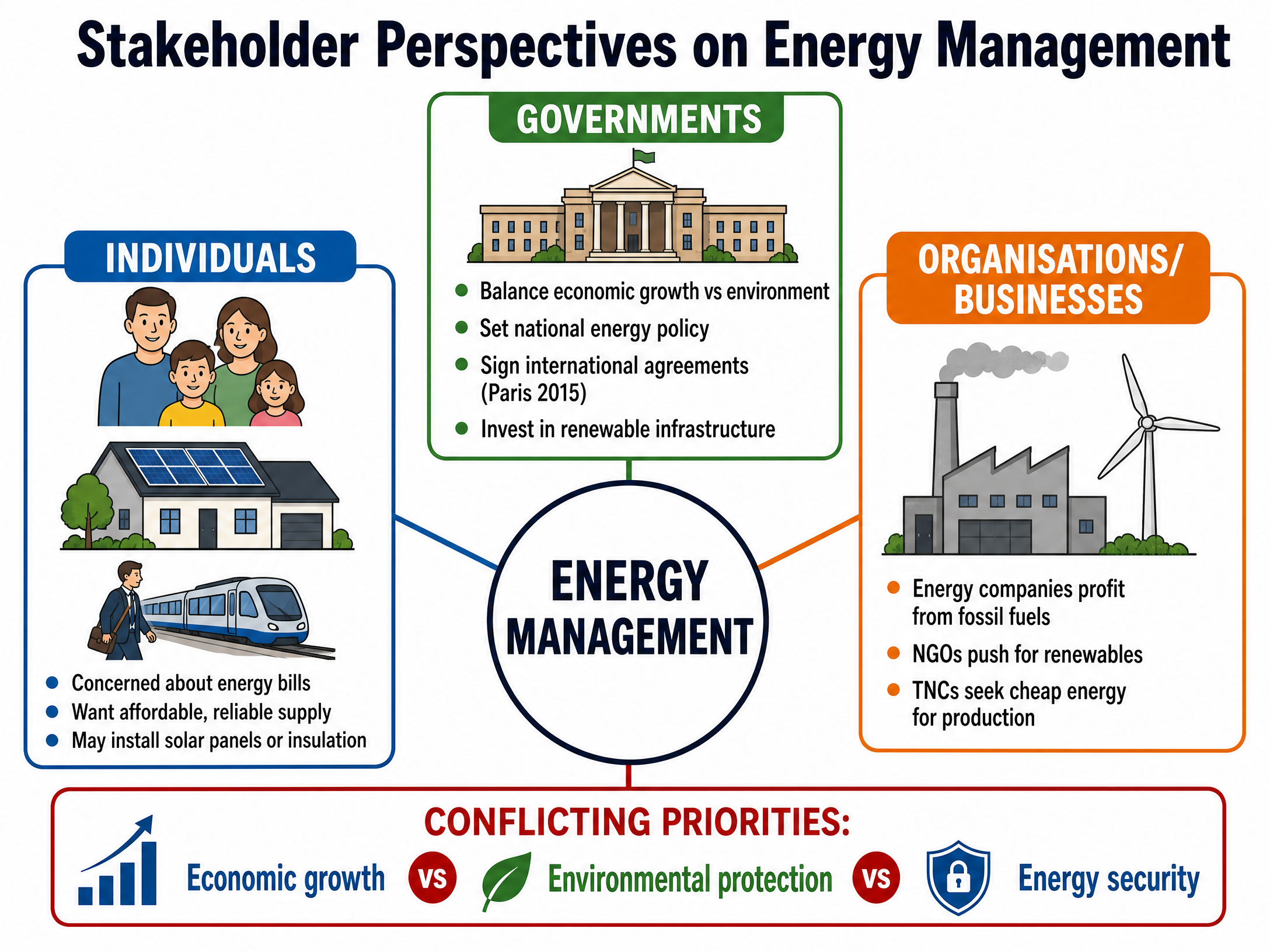
Different groups have fundamentally different priorities regarding energy management, leading to significant conflict.
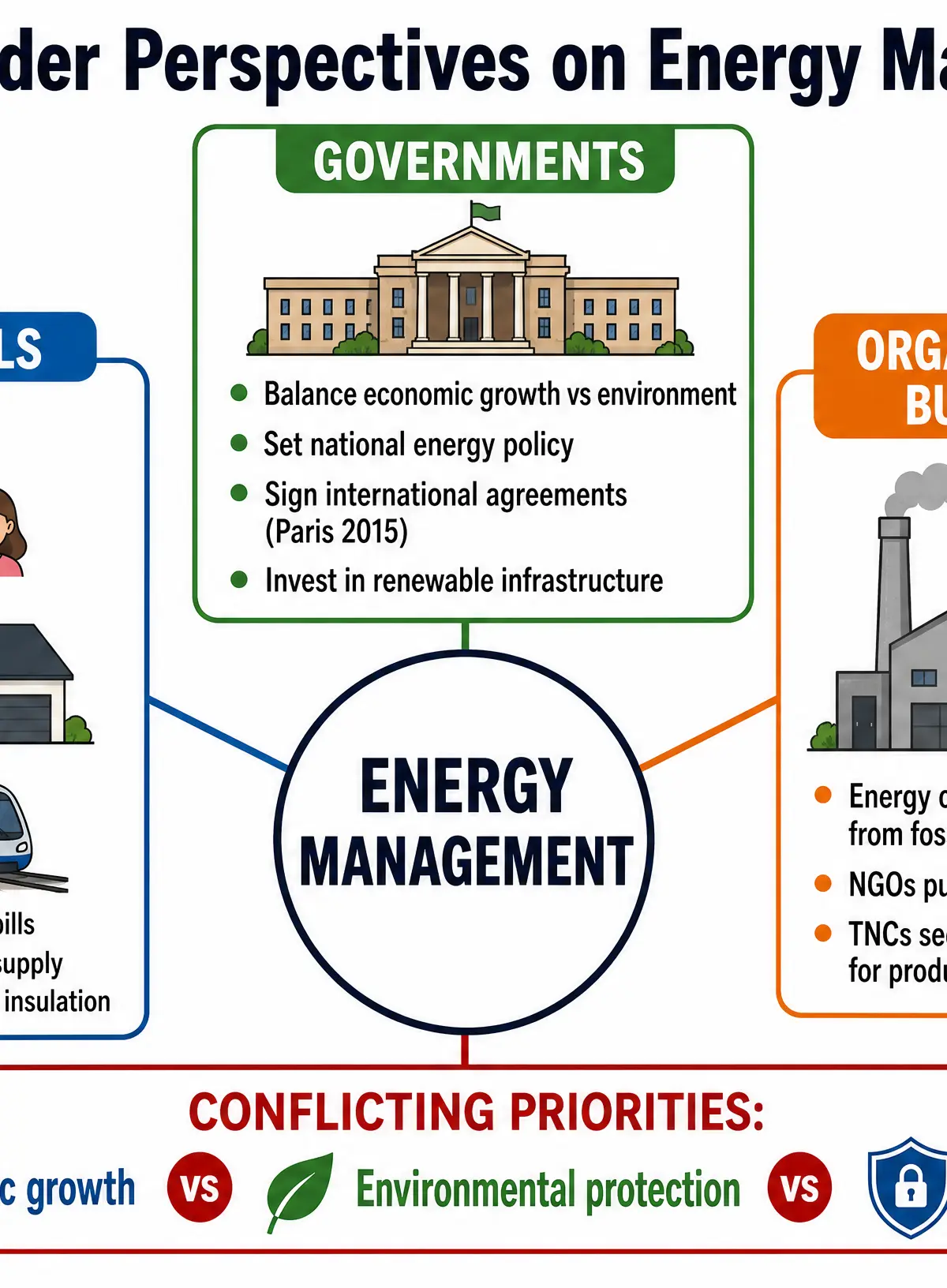
Individuals
Role: Consumers and voters.
Perspectives:
- Primarily concerned with energy affordability and reliable supply (avoiding blackouts).
- May face 'fuel poverty' if green taxes increase bills.
- Increasingly willing to adopt micro-generation (e.g., solar panels) if financially incentivised (e.g., via feed-in tariffs).
Organisations
Role: Energy producers, industries, and NGOs.
Perspectives:
- Transnational Corporations (TNCs) (e.g., BP, Shell) have billions invested in fossil fuel infrastructure; they advocate for a slower, 'transitional' approach using natural gas.
- Manufacturing industries require cheap, reliable baseload power to remain globally competitive.
- NGOs (e.g., Greenpeace) demand rapid, immediate decarbonisation regardless of short-term economic costs.
Governments
Role: Policymakers and regulators.
Perspectives:
- Must balance the 'Energy Trilemma': Energy Security, Energy Equity (affordability), and Environmental Sustainability.
- Face political pressure to maintain economic growth while meeting international climate obligations.
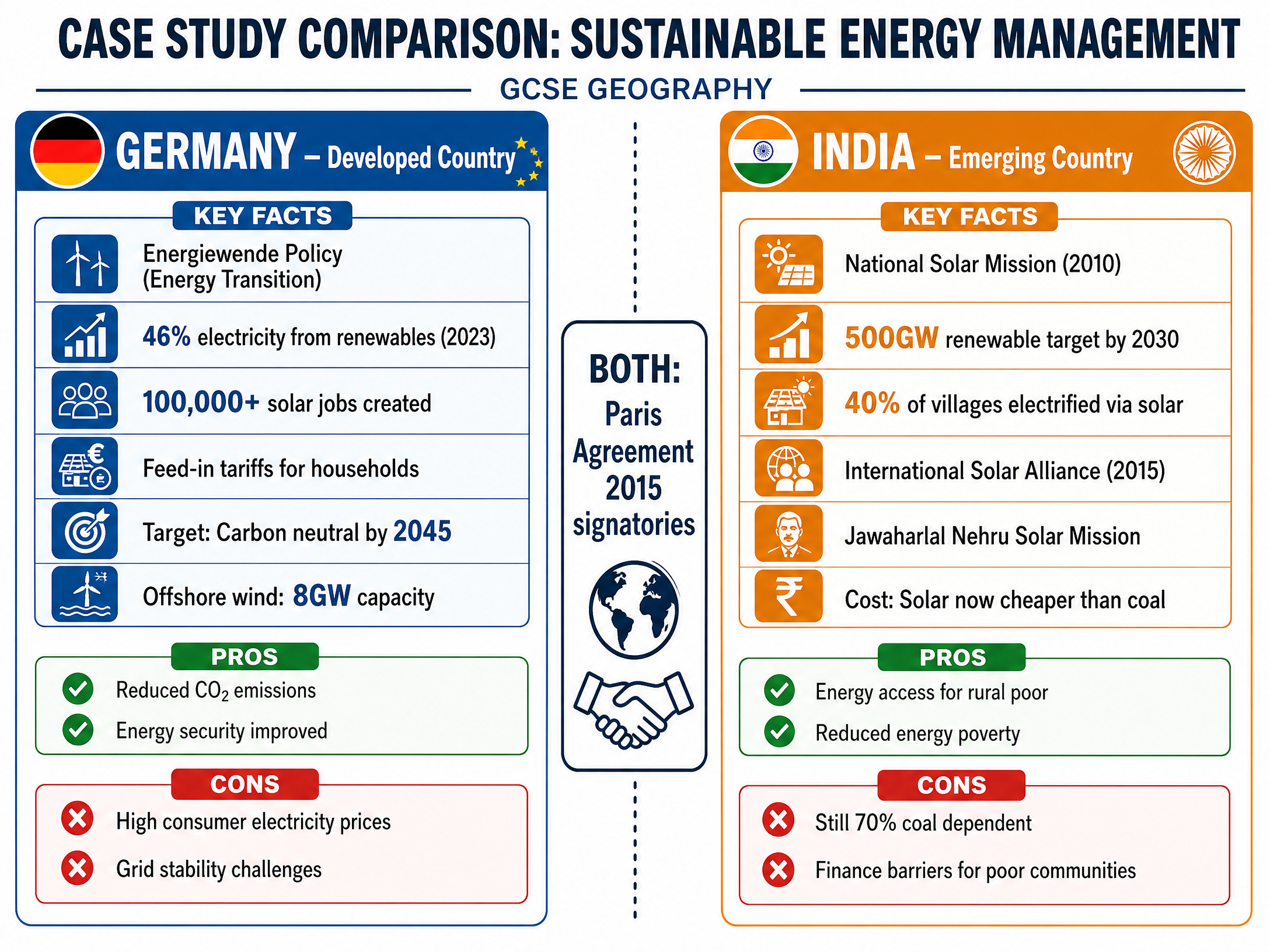
Case Study 1: Developed Country (Germany)
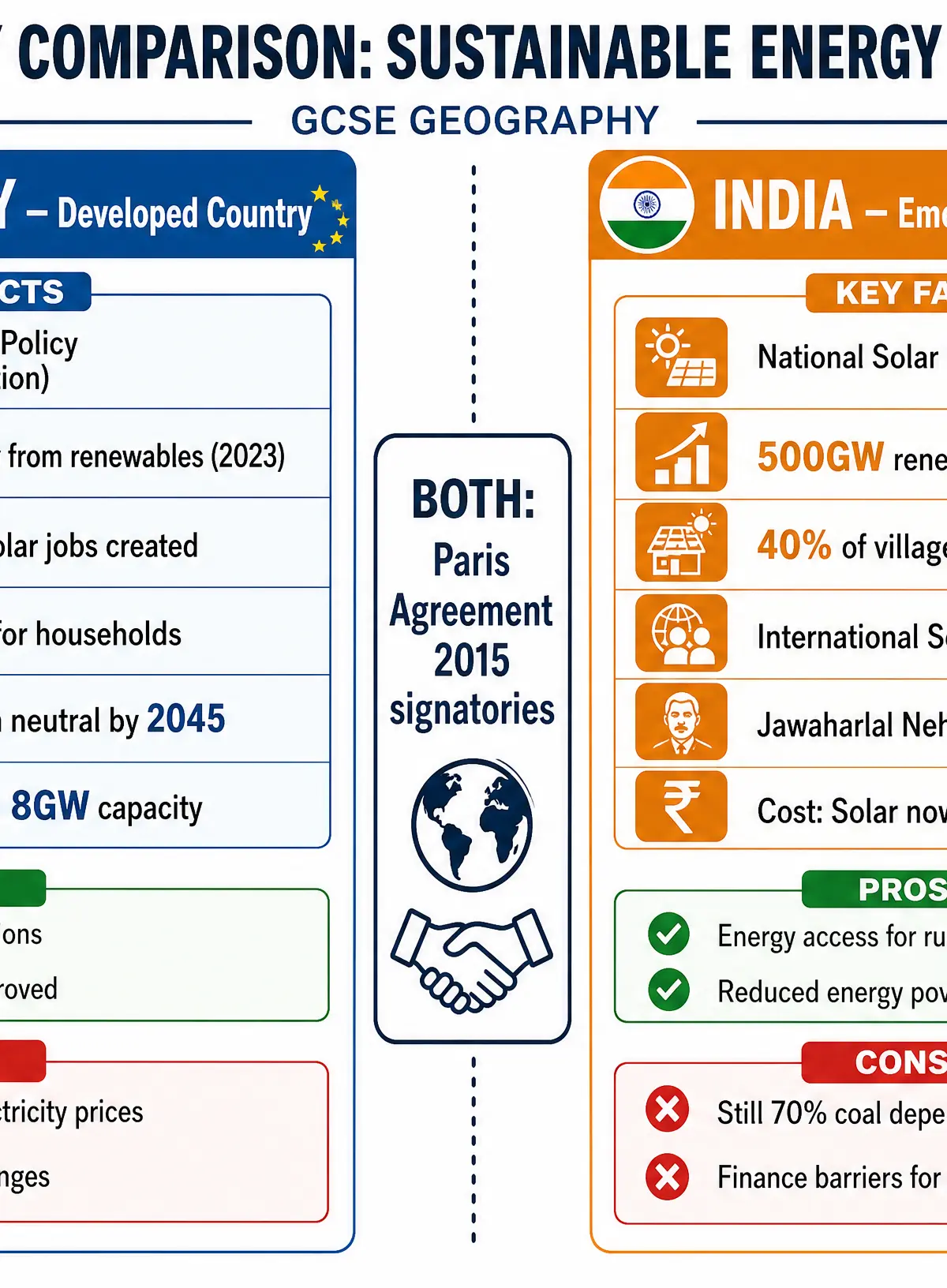
Germany provides an excellent example of a developed nation attempting a radical shift in its energy mix.
The Strategy: Energiewende (Energy Transition)
Launched in 2010, this is Germany's policy to transition to a low-carbon, nuclear-free economy.
Specific Knowledge & Implementation:
- Renewable Growth: By 2023, approx. 46% of Germany's electricity came from renewables.
- Feed-in Tariffs: The government guaranteed above-market prices for individuals generating solar power, heavily incentivising local-scale adoption.
- Offshore Wind: Massive investment in the North Sea, reaching 8GW of installed capacity.
- Nuclear Phase-out: Accelerated following the 2011 Fukushima disaster, with the final plants closing in 2023.
Evaluation of Success
Positives:
- Significant reduction in domestic CO2 emissions.
- Creation of over 100,000 jobs in the renewable energy sector.
- Strong technological innovation exported globally.
Limitations:
- High Costs: German consumers pay some of the highest electricity prices in Europe due to the 'EEG surcharge' funding the transition.
- Grid Instability: The intermittent nature of wind/solar requires massive, expensive grid upgrades (the 'SuedLink' transmission lines).
- Coal Reliance: To compensate for the nuclear phase-out and the 2022 energy crisis, Germany controversially increased its reliance on highly polluting lignite (brown coal).
Case Study 2: Emerging Country (India)
India illustrates the tension between rapid economic development and sustainable management.
The Strategy: Rapid Renewable Expansion alongside Coal
India must provide energy for its 1.4 billion population while industrialising its economy.
Specific Knowledge & Implementation:
- National Solar Mission (2010): Originally targeted 20GW by 2022; India smashed this and now targets 500GW of non-fossil fuel capacity by 2030.
- International Solar Alliance: Co-founded by India in 2015 to promote solar investment across developing nations.
- Local Scale Impact: Solar micro-grids have electrified thousands of remote villages that were previously unconnected to the national grid.
Evaluation of Success
Positives:
- Massive reduction in 'energy poverty' for rural communities.
- Solar power is now cheaper than new coal plants in many Indian states.
- India is a global leader in solar deployment despite lower GDP per capita than Western nations.
Limitations:
- Fossil Fuel Dependence: India still generates roughly 70% of its electricity from coal.
- Development vs Environment: India argues it cannot sacrifice economic growth (which lifts millions out of poverty) to solve a climate crisis historically caused by developed nations.
- Financial Barriers: Upgrading the national grid to handle intermittent renewables requires hundreds of billions in international climate finance, which has been slow to materialise.
Visual Resources
3 diagrams and illustrations
Interactive Diagrams
1 interactive diagram to visualise key concepts
Conceptual Flow Outline
The Three Pillars of Sustainable Energy Management
Worked Examples
3 worked examples — open one to explore the question and available guidance.
Practice Questions
Test your understanding — click to reveal model answers
Explain one way that energy can be managed sustainably at a local scale. (2 marks)
Hint: Think about what an individual household or small village can do.
To what extent has a named emerging or developing country been successful in managing its energy resources sustainably? (9 marks + 3 SPaG)
Hint: Use India as your example. Balance the success of solar rollout against the ongoing reliance on coal.
Explain why international agreements are important for sustainable energy management. (4 marks)
Hint: Think about the global nature of climate change and the need for shared financial/technological resources.
Assess the view that economic factors are the biggest barrier to sustainable energy management. (6 marks)
Hint: Agree that costs are high, but counter-argue with other barriers like political will or geographical constraints.
State one characteristic of a sustainable energy supply. (1 mark)
Hint: Think of the Brundtland definition.