Pearson Edexcel · GCSE · Geography
Meeting the demands for energy resources can involve interventions by different interest groups
This topic explores the complex challenge of meeting global energy demands while balancing the competing interests of different stakeholders. It is crucial for the exam as it tests your ability to evaluate sustainable management strategies using real-world case studies from developed and emerging economies.
- 6 min read
- 3 worked examples
- 5 practice questions
- 6 key terms
Study Notes
Overview
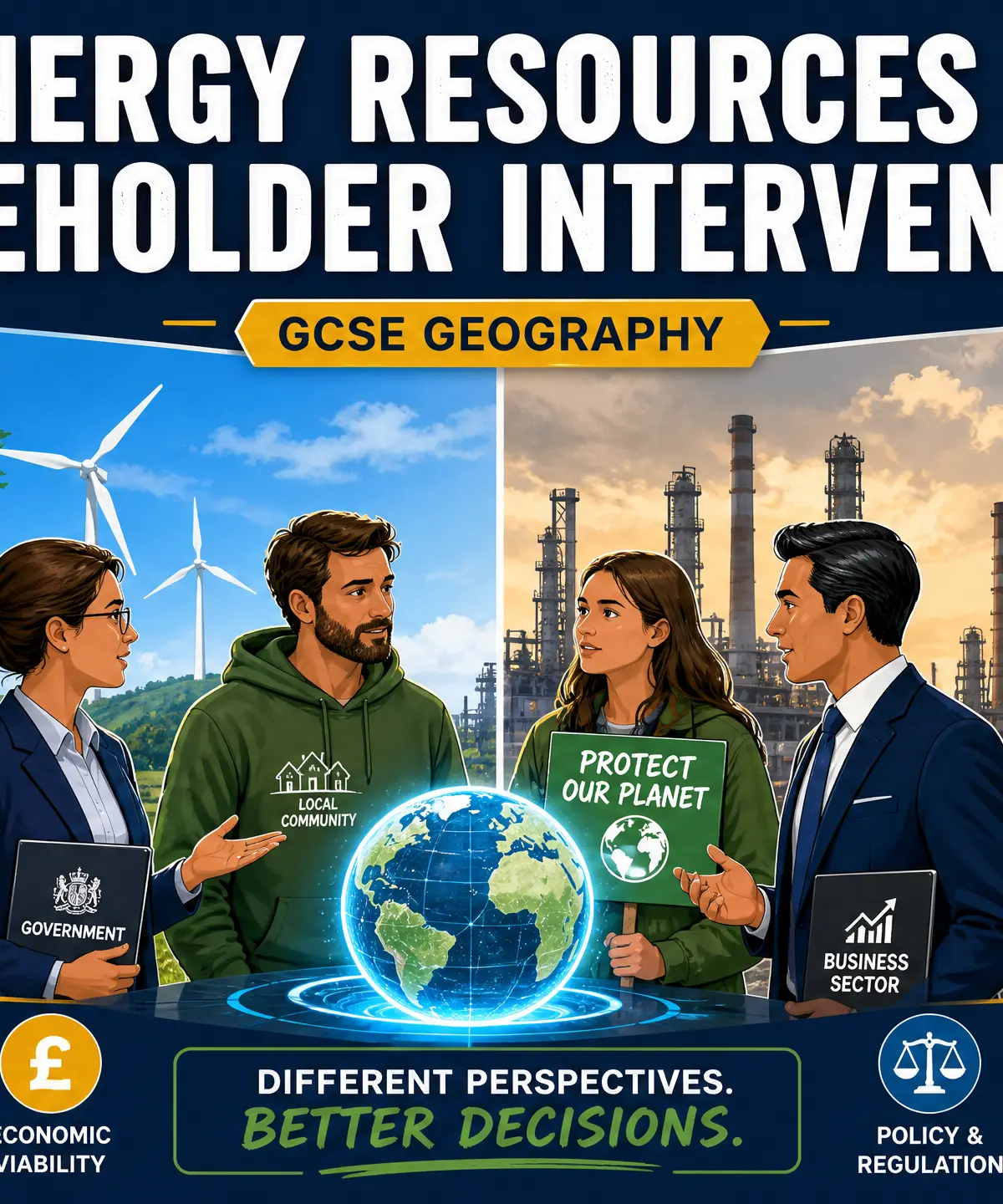
Meeting the global demand for energy is one of the most pressing geographical challenges of the 21st century. As populations grow and countries industrialise, the need for power increases. However, the exploitation and consumption of energy resources—both renewable and non-renewable—involve complex decisions that affect various stakeholders differently. Examiners expect you to understand not just where energy comes from, but who makes the decisions and why different groups might support or oppose them. This topic requires you to evaluate sustainable management strategies at local, national, and international scales, supported by specific case study evidence from one developed country and one emerging or developing country.

The Stakeholders
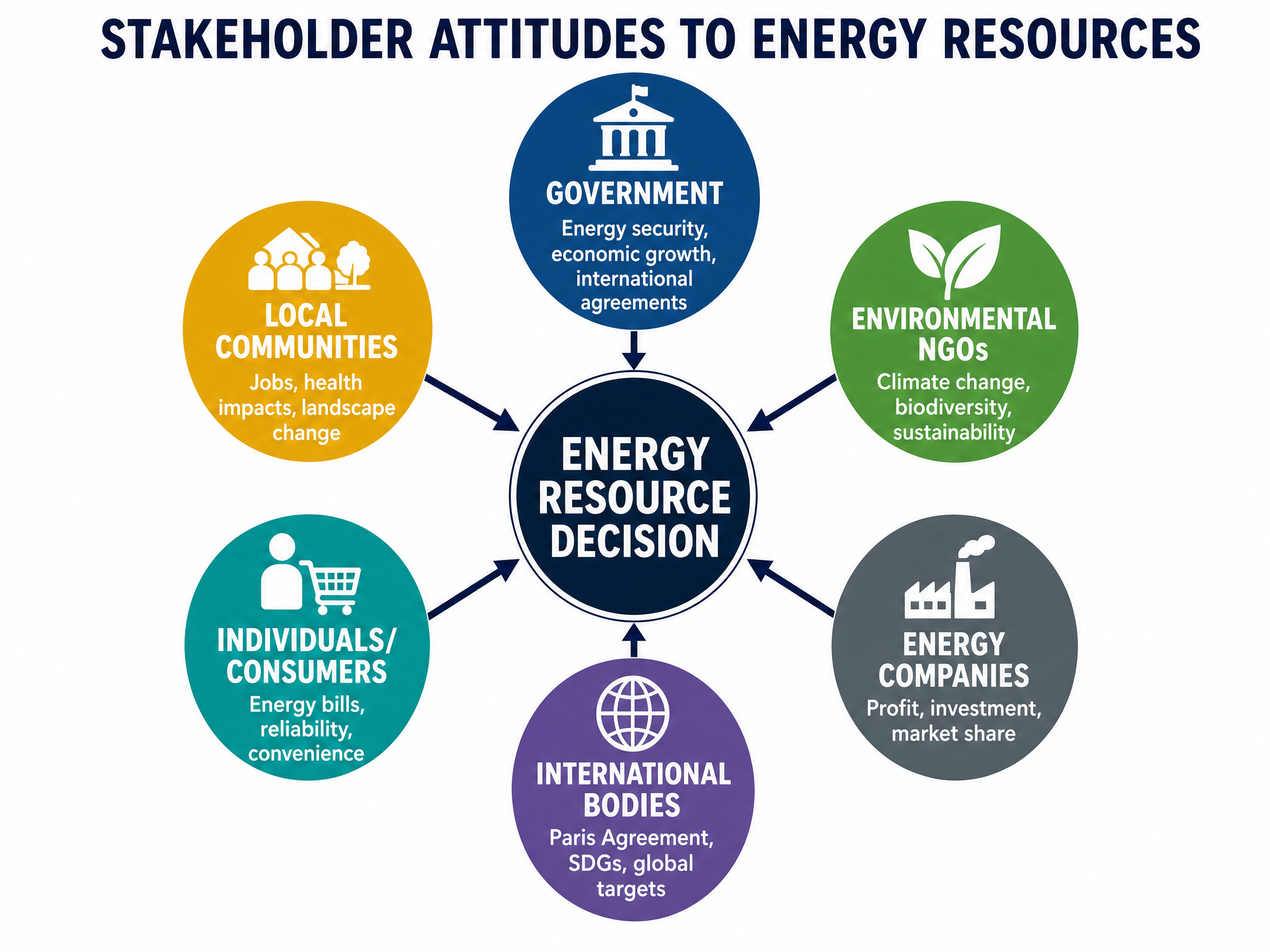
A stakeholder is any individual, group, or organisation with an interest in, or affected by, a particular decision or development. In energy management, there are six main groups, each with distinct attitudes.
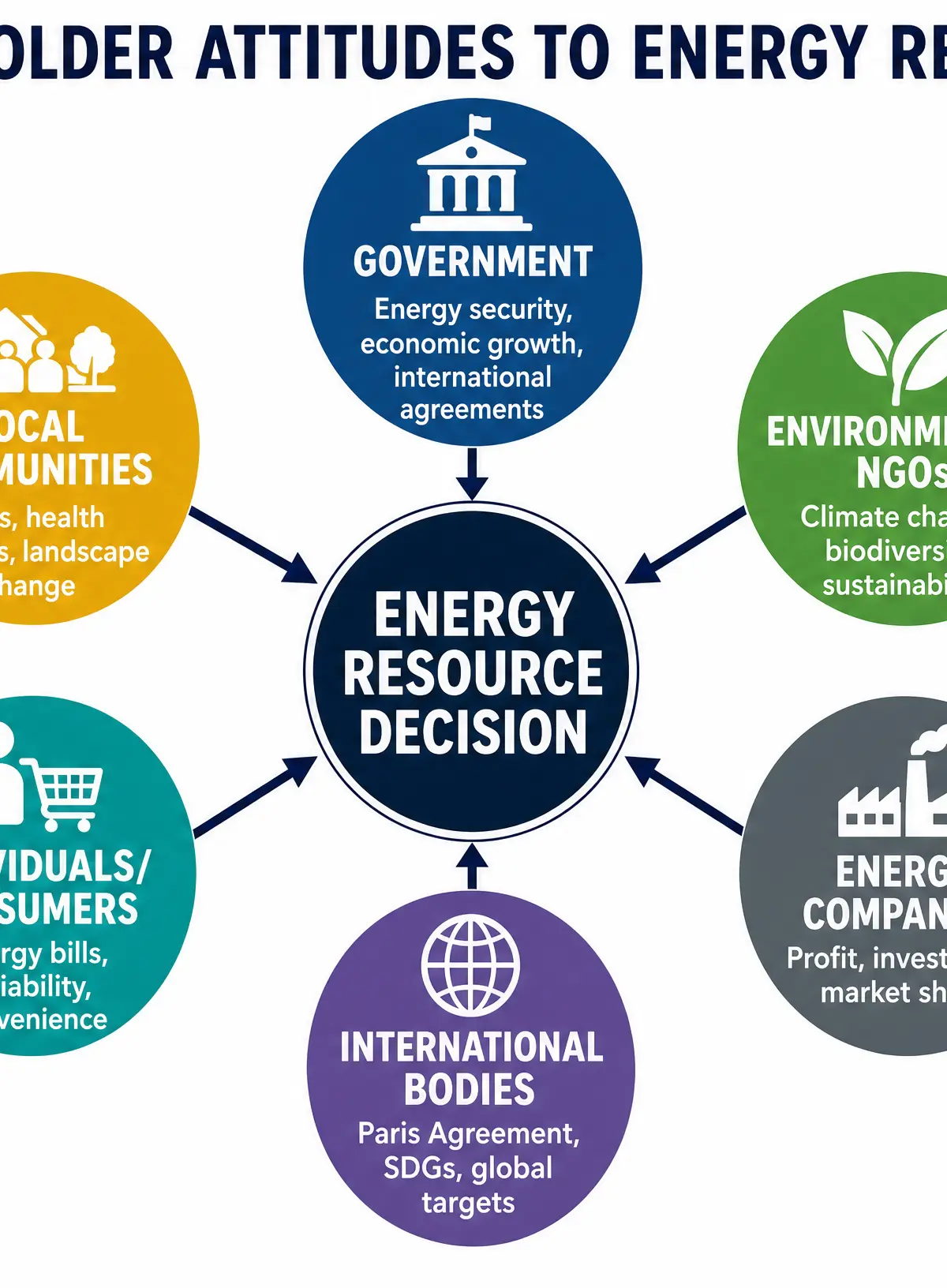
1. Governments
Role: National and local authorities responsible for policy, regulation, and taxation.
Attitude: Focused on energy security (ensuring reliable supply), economic growth, and meeting international environmental commitments (like the Paris Agreement). They often have to balance the immediate need for cheap energy against long-term sustainability goals.
2. Energy Companies (TNCs)
Role: Transnational corporations (like Shell or BP) that extract, process, and distribute energy.
Attitude: Primarily driven by profit and shareholder returns. Historically focused on fossil fuels, many are now transitioning to renewables as technology costs fall and government regulations tighten.
3. Local Communities
Role: People living near energy infrastructure (e.g., wind farms, coal mines, nuclear plants).
Attitude: Often concerned with immediate impacts. They may support projects that bring jobs and investment, but strongly oppose those that cause noise, visual pollution, or health risks (a phenomenon known as NIMBY-ism: Not In My Back Yard).
4. Environmental NGOs
Role: Non-governmental organisations like Greenpeace or Friends of the Earth.
Attitude: Prioritise environmental protection, biodiversity, and rapid decarbonisation to mitigate climate change. They often campaign against fossil fuel extraction and advocate for sustainable, renewable alternatives.
5. International Bodies
Role: Organisations like the United Nations (UN) or the Intergovernmental Panel on Climate Change (IPCC).
Attitude: Focus on global cooperation, setting emission reduction targets, and promoting sustainable development (e.g., UN Sustainable Development Goal 7: Affordable and Clean Energy).
6. Consumers / Individuals
Role: The general public who use energy for homes and transport.
Attitude: Generally want reliable, affordable energy. While many support green energy in principle, their choices are often constrained by cost and convenience.
Case Studies: Sustainable Energy Management
Examiners require you to use specific named examples of how countries manage energy resources sustainably. You must contrast a developed country with an emerging/developing country.
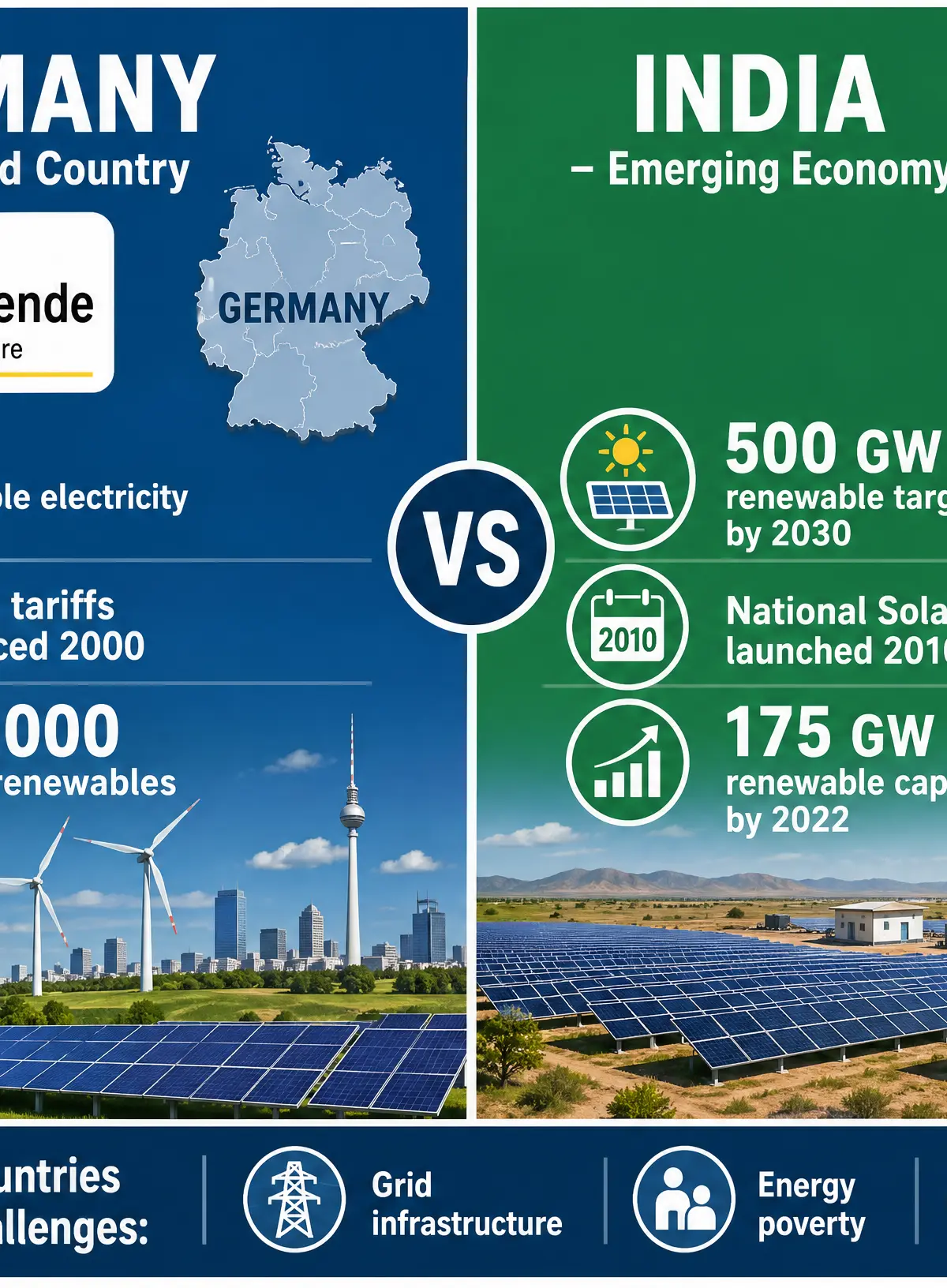
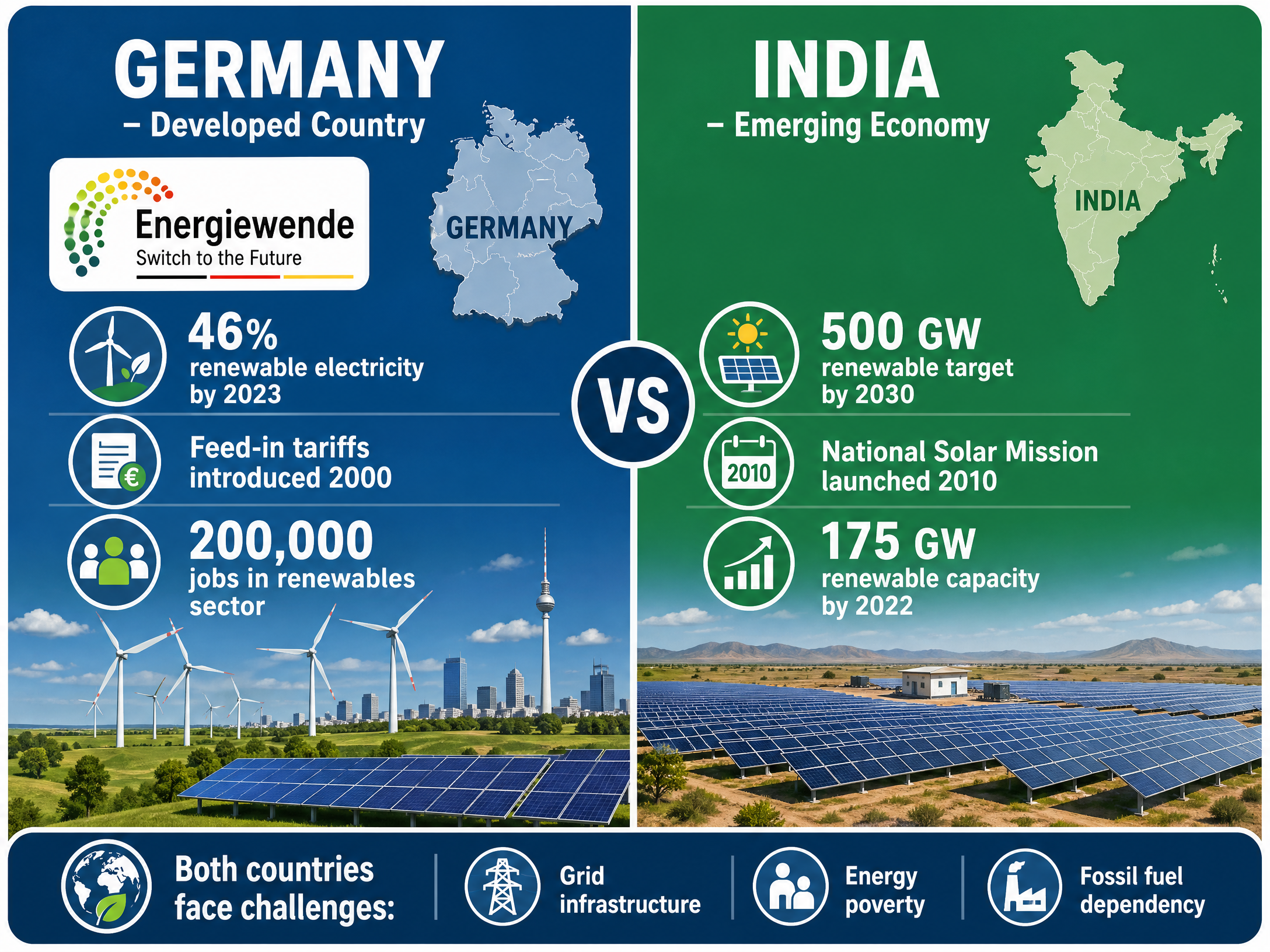
Developed Country: Germany (The Energiewende)
What happened: In 2000, Germany launched the Energiewende (Energy Transition), a national policy to move away from fossil fuels and nuclear power towards a low-carbon, renewable-heavy energy system.
Key Actions & Specific Knowledge:
- Feed-in Tariffs: The 2000 Renewable Energy Sources Act guaranteed above-market prices for renewable electricity fed into the grid, incentivising investment.
- Results: By 2023, approx. 46% of Germany's electricity came from renewables (mainly wind and solar).
- Economic Impact: The renewable sector employs over 200,000 people.
- Challenges: Phasing out nuclear (accelerated after Fukushima in 2011) and coal (target 2038) simultaneously led to short-term reliance on imported natural gas, causing energy security issues and price spikes following the 2022 Russian invasion of Ukraine.
Stakeholder Conflict: The government pushed the transition, but energy companies initially resisted the loss of fossil fuel assets. Local communities sometimes opposed wind farms (NIMBY-ism), while NGOs criticised the slow phase-out of coal.
Emerging Economy: India (National Solar Mission)
What happened: India faces the dual challenge of lifting millions out of energy poverty while managing its status as the world's third-largest greenhouse gas emitter.
Key Actions & Specific Knowledge:
- National Solar Mission (2010): Aimed to establish India as a global leader in solar energy.
- Targets & Results: Achieved 175 GW of renewable capacity by 2022; new target is 500 GW by 2030.
- Pavagada Solar Park: A 2,000 MW facility in Karnataka (completed 2019). Uniquely, the land was leased from local farmers, providing them with guaranteed rental income and reducing community opposition.
- Challenges: India remains heavily reliant on coal (approx. 70% of electricity) because it is cheap, abundant locally, and essential for rapid industrialisation.
Stakeholder Conflict: The government must balance international pressure (UN, NGOs) to decarbonise against the urgent need to provide cheap electricity to its 1.4 billion citizens and protect jobs in the coal industry.
Core Geographical Concepts
Energy Security vs. Sustainability
The tension between ensuring a reliable, affordable energy supply (security) and protecting the environment for future generations (sustainability). Stakeholders weigh these differently.
The Energy Mix
The combination of different energy sources a country uses. A diverse mix improves energy security by reducing reliance on a single source or supplier.
Scale of Intervention
Interventions happen at different scales: local (community energy projects), national (government subsidies like feed-in tariffs), and international (Paris Agreement targets).
Worked Examples
3 worked examples — open one to explore the question and available guidance.
Practice Questions
Test your understanding — click to reveal model answers
State two groups of stakeholders who might have an interest in a new energy development. (2 marks)
Hint: Think of the GENIIC acronym.
Explain why a national government might continue to support the extraction of non-renewable energy resources. (4 marks)
Hint: Think about the economy and energy security.
Using a named example of an emerging or developing country, explain one strategy used to manage energy resources sustainably. (4 marks)
Hint: Use the India case study and the Pavagada Solar Park.
To what extent do local communities and energy companies have conflicting views on renewable energy developments? (6 marks)
Hint: Provide a balanced argument. When do they conflict? When might they agree?
'The transition to sustainable energy is entirely dependent on the actions of national governments.' Assess this statement. (9 marks)
Hint: Governments are important, but what about NGOs, International Bodies, and Energy Companies?