Pearson Edexcel · GCSE · Geography
The interactions of economic, social and demographic processes influence the development of the chosen developing or emerging country
This topic explores the dramatic transformation of emerging economies, using India as a prime example. Understanding how economic growth, demographic shifts, and social changes interact is crucial for scoring high marks in GCSE Geography.
- 4 min read
- 3 worked examples
- 5 practice questions
- 6 key terms
Study Notes
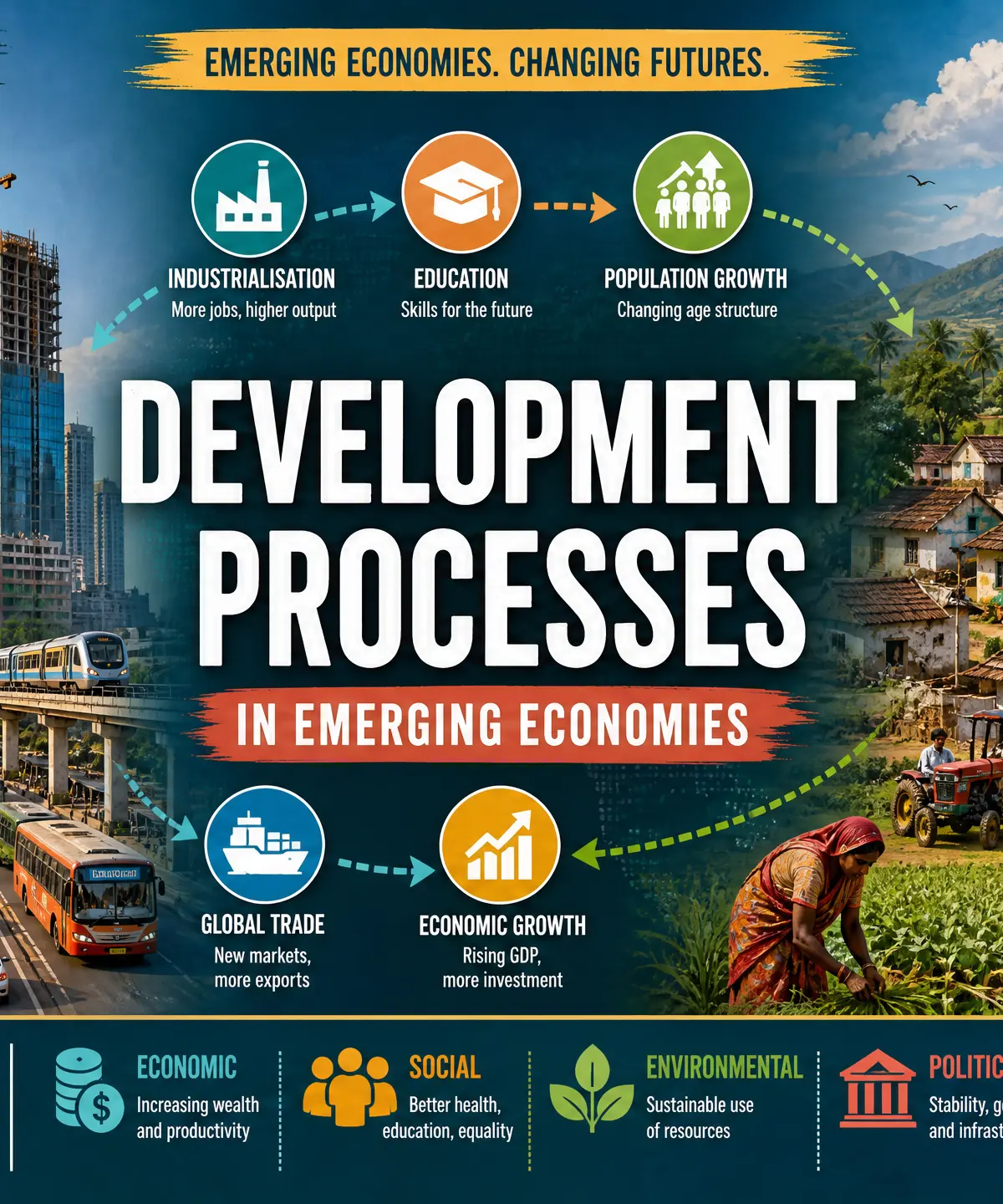
Overview
The development of emerging countries is a complex, interconnected process. Examiners want you to understand that economic growth does not happen in isolation—it is deeply linked to demographic changes (like falling birth rates and rising life expectancy) and social transformations (like better education and a growing middle class). This topic requires you to understand these processes, explain how they interact, and evaluate both the positive and negative impacts of rapid development. We will use India as our primary case study, as it provides excellent, mark-winning data for your exam answers.

Key Economic Processes
Sectoral Shift
Date(s): 1990 to present
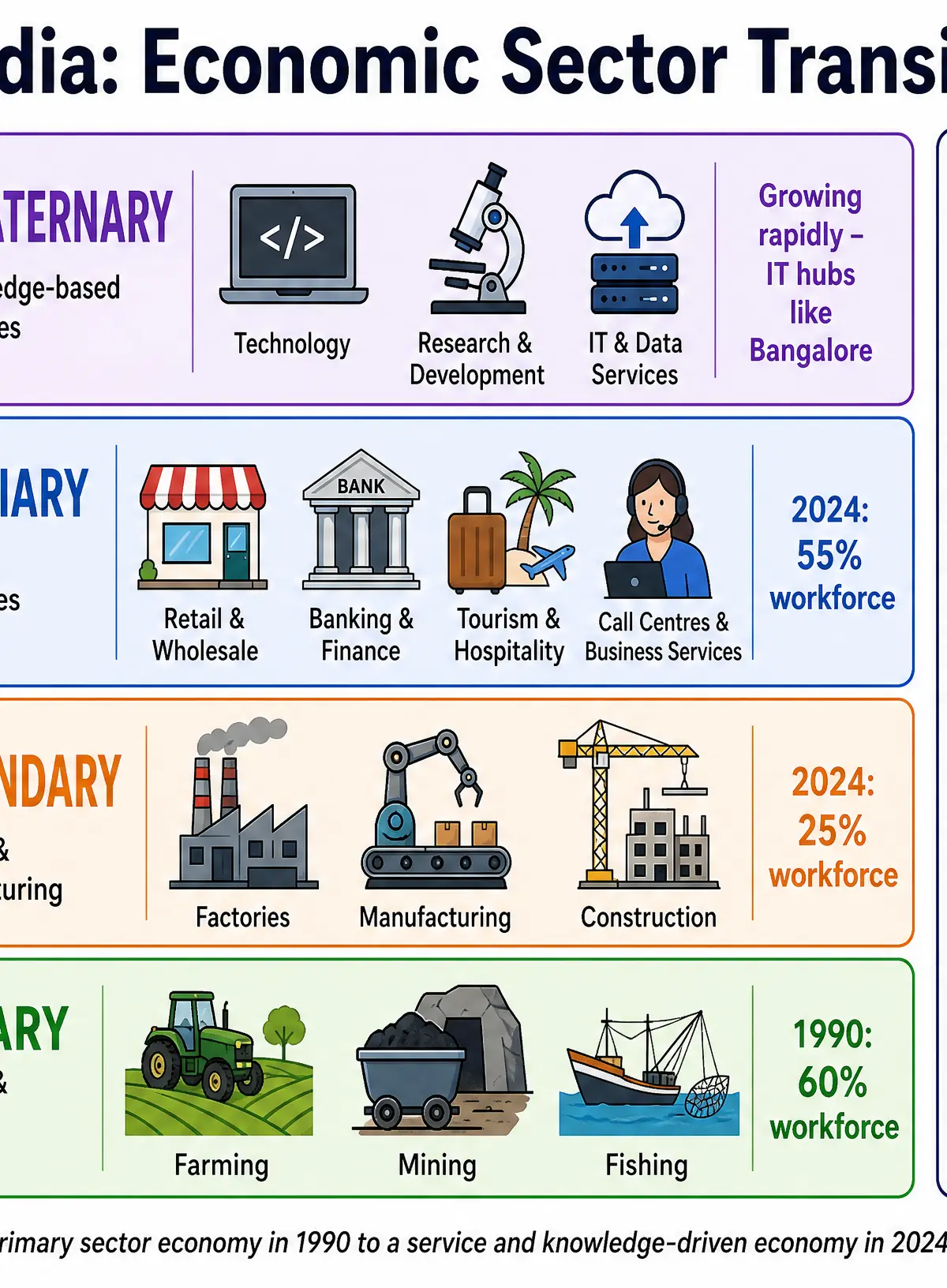
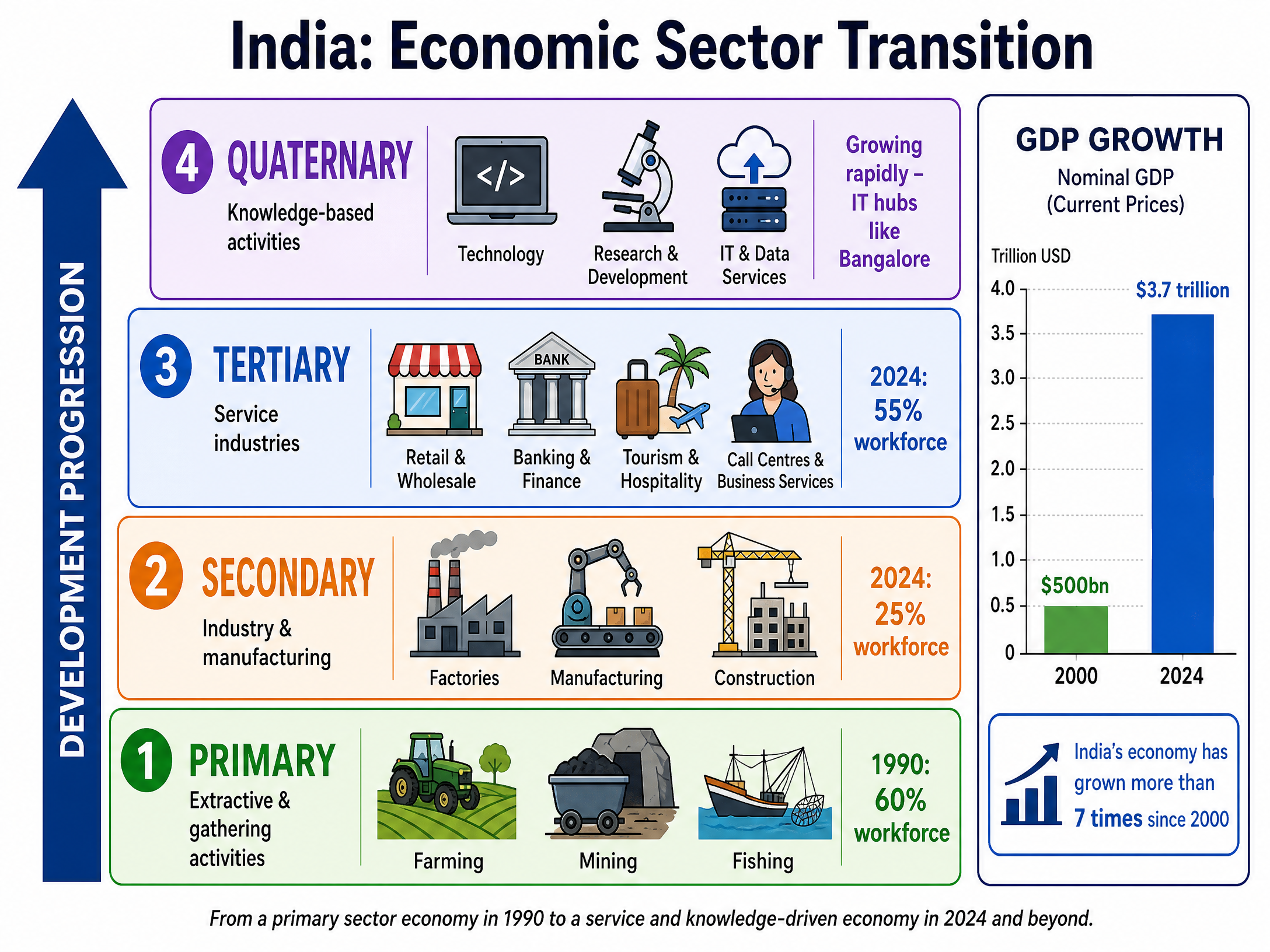
What happened: India has transitioned from an economy dominated by the primary sector to one driven by the tertiary and quaternary sectors.
Why it matters: This shift has driven massive GDP growth and created a new middle class, but it has also led to uneven development between urban tech hubs and rural agricultural areas.
Specific Knowledge: In 1990, 60% of the workforce was in the primary sector. By 2024, the tertiary sector employed 55% of the workforce. GDP grew from 500 billion in 2000 to3.7 trillion in 2024.
Trade and Investment
Date(s): Post-1991 economic reforms
What happened: India opened its economy to foreign direct investment (FDI) and transnational corporations (TNCs).
Why it matters: International trade integrated India into the global economy, creating jobs and transferring technology.
Specific Knowledge: TNCs like Amazon and Apple invest in India, while domestic TNCs like Tata and Infosys operate globally.
Key Demographic Processes
Demographic Transition
Date(s): 1990 to present
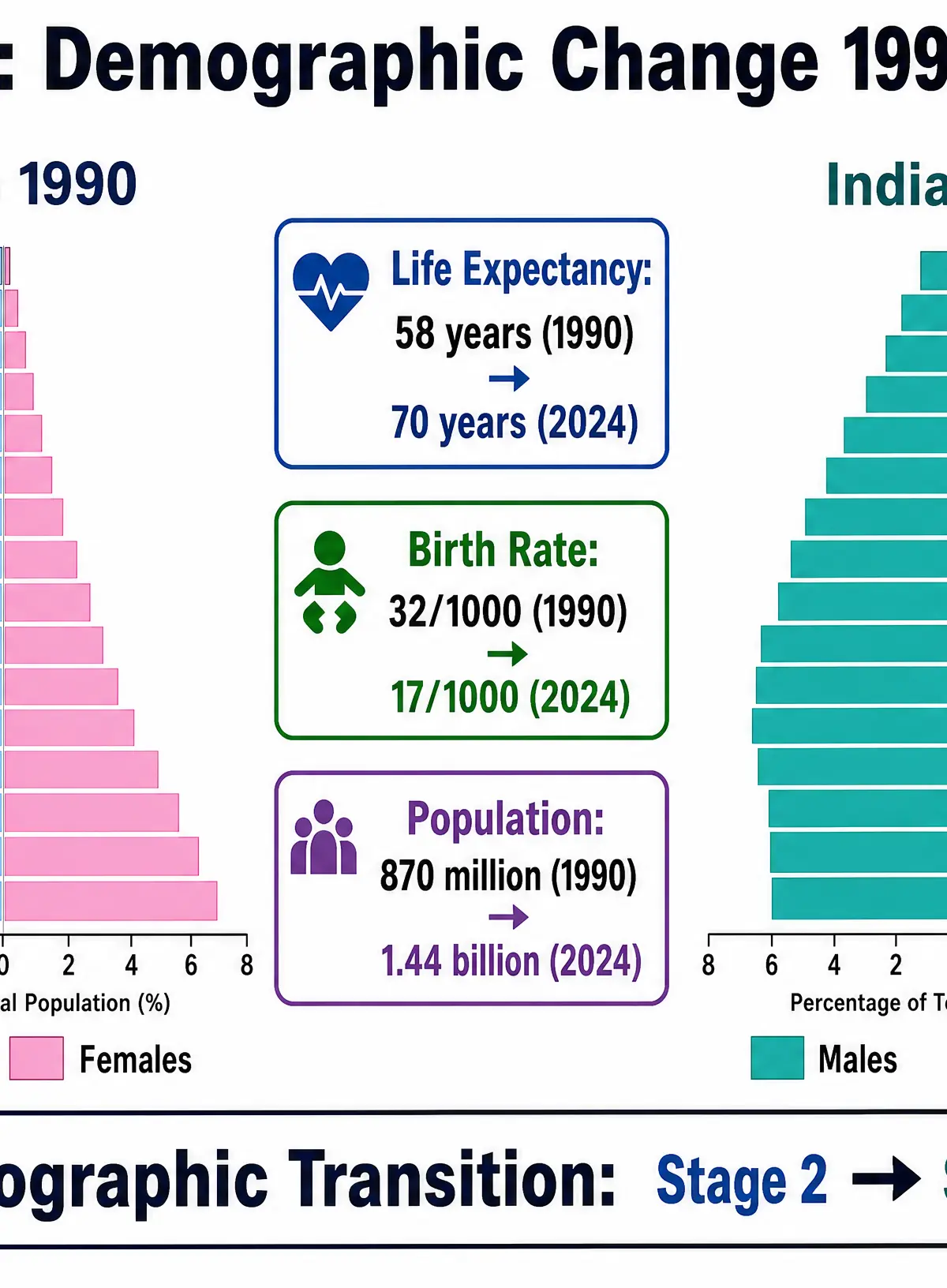
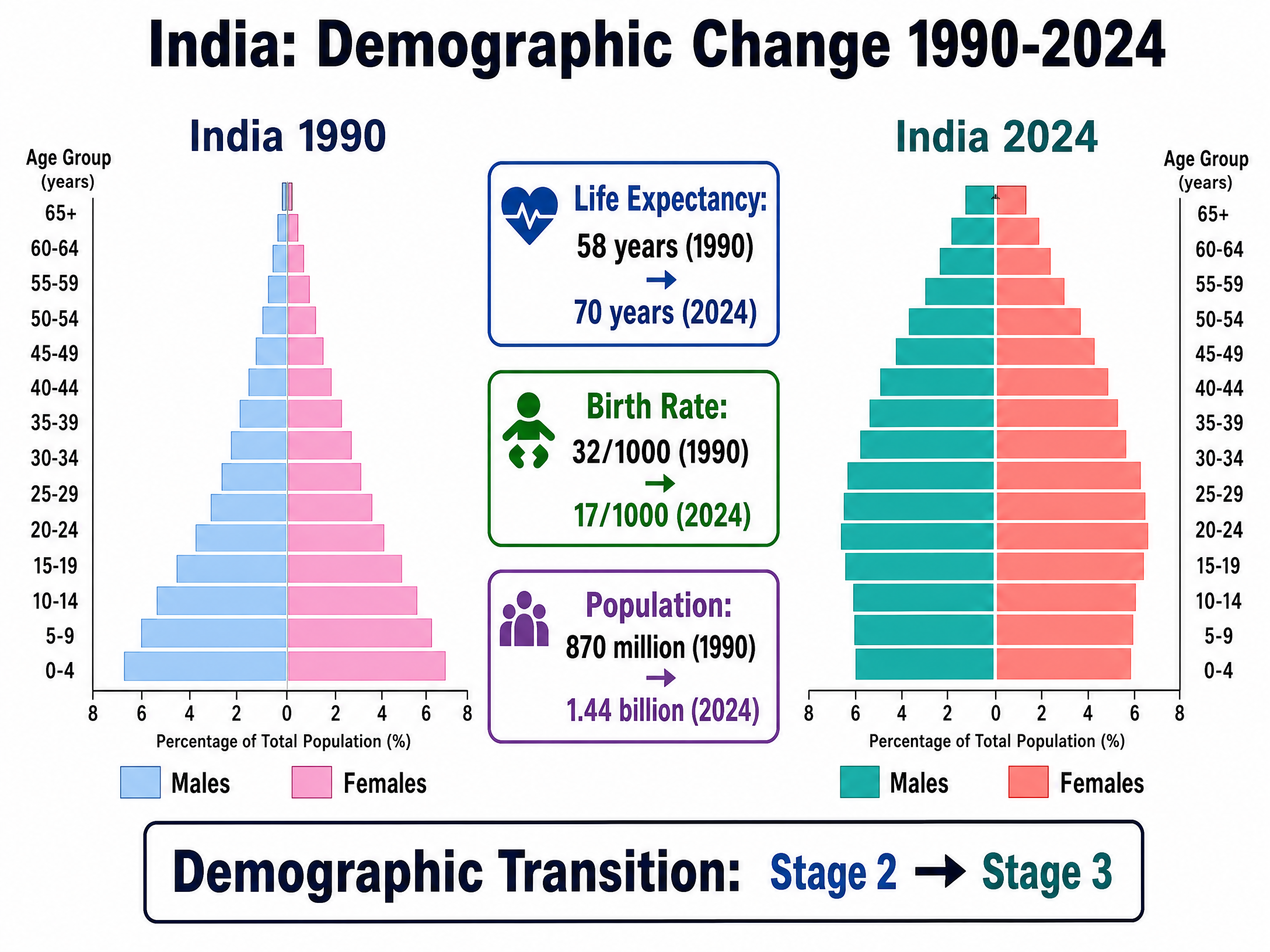
What happened: India's population structure has changed from a classic wide-base pyramid to a more rectangular shape with a large working-age population.
Why it matters: This creates a 'demographic dividend'—a large workforce that can drive economic growth and productivity.
Specific Knowledge: Birth rates fell from 32/1000 in 1990 to 17/1000 in 2024. Life expectancy rose from 58 to 70 years. The total population reached 1.44 billion.
Key Social Processes
Rise of the Middle Class and Inequality
Date(s): Ongoing
What happened: While 300 million people have entered the middle class, inequality remains high.
Why it matters: Development is uneven. Urban 'cores' gain wealth rapidly, while rural 'peripheries' lag behind.
Specific Knowledge: India's Gini coefficient is approximately 0.35. Literacy rates improved from 52% (1990) to 77% (2024).
Managing the Impacts of Development
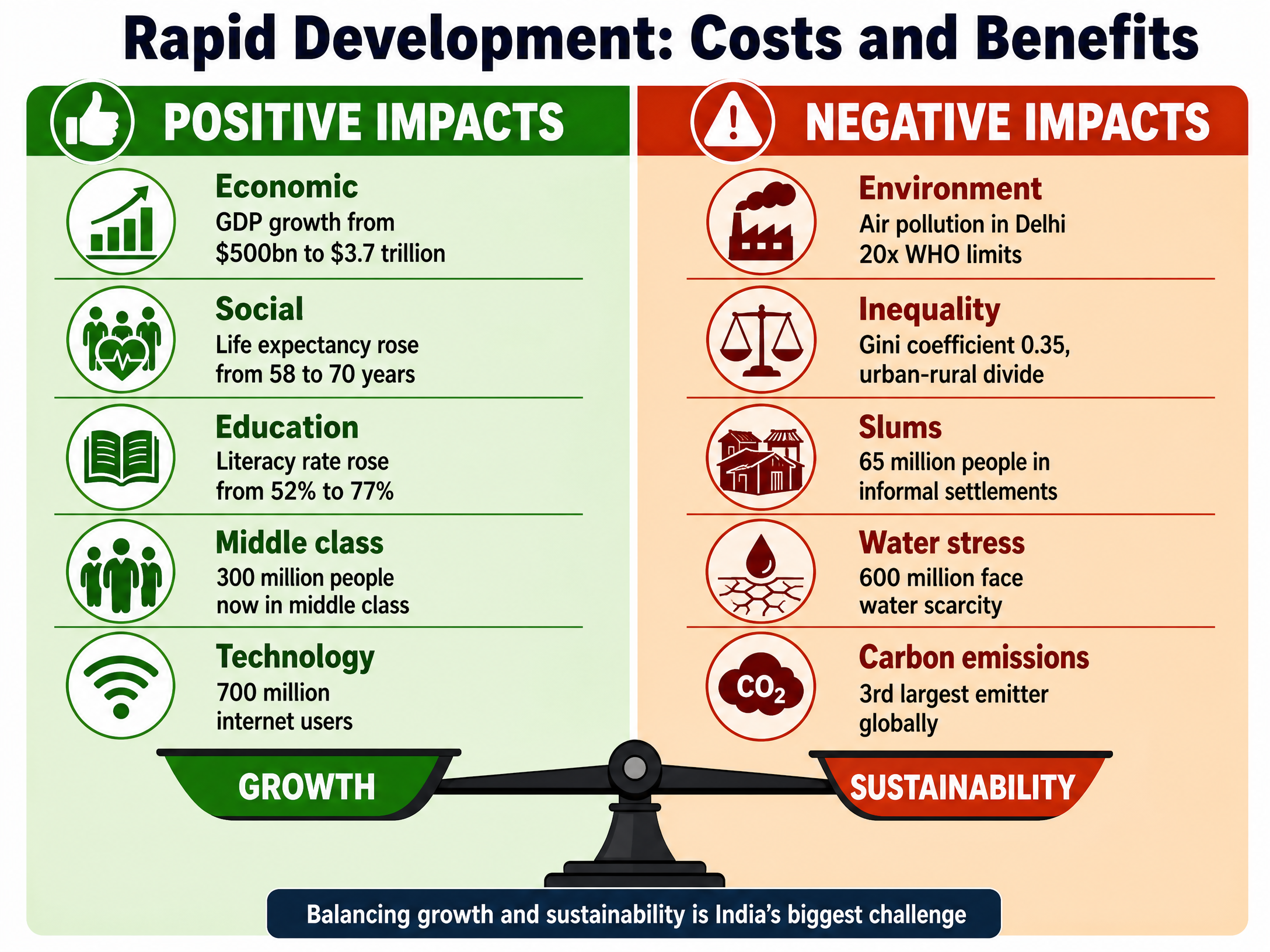
Rapid development brings both benefits and severe costs.
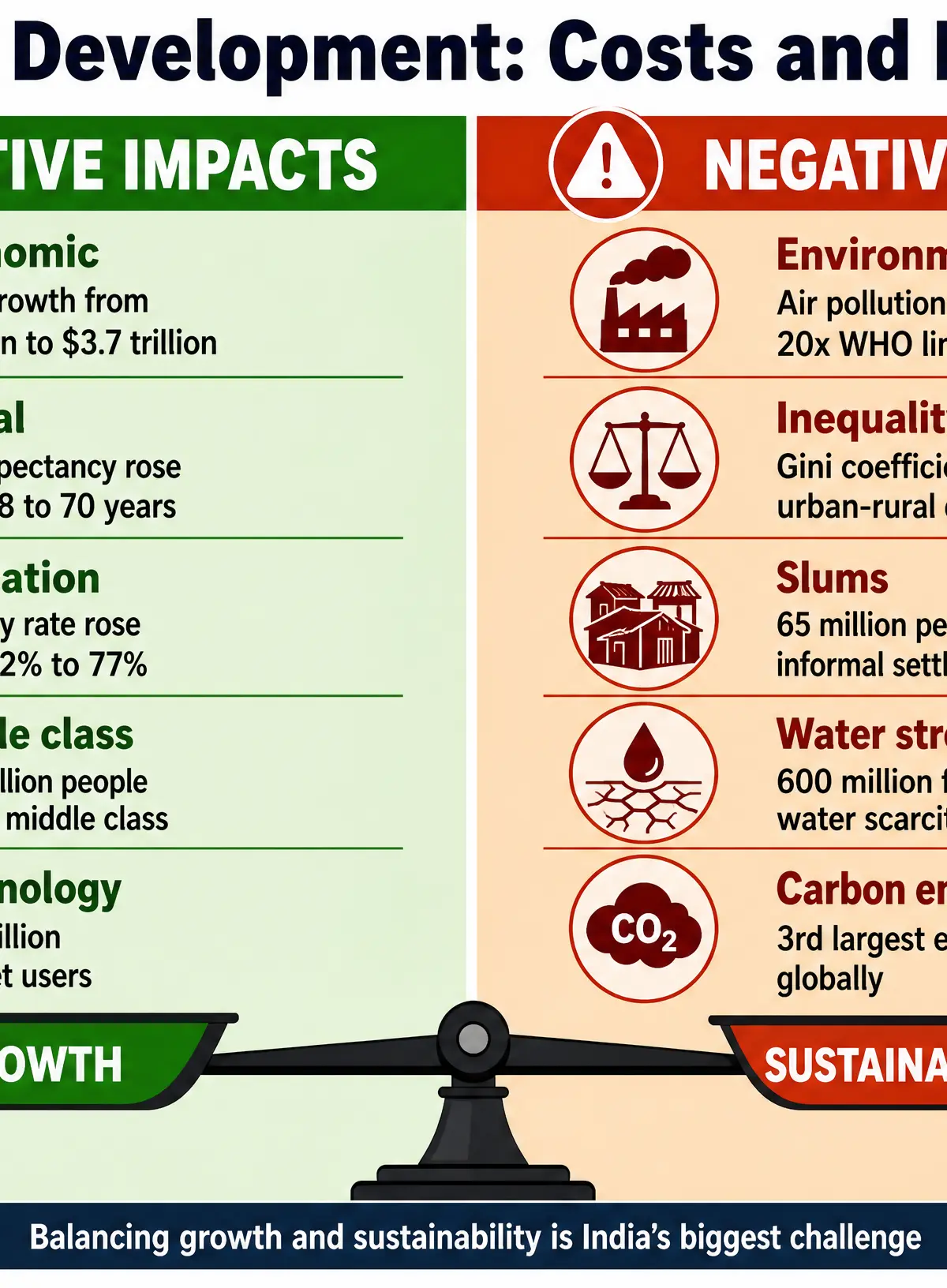
Positive Impacts: Higher incomes, better healthcare, improved education, global influence.
Negative Impacts: Severe air pollution (Delhi often exceeds WHO limits by 20x), water scarcity (affecting 600 million), and the growth of informal settlements (65 million people).
Management Strategies: The government uses public investment to manage these impacts, such as the Smart Cities Mission and the Swachh Bharat (Clean India) Mission to improve sanitation.
Visual Resources
3 diagrams and illustrations
Interactive Diagrams
1 interactive diagram to visualise key concepts
Conceptual Flow Outline
How demographic changes drive economic growth
Worked Examples
3 worked examples — open one to explore the question and available guidance.
Practice Questions
Test your understanding — click to reveal model answers
For a named emerging country, explain how international trade and investment have influenced its economic development. (6 marks)
Hint: Name India. Discuss TNCs, FDI, and the growth of specific sectors like IT or manufacturing.
Assess the extent to which social development has kept pace with economic development in a named emerging country. (9 marks)
Hint: Look at both sides. Where has social development succeeded (education, life expectancy)? Where has it failed (inequality, slums)?
Describe the changes in employment sectors as a country develops. (3 marks)
Hint: Think about the transition from farming to factories to services.
State two ways the government can manage the negative impacts of rapid development. (2 marks)
Hint: Think about specific Indian government policies.
Explain one reason why rapid economic development can lead to environmental degradation. (2 marks)
Hint: Link industrial growth to a specific environmental problem.