Pearson Edexcel · GCSE · Geography
The level of development of the chosen developing or emerging country is influenced by its location and context in the world
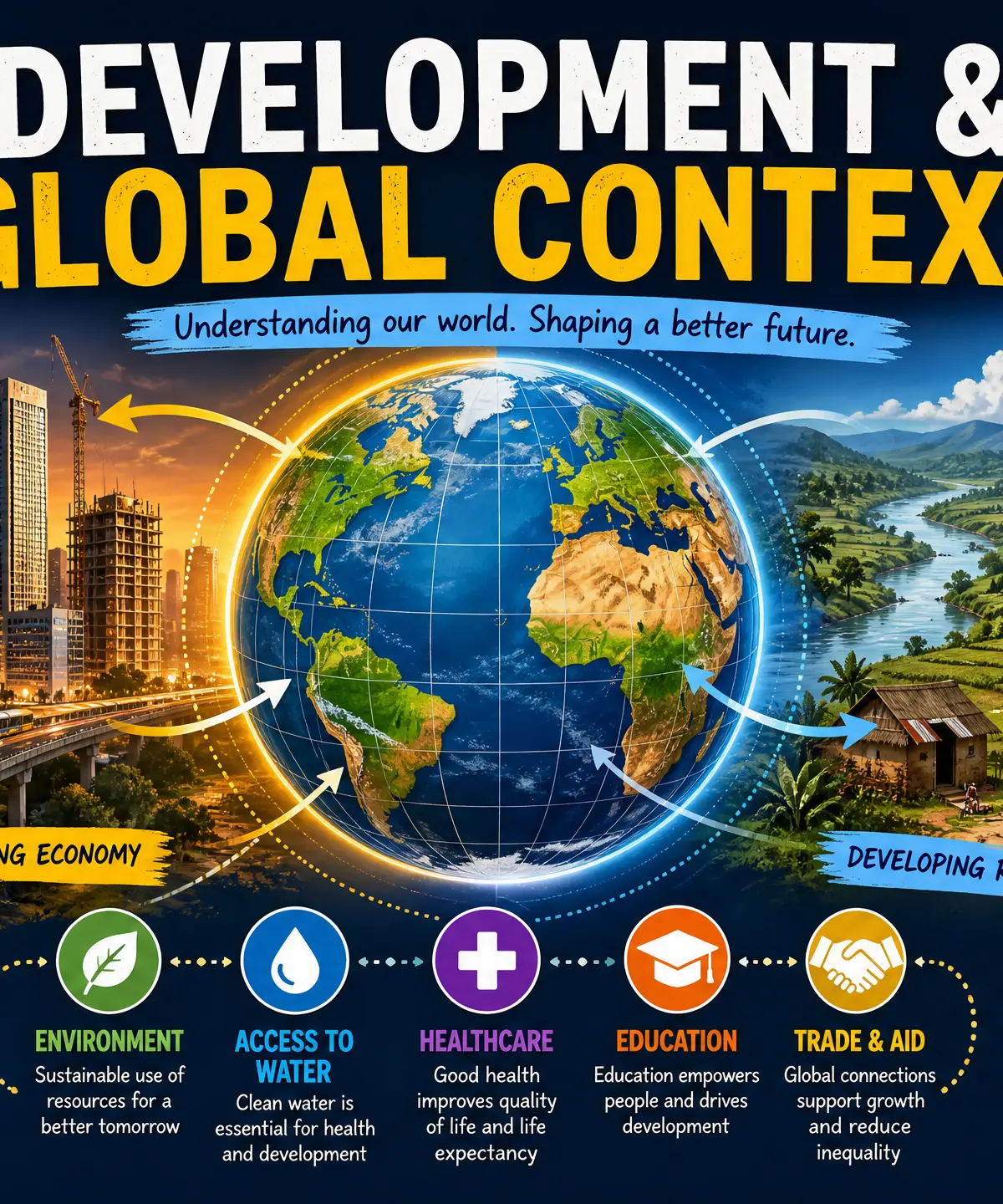
Development is deeply unequal across the globe, shaped by a complex web of physical location, historical legacies, and political decisions. This study guide unpacks the core-periphery model and uses Nigeria as a detailed case study to show how a country's context influences its growth, preparing you to tackle high-mark evaluation questions with specific evidence.
- 6 min read
- 3 worked examples
- 5 practice questions
- 6 key terms
Study Notes
Overview
This topic examines how the level of development of a chosen developing or emerging country is shaped by its geographical location, global context, and internal regional disparities. Examiners are looking for your ability to move beyond simplistic explanations (like "they are poor because they have no money") and instead analyze the interconnected physical, historical, economic, and political factors that drive or hinder progress. Using Nigeria as our primary case study, we will explore the core-periphery model and understand why development is uneven within a single nation. To achieve top marks, you must use specific, located examples and accurate statistics rather than vague generalizations.
Listen to the companion podcast for a comprehensive overview of this topic:

The Concept of Development
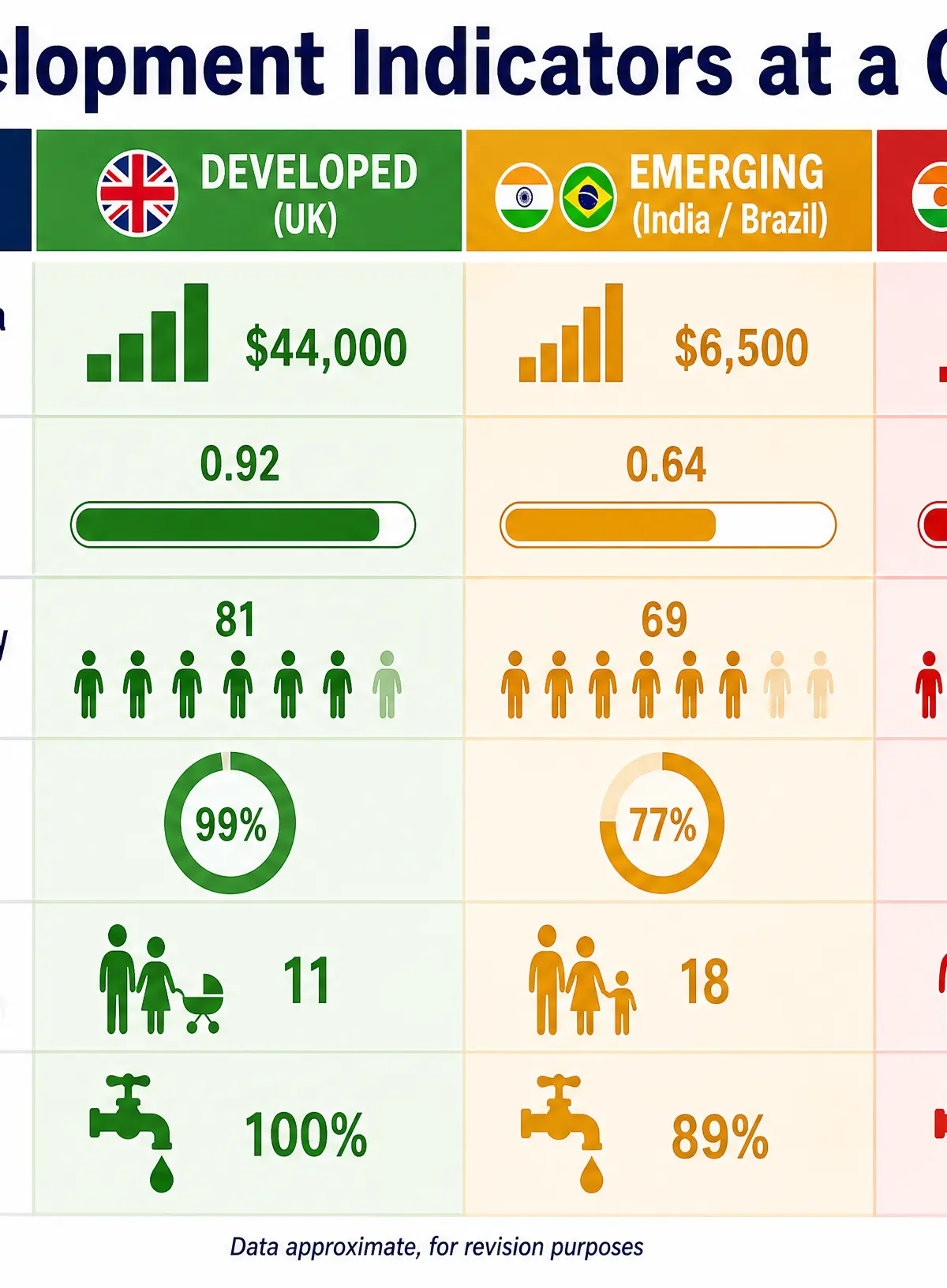
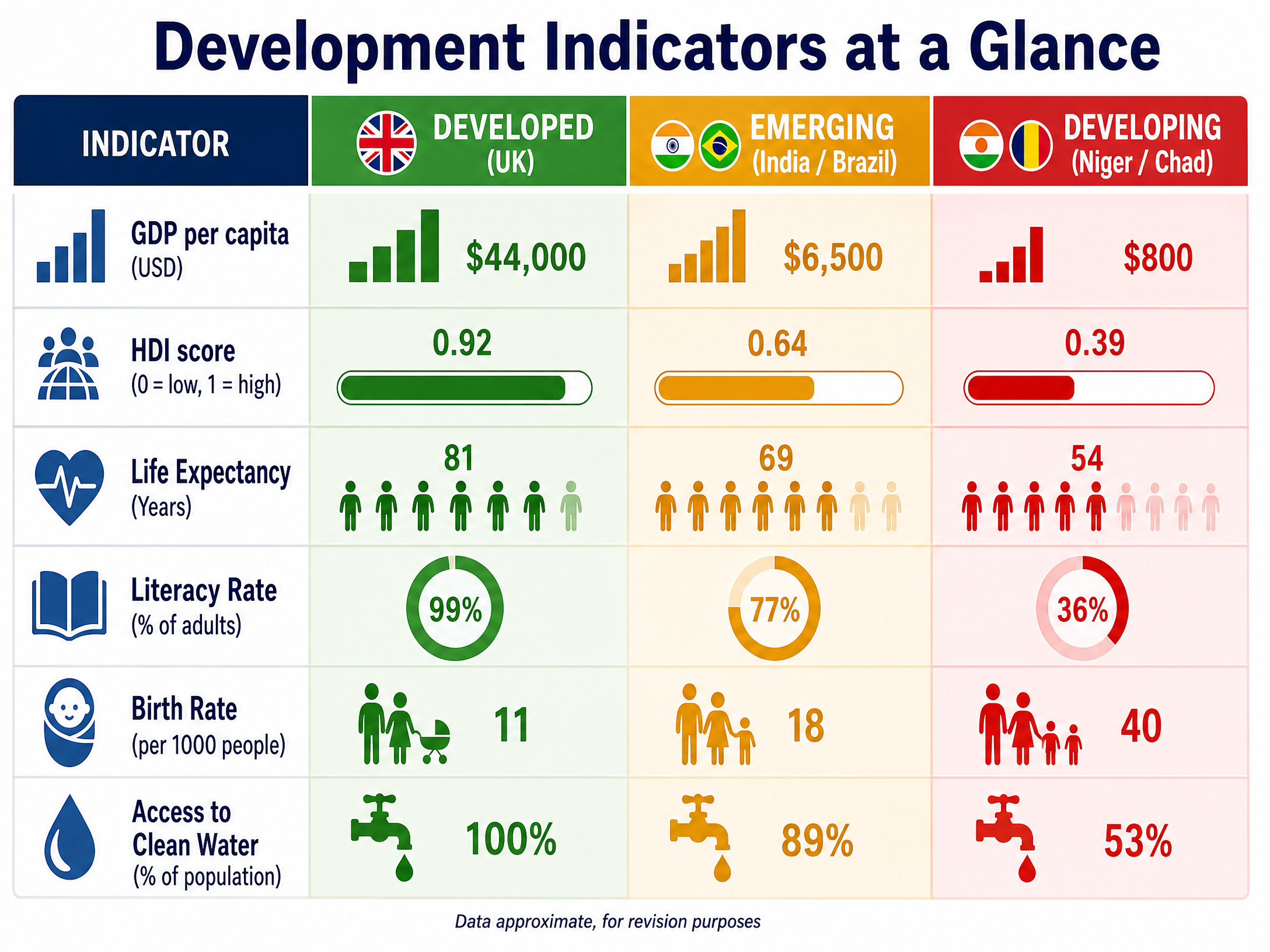
Development is the process of change that improves the quality of life and standard of living of a population. It is measured using various indicators.
Measuring Development
Economic Indicators:
- Gross Domestic Product (GDP): The total value of goods and services produced by a country in a year.
- GNI per capita: Gross National Income divided by the population.
Social Indicators:
- Life Expectancy: The average age a person is expected to live.
- Literacy Rate: The percentage of adults who can read and write.
- Infant Mortality Rate: The number of babies who die before their first birthday per 1000 live births.
Composite Indicators:
- Human Development Index (HDI): A score between 0 and 1 combining life expectancy, education (years of schooling), and income (GNI per capita). Examiners prefer HDI because it provides a broader picture of well-being than economic data alone.
Case Study: Nigeria's Global Context
Nigeria is an emerging country (or Newly Emerging Economy - NEE) located in West Africa, bordering the Gulf of Guinea.
Global and Regional Importance
Economic Significance:
- In 2014, Nigeria became the largest economy in Africa (GDP approx. $440 billion).
- It supplies 2.7% of the world's oil, making it globally significant for energy security.
- It is a member of OPEC (Organization of the Petroleum Exporting Countries) and the UN.
Political and Social Significance:
- With over 200 million people, it has the largest population in Africa.
- It plays a leading role in the African Union and UN peacekeeping missions.
- It is a multi-ethnic, multi-faith country (over 250 ethnic groups), roughly split between a Muslim north and Christian south.
Contextual Factors Influencing Development
Physical Context:
- Location: Coastal position enables global trade via ports like Lagos.
- Climate: Varies from tropical rainforest in the south (good for agriculture) to semi-arid in the north (prone to drought and desertification).
Historical Context:
- Colonialism: Ruled by the UK until 1960. The British built infrastructure (railways, ports) primarily to extract resources from the interior to the coast, establishing early patterns of uneven development.
- Slave Trade: Suffered severe population and economic loss between the 16th and 19th centuries.
Political Context:
- Instability: Suffered a civil war (1967-1970) and several military dictatorships before establishing a stable democracy in 1999.
- Corruption: Historic mismanagement of oil wealth has hindered national development.
Uneven Development: The Core-Periphery Model
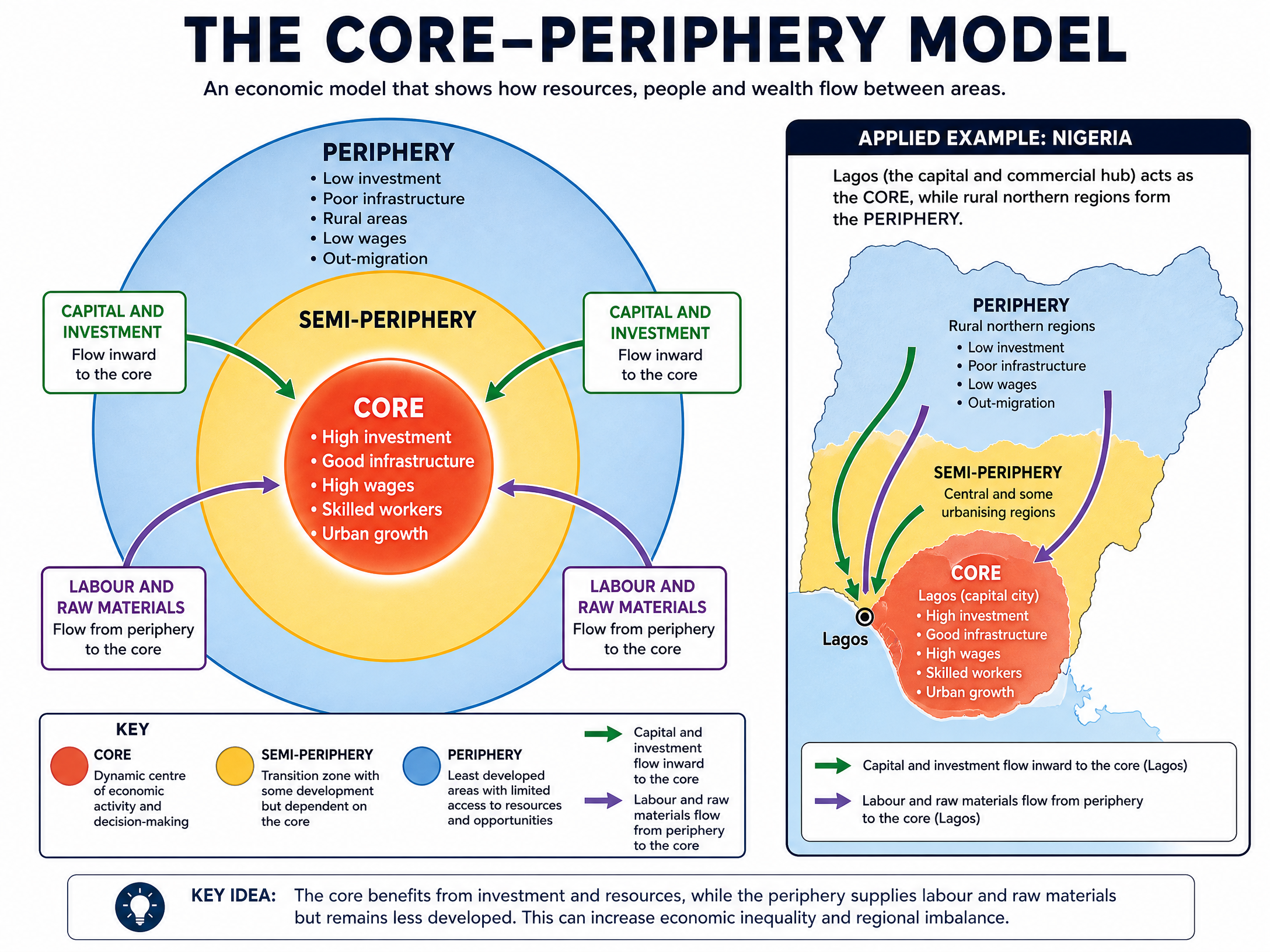
Development rarely happens evenly across a country. This is explained by the Core-Periphery Model.
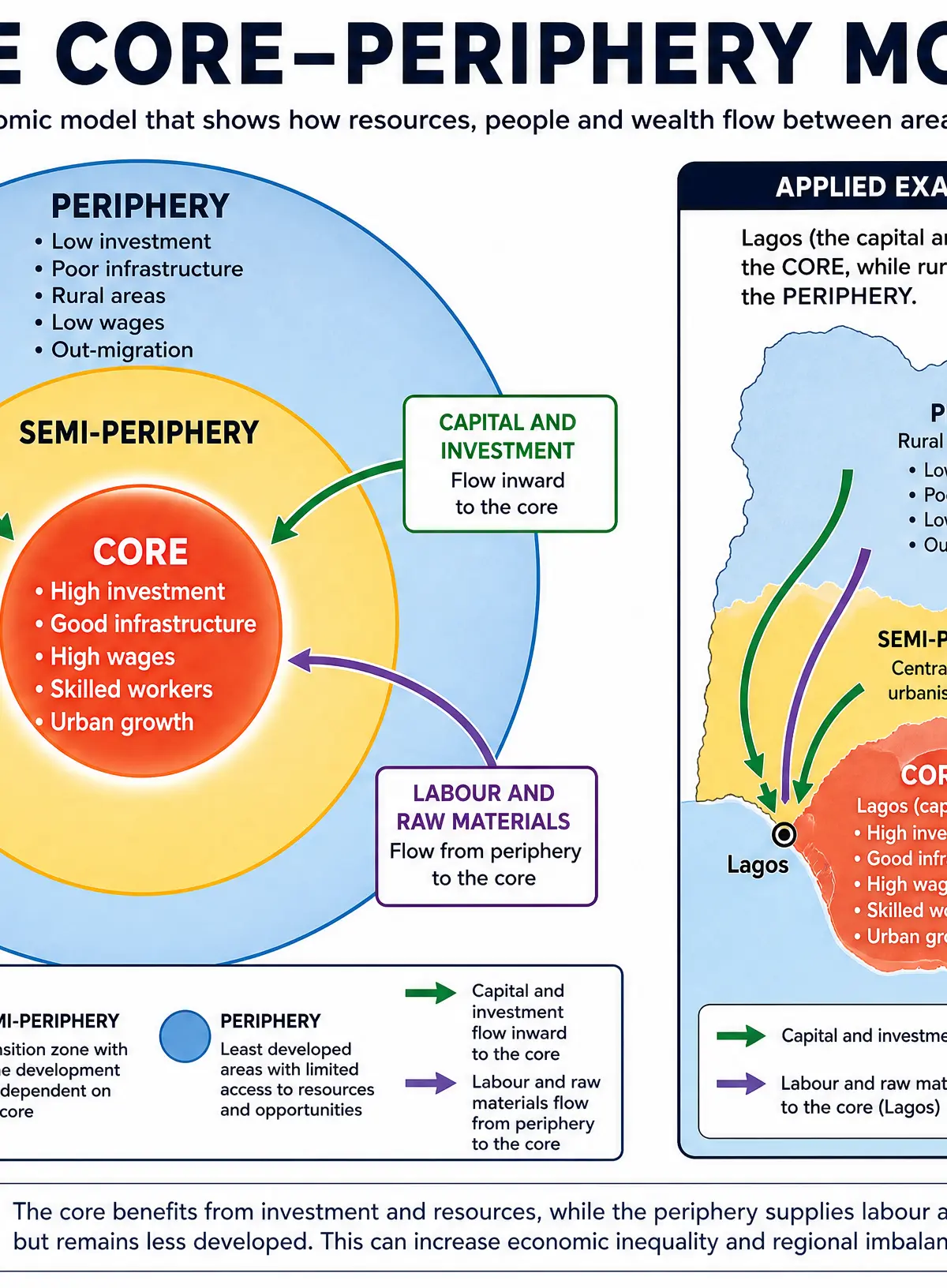
The Core (e.g., Lagos, South-West Nigeria)
Characteristics: High investment, good infrastructure, skilled workforce, high wages, concentration of industry and services.
Why it develops: Initial advantages (like a port or capital city status) attract investment. This creates jobs, which attracts migration (brain drain from the periphery). The increased wealth leads to better services (schools, hospitals), creating a positive multiplier effect.
The Periphery (e.g., North-East Nigeria)
Characteristics: Low investment, poor infrastructure, reliance on primary industry (farming), low wages, out-migration.
Why it lags behind: Lack of initial advantages. Young, skilled workers migrate to the core. Less tax revenue means poorer services, creating a cycle of decline.
Regional Inequality in Nigeria
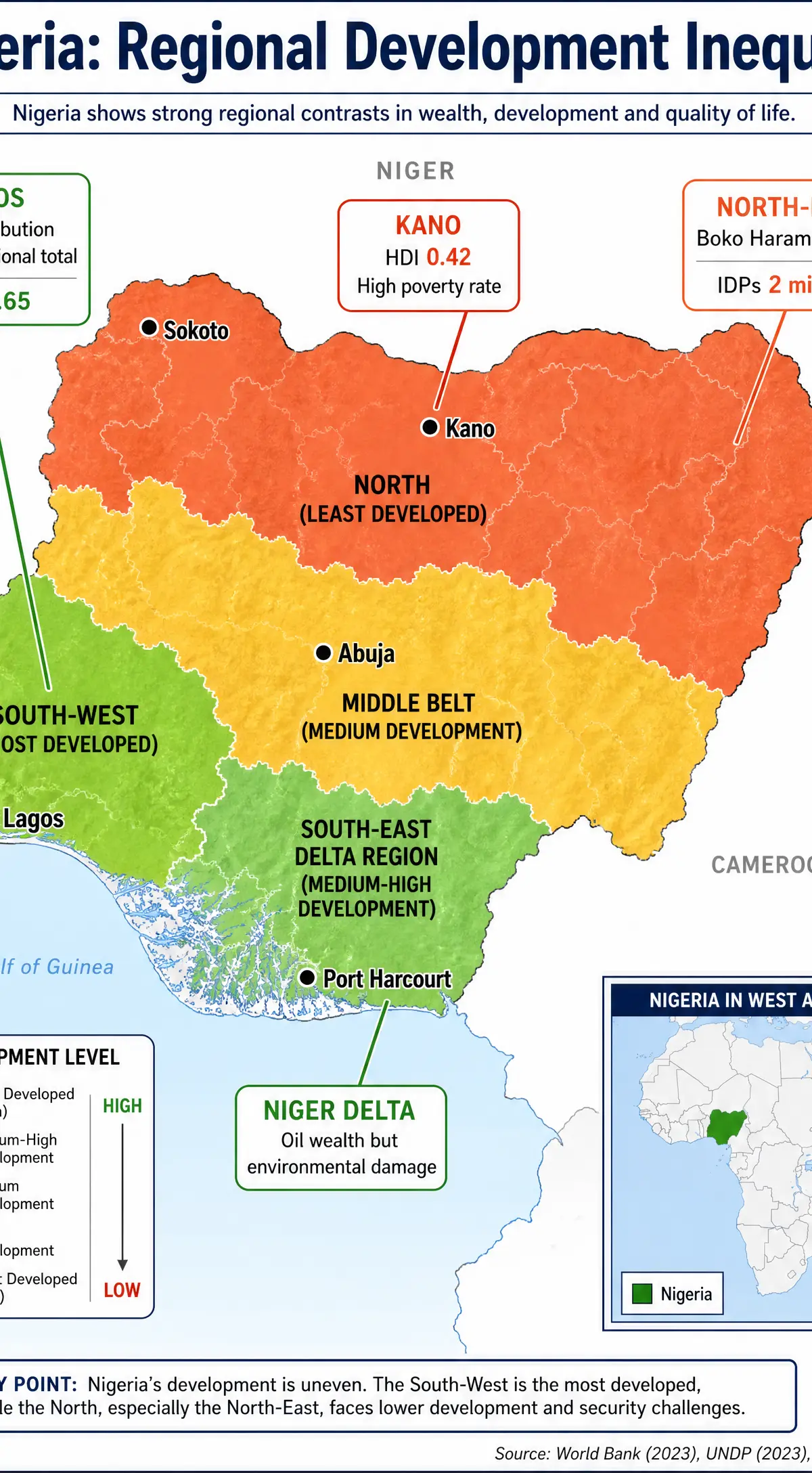
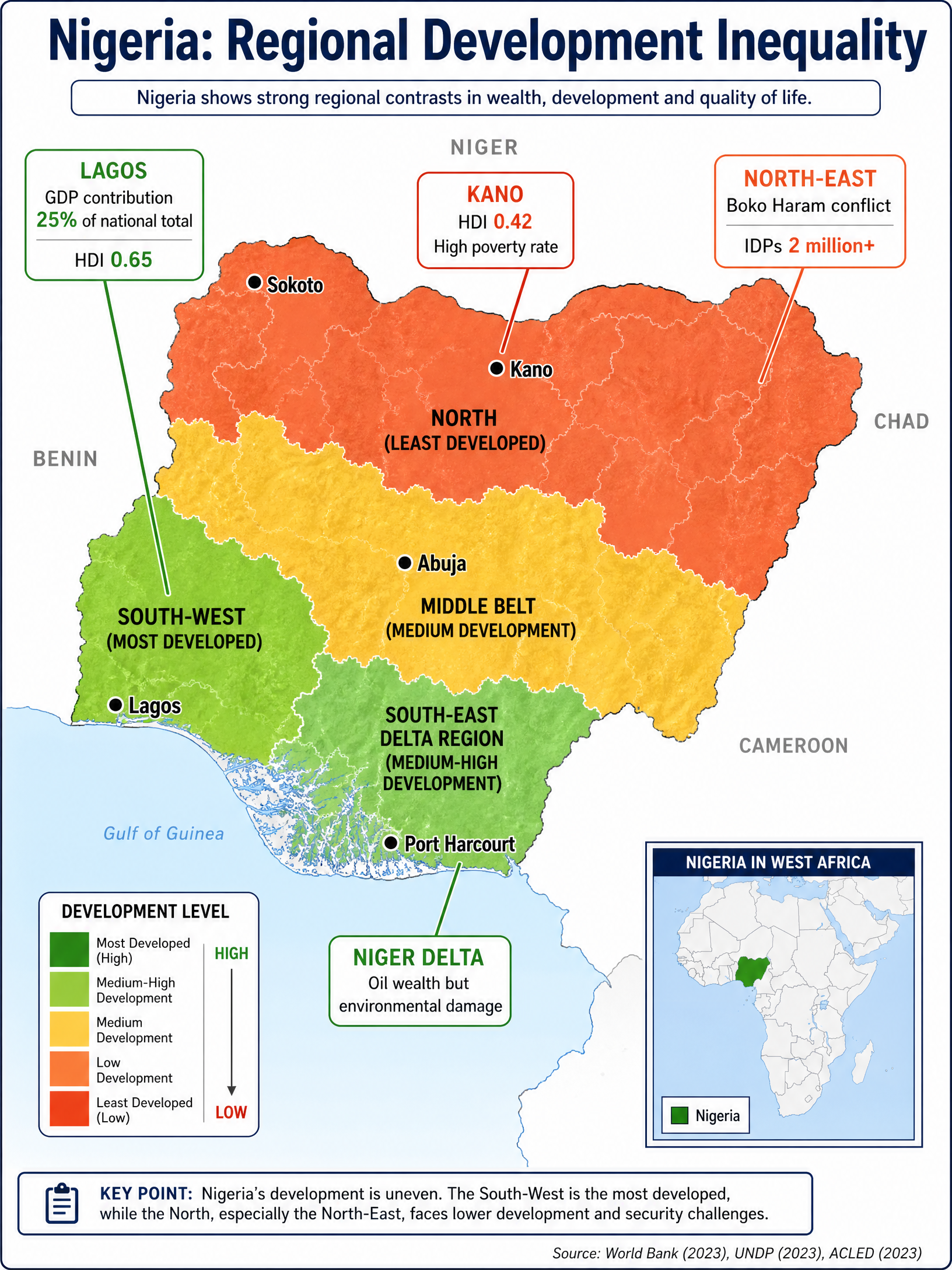
The Wealthy South:
- Lagos: HDI of 0.65. Contributes ~25% of national GDP. Hub for finance, media (Nollywood), and manufacturing.
- Niger Delta: High GDP due to oil, but severe environmental degradation (oil spills) means local quality of life remains poor.
The Poorer North:
- North-East (e.g., Borno State): HDI of ~0.42.
- Reasons for low development: Harsh physical environment (desertification), historic lack of infrastructure investment, and since 2009, the Boko Haram insurgency which has displaced over 2 million people and destroyed schools and clinics.
Visual Resources
3 diagrams and illustrations
Interactive Diagrams
1 interactive diagram to visualise key concepts
Conceptual Flow Outline
The Positive Multiplier Effect in the Core
Worked Examples
3 worked examples — open one to explore the question and available guidance.
Practice Questions
Test your understanding — click to reveal model answers
State two indicators used to calculate the Human Development Index (HDI). (2 marks)
Hint: Think about health, wealth, and education.
Explain two reasons why development is uneven within a named developing or emerging country. (4 marks)
Hint: Name Nigeria. Give one physical reason and one human/political reason.
Assess the social and economic impacts of uneven development within a named country. (9 marks)
Hint: Look at the impacts on both the core (Lagos) and the periphery (the North). Is it all positive for the core?
Explain how a country's global location can influence its level of development. (4 marks)
Hint: Think about trade routes, being landlocked vs coastal, and climate zones.
Evaluate the usefulness of the Human Development Index (HDI) compared to GDP per capita as a measure of development. (6 marks)
Hint: What does HDI show that GDP misses? Does HDI have any flaws?