Pearson Edexcel · GCSE · Geography
The level of development varies globally
This study explores why wealth and well-being vary dramatically across the globe. Understanding these patterns is crucial for explaining contemporary global challenges and evaluating strategies to improve the quality of life for millions of people.
- 5 min read
- 3 worked examples
- 5 practice questions
- 6 key terms
Study Notes
Overview
This study guide covers the fundamental concepts of global development in GCSE Geography. Examiners expect candidates to understand that development is a multifaceted concept—encompassing economic, social, and political dimensions. You will explore how development is measured using both single indicators like GDP per capita and composite measures like the Human Development Index (HDI). Furthermore, this topic requires an understanding of the complex physical, historical, and economic factors that create uneven development both between and within countries. Finally, you will evaluate various strategies aimed at reducing this development gap, comparing top-down mega-projects with bottom-up community-led initiatives.
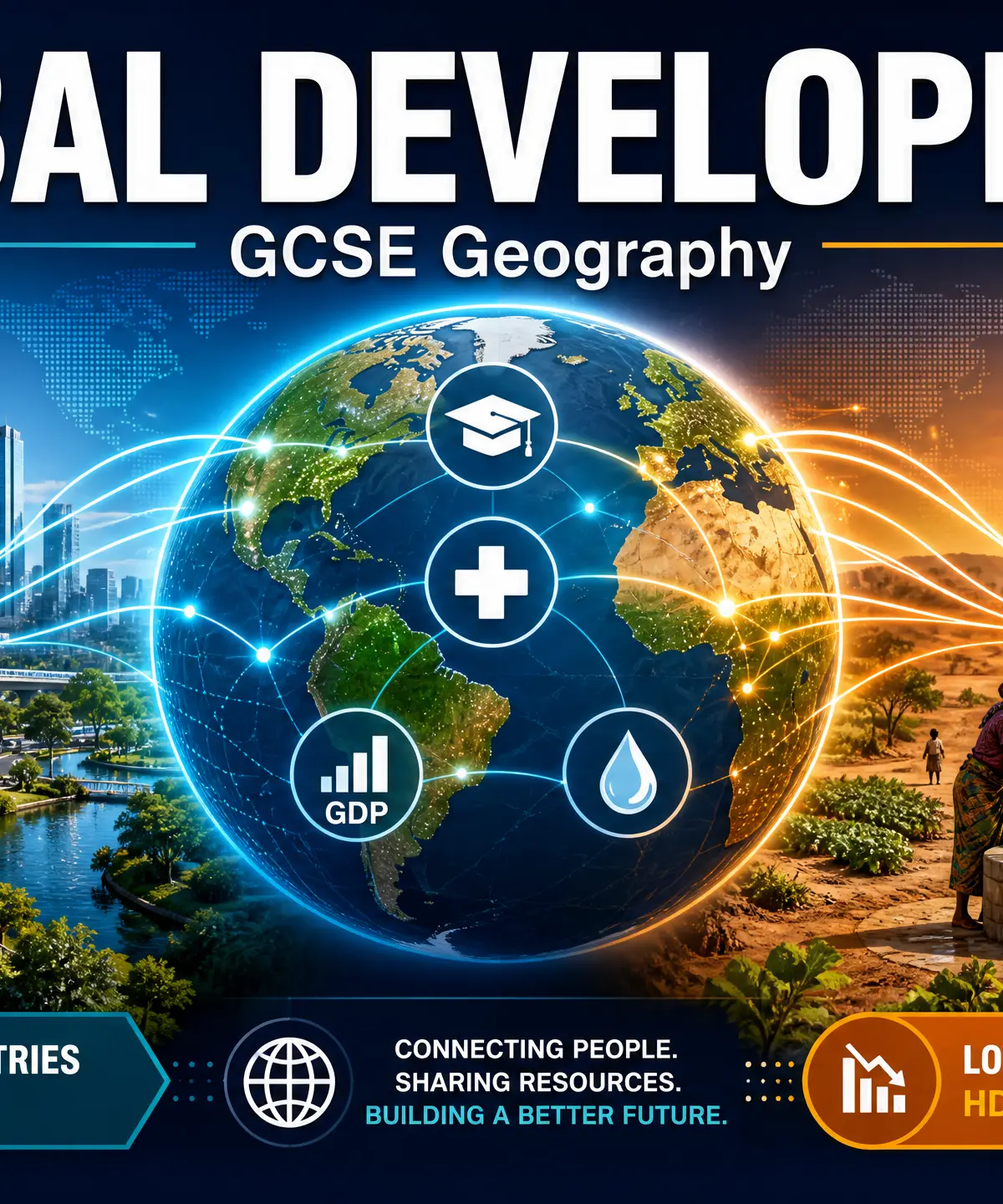
Listen to the Podcast
Before diving into the details, listen to this comprehensive 10-minute podcast covering the core concepts, key factors, and essential exam tips for this topic.

Defining and Measuring Development
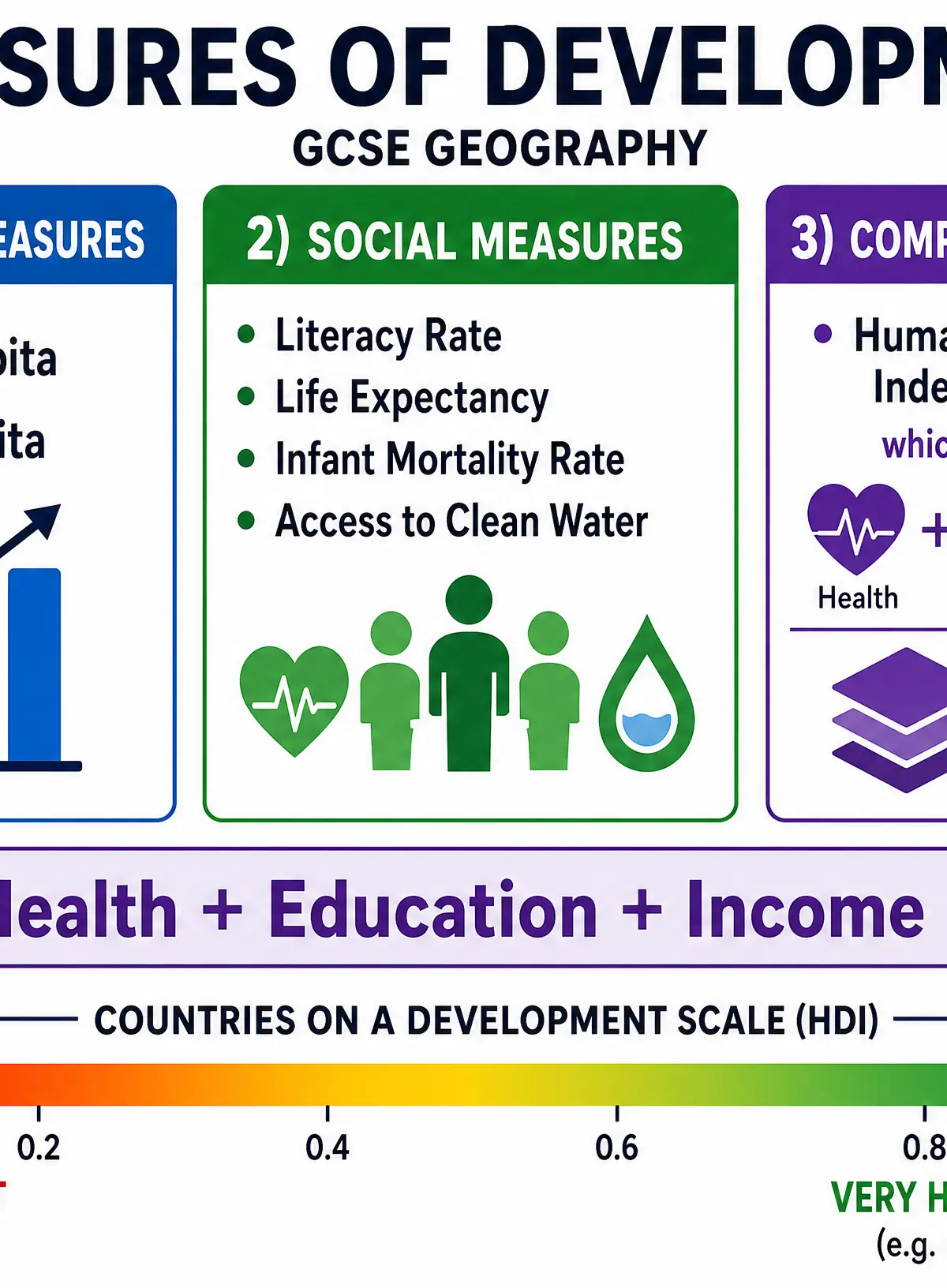
Development is about the improvement in the quality of life and standard of living of a population. It is not just about wealth. Examiners reward candidates who distinguish between the three main strands:
- Economic Development: Increases in wealth, income, and employment.
- Social Development: Improvements in health, education, housing, and access to clean water.
- Political Development: Advancements in human rights, democracy, and freedom from corruption.
Single vs. Composite Measures
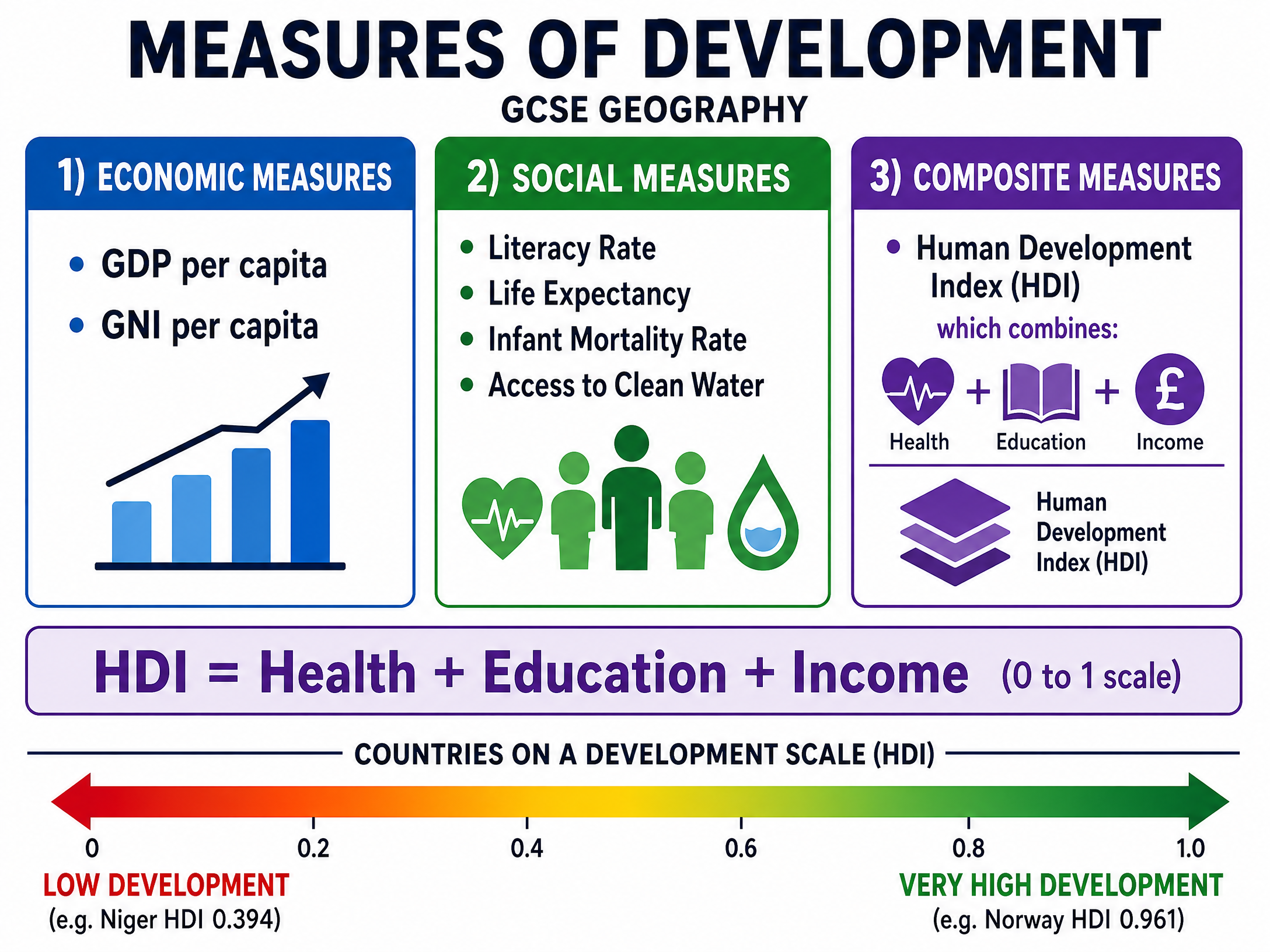
Single measures look at one specific aspect of development. For example, GDP per capita (Gross Domestic Product divided by population) measures average wealth. However, it hides inequalities and ignores social factors.
To get a fuller picture, geographers use composite measures. The Human Development Index (HDI) is the most important of these. It combines:
- Life expectancy (health)
- Mean years of schooling (education)
- GNI per capita (income)
The Causes of Uneven Development
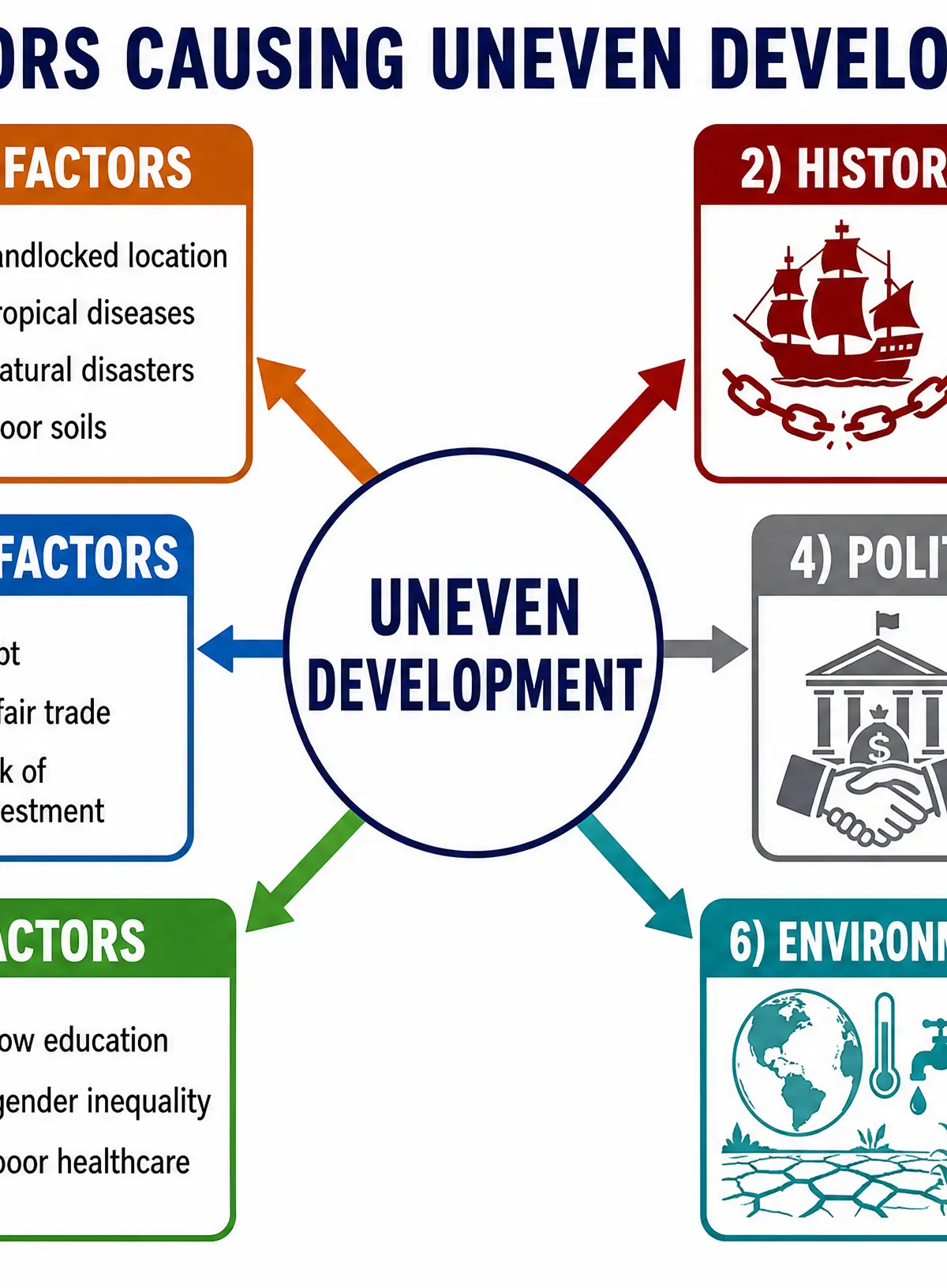
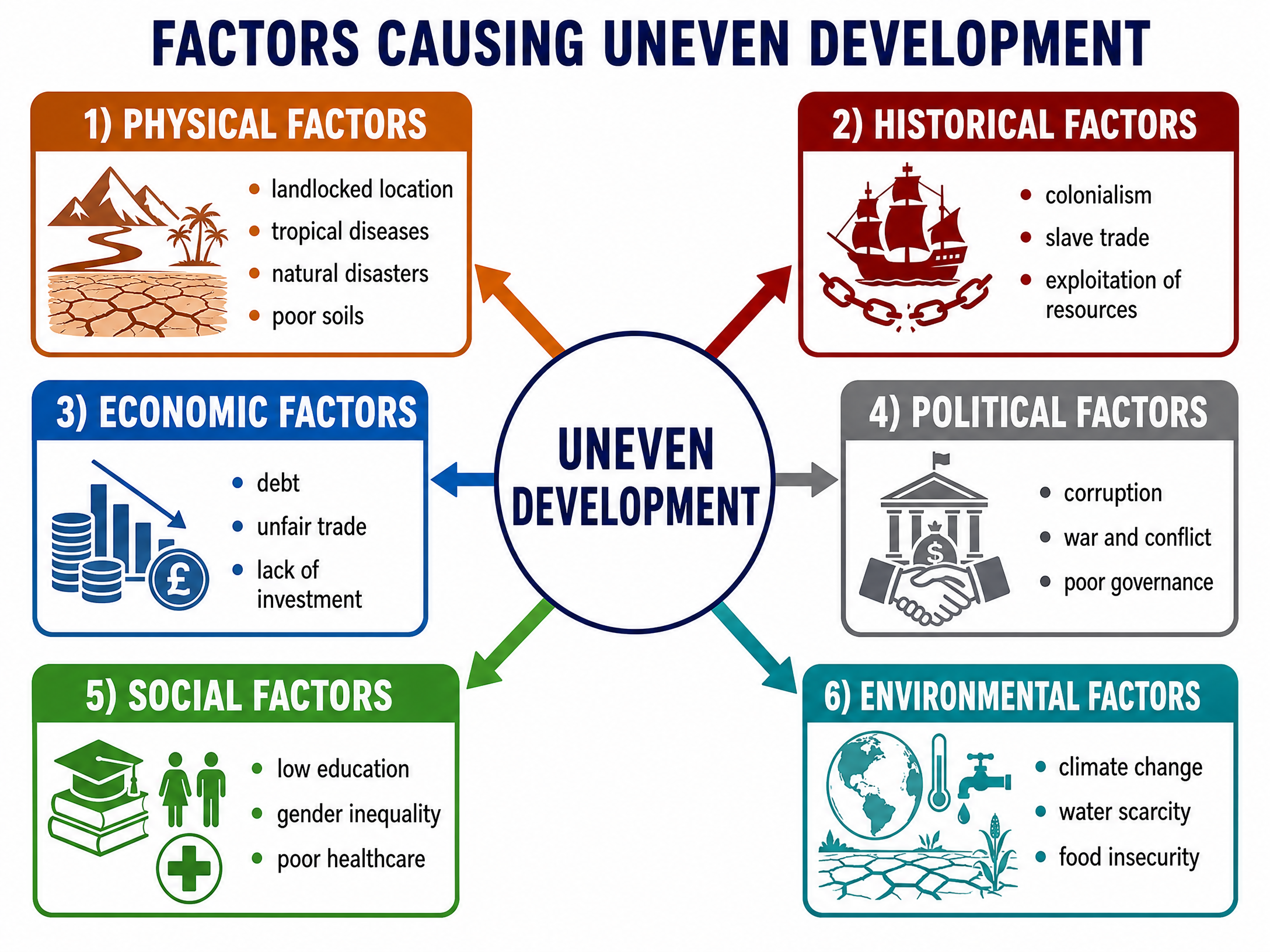
Development is highly uneven globally. High-Income Countries (HICs) are generally found in North America, Western Europe, and Australasia, while Low-Income Countries (LICs) are concentrated in Sub-Saharan Africa and parts of Asia. This unevenness is driven by a combination of factors.
Physical Factors
- Landlocked Location: Countries without a coastline (e.g., Chad, Bolivia) face higher transport costs, making international trade difficult.
- Climate and Disease: Tropical climates often suffer from diseases like malaria, which reduces the workforce's productivity and strains healthcare systems.
- Natural Hazards: Frequent earthquakes, floods, or droughts force countries to spend money on rebuilding rather than development.
Historical Factors
- Colonialism: Many LICs were historically colonised. Their resources were exploited to enrich the colonising powers, and their economies were structured to export cheap raw materials rather than manufacture valuable goods.
- Conflict: Historical and ongoing wars destroy infrastructure, displace populations, and deter foreign investment.
Economic Factors
- Debt: Many developing nations took on heavy loans. High interest repayments mean less money is available for education and healthcare.
- Unfair Trade: LICs often export low-value primary products (like agricultural goods) and import high-value manufactured goods. Trade barriers and tariffs imposed by HICs can also disadvantage poorer nations.
Strategies to Reduce the Development Gap
To address uneven development, various strategies are employed. Examiners expect you to evaluate these, offering both advantages and limitations.
Top-Down vs. Bottom-Up Development
Top-Down Development involves large-scale, expensive projects planned and managed by governments or international organisations (e.g., the World Bank).
- Example: The Three Gorges Dam in China.
- Advantages: Can impact millions of people quickly; generates significant national income.
- Limitations: Often ignores local needs; can cause massive environmental damage and displace local communities; requires huge loans.
Bottom-Up Development involves small-scale projects planned with and managed by local communities, often supported by NGOs.
- Example: Intermediate Technology Development Group (Practical Action) installing micro-hydro schemes in Peru.
- Advantages: Directly targets the poorest communities; uses appropriate technology that locals can maintain; environmentally sustainable.
- Limitations: Small scale means it only helps a limited number of people; does not fix national-level economic issues like debt.
Other Strategies
- Fairtrade: Ensures farmers receive a fair price for their goods and a premium to invest in community projects.
- Debt Relief: Cancelling the debts of the poorest countries so they can invest in social development.
Visual Resources
2 diagrams and illustrations
Interactive Diagrams
1 interactive diagram to visualise key concepts
Conceptual Flow Outline
Flowchart showing the interconnected causes of uneven development.
Worked Examples
3 worked examples — open one to explore the question and available guidance.
Practice Questions
Test your understanding — click to reveal model answers
Explain how historical factors have contributed to uneven global development. (4 marks)
Hint: Think about the legacy of colonialism and how it affected the economies of colonised nations.
To what extent is international aid the best way to reduce the global development gap? (9 marks + 3 SPaG)
Hint: You need to evaluate aid (both positive and negative) and then compare it to at least one other strategy (like Fairtrade or debt relief) to form a judgement.
State two social measures of development. (2 marks)
Hint: Think about health and education, not money.
Explain one disadvantage of using a top-down development strategy. (2 marks)
Hint: Think about the scale of these projects and who makes the decisions.
Outline the concept of the core-periphery model in relation to uneven development. (3 marks)
Hint: Explain the difference between the core and the periphery within a single country.