Pearson Edexcel · A-Level · Greek
Όψεις της Κύπρου (Aspects of Cyprus)
The period between 1974 and 1983 represents the most turbulent and transformative decade in modern Cypriot history. This study guide explores the geographical context, the devastating 1974 Turkish invasion, and the profound societal changes that led to the division of the island and the unilateral declaration of the TRNC.
- 7 min read
- 3 worked examples
- 5 practice questions
- 7 key terms
Study Notes
Overview
This study guide focuses on Theme 3 of your GCSE Greek specification: Όψεις της Κύπρου (Aspects of Cyprus), specifically the historical research subject covering the period from 1974 to 1983. This was a defining era that fundamentally altered the demographic, economic, and political landscape of the island. Examiners expect candidates to move beyond mere narrative; you must demonstrate a critical understanding of how the physical and human geography of Cyprus intersected with historical events. You will need to analyse the causes and consequences of the 1974 Turkish invasion, the resulting refugee crisis, and the long-term societal impact culminating in the 1983 declaration of the TRNC. To achieve the highest marks, your arguments must be supported by specific evidence, precise dates, and relevant findings from authentic Greek-language research sources.
Listen to the Podcast

Geographical Context
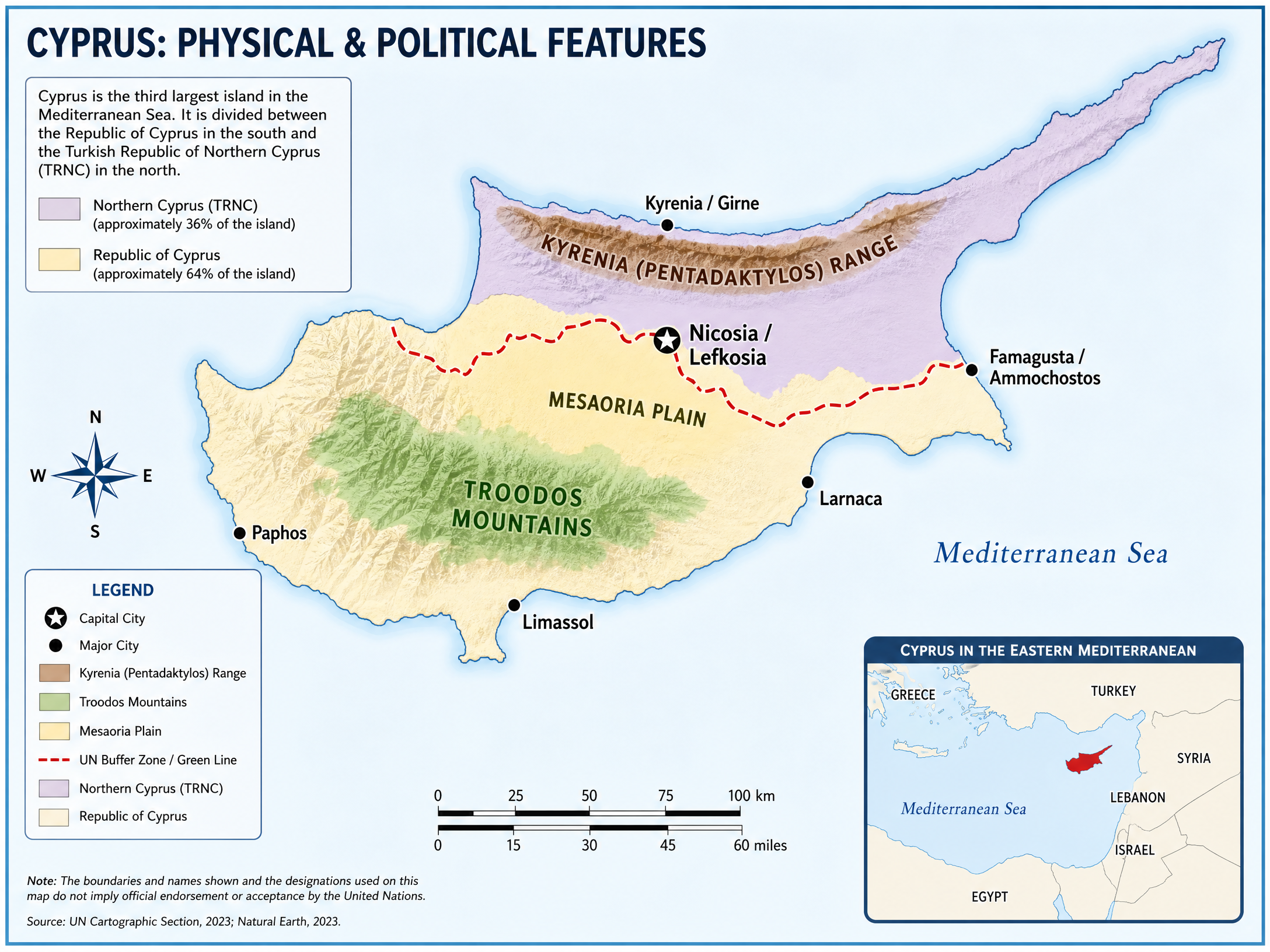
Cyprus is the third largest island in the Mediterranean Sea, covering 9,251 square kilometres. Its physical geography played a significant role in its history and the events of 1974.
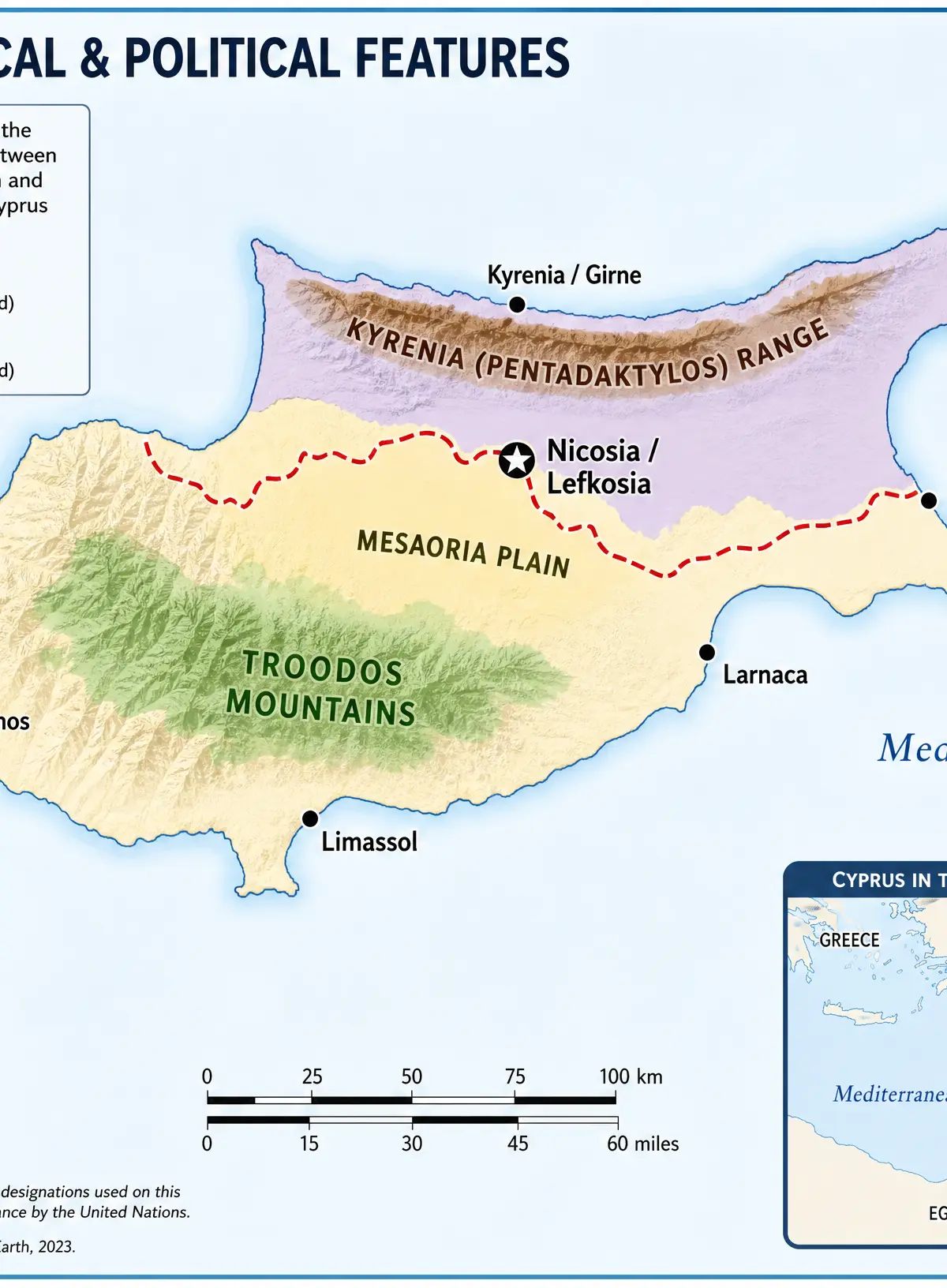
Key Physical Features:
- Troodos Mountains: Located in the south and centre, rising to Mount Olympus (1,952m).
- Kyrenia (Pentadaktylos) Range: A narrow, rugged mountain range running along the northern coast.
- Mesaoria Plain: The fertile agricultural heartland lying between the two mountain ranges.
Human Geography (Pre-1974):
Before the invasion, the island had a population of approximately 641,000. Greek Cypriots made up 78.9% (506,000) and Turkish Cypriots 18.3% (118,000), with smaller communities of Maronites, Armenians, and Latins. The population was largely intermingled across the island.
Key Events & Developments
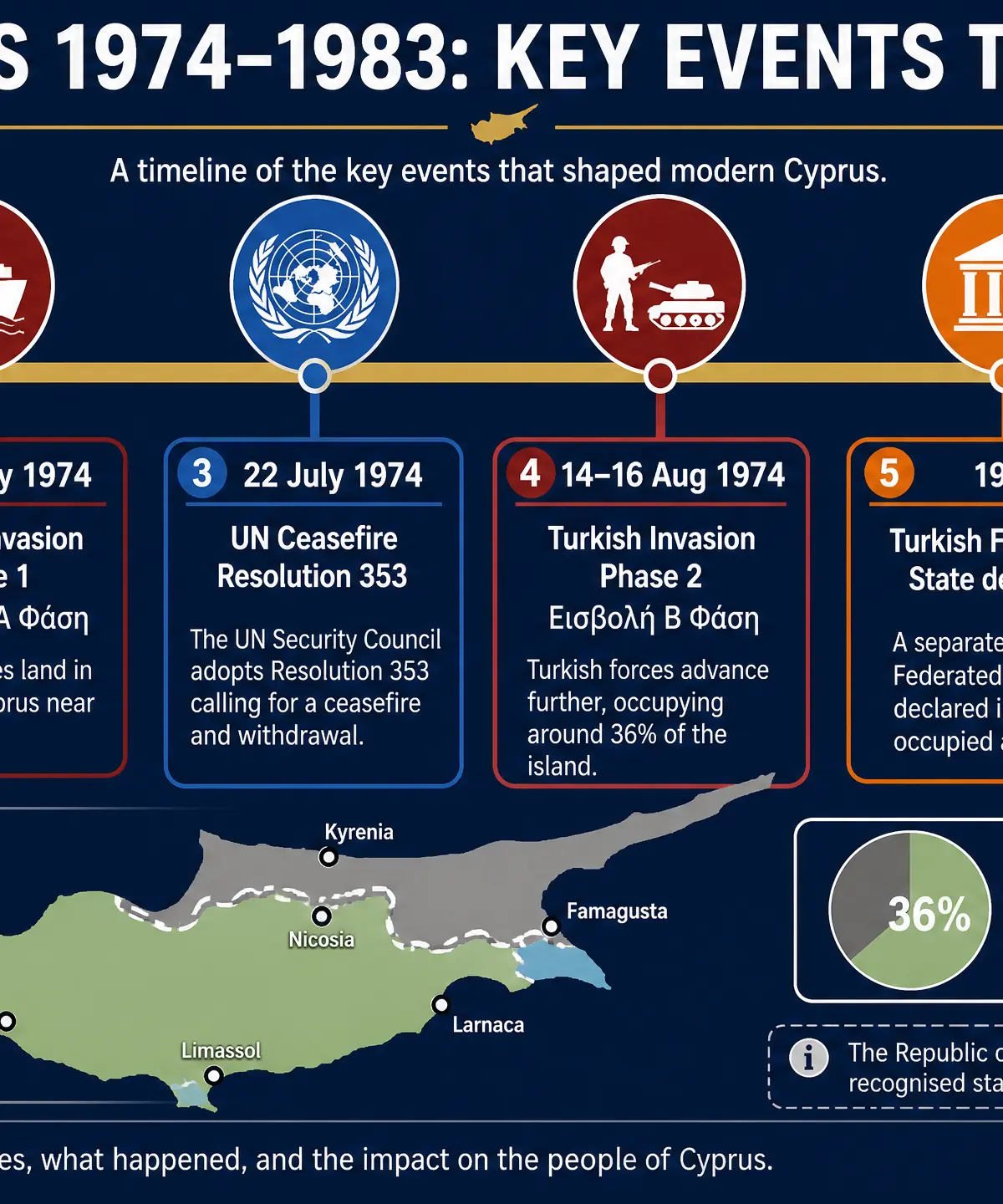
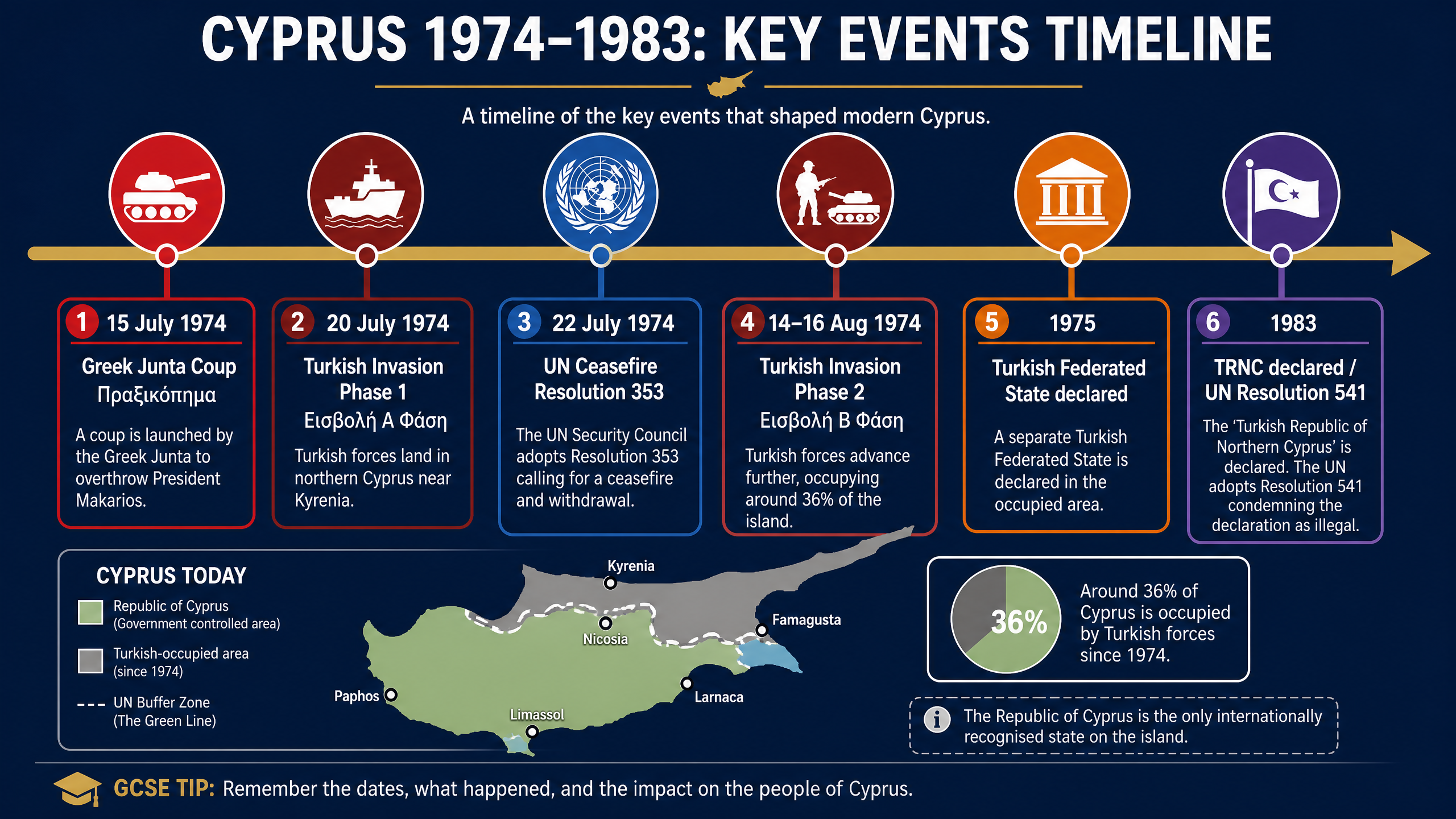
The Greek Junta Coup (Πραξικόπημα)
Date(s): 15 July 1974
What happened: The Greek military junta (dictatorship) ordered a coup d'état against the legitimate President of Cyprus, Archbishop Makarios III. The Cypriot National Guard and the paramilitary group EOKA B carried out the attack, installing Nikos Sampson as a puppet president.
Why it matters: This event provided Turkey with the pretext to invade. The coup's ultimate goal was Enosis (union with Greece), which deeply alarmed the Turkish Cypriot community and the Turkish government.
Specific Knowledge: Makarios survived and fled to Britain. The Greek junta collapsed shortly after on 24 July 1974.
Operation Attila Phase 1 (Εισβολή Α Φάση)
Date(s): 20 July 1974
What happened: At 5:30 am, Turkey launched a massive military invasion, landing 40,000 troops on the northern coast near Kyrenia.
Why it matters: This marked the beginning of the occupation. The UN Security Council quickly passed Resolution 353 (22 July) demanding a ceasefire, which Turkey initially accepted but later broke.
Specific Knowledge: Turkish forces initially captured about 3% of the island, establishing a beachhead connecting Kyrenia to Turkish Cypriot enclaves in Nicosia.
Operation Attila Phase 2 (Εισβολή Β Φάση)
Date(s): 14-16 August 1974
What happened: Following the breakdown of peace talks in Geneva, Turkey launched a second, much larger offensive, rapidly advancing to capture Famagusta (Ammochostos), Morphou, and the Karpas Peninsula.
Why it matters: This phase resulted in the capture of 36.2% of the island's territory and caused the massive displacement of the Greek Cypriot population.
Specific Knowledge: The UN Buffer Zone (Green Line) was established along the ceasefire line of 16 August, dividing the capital Nicosia and the entire island.
The Declaration of the TRNC
Date(s): 15 November 1983
What happened: The Turkish Cypriot leader, Rauf Denktaş, unilaterally declared the establishment of the "Turkish Republic of Northern Cyprus" (TRNC).
Why it matters: This act attempted to formalise the division of the island permanently. It was universally condemned by the international community.
Specific Knowledge: UN Security Council Resolution 541 (18 November 1983) declared the TRNC "null and void". To this day, it is recognised only by Turkey.
Societal Impact
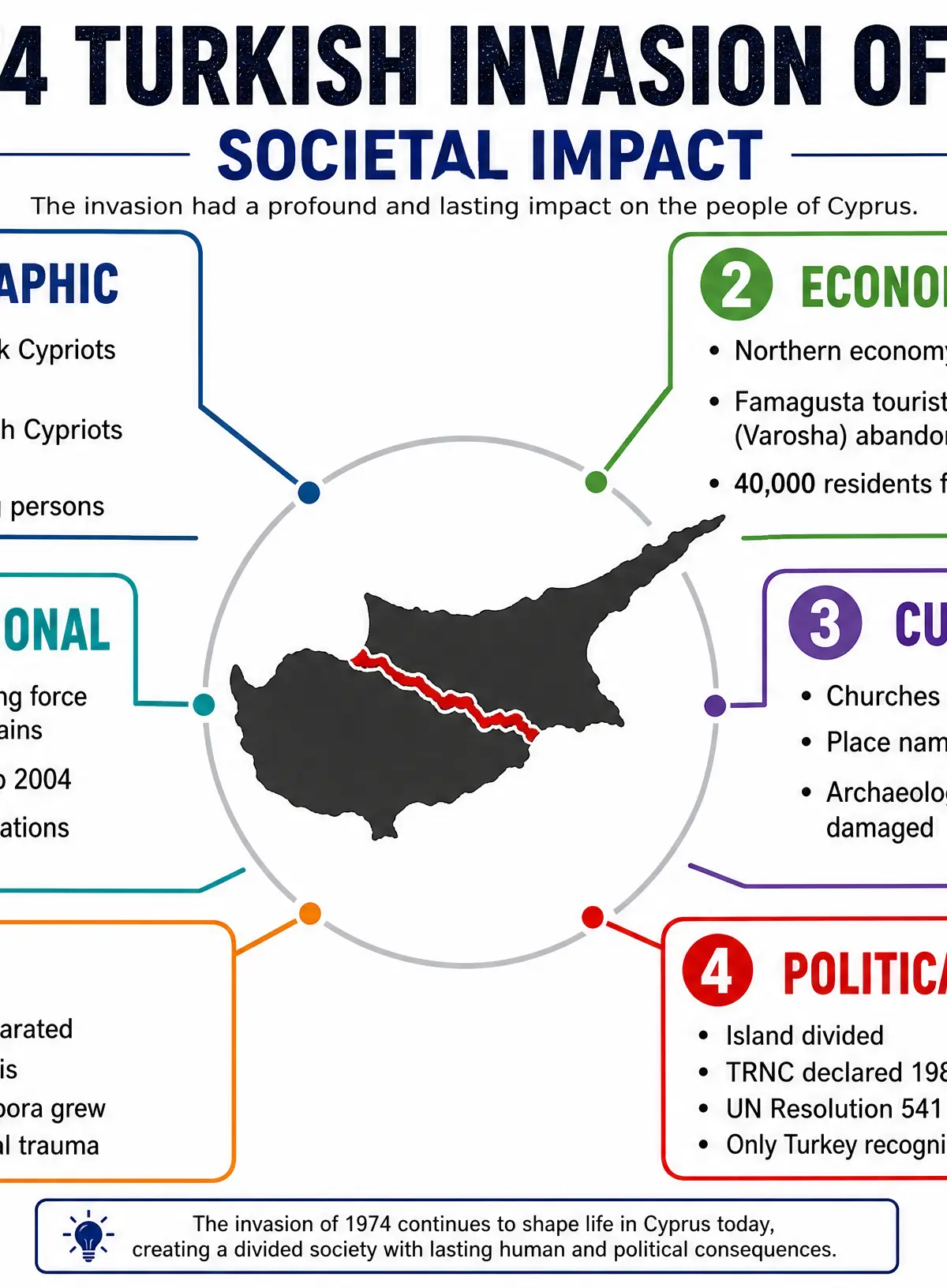
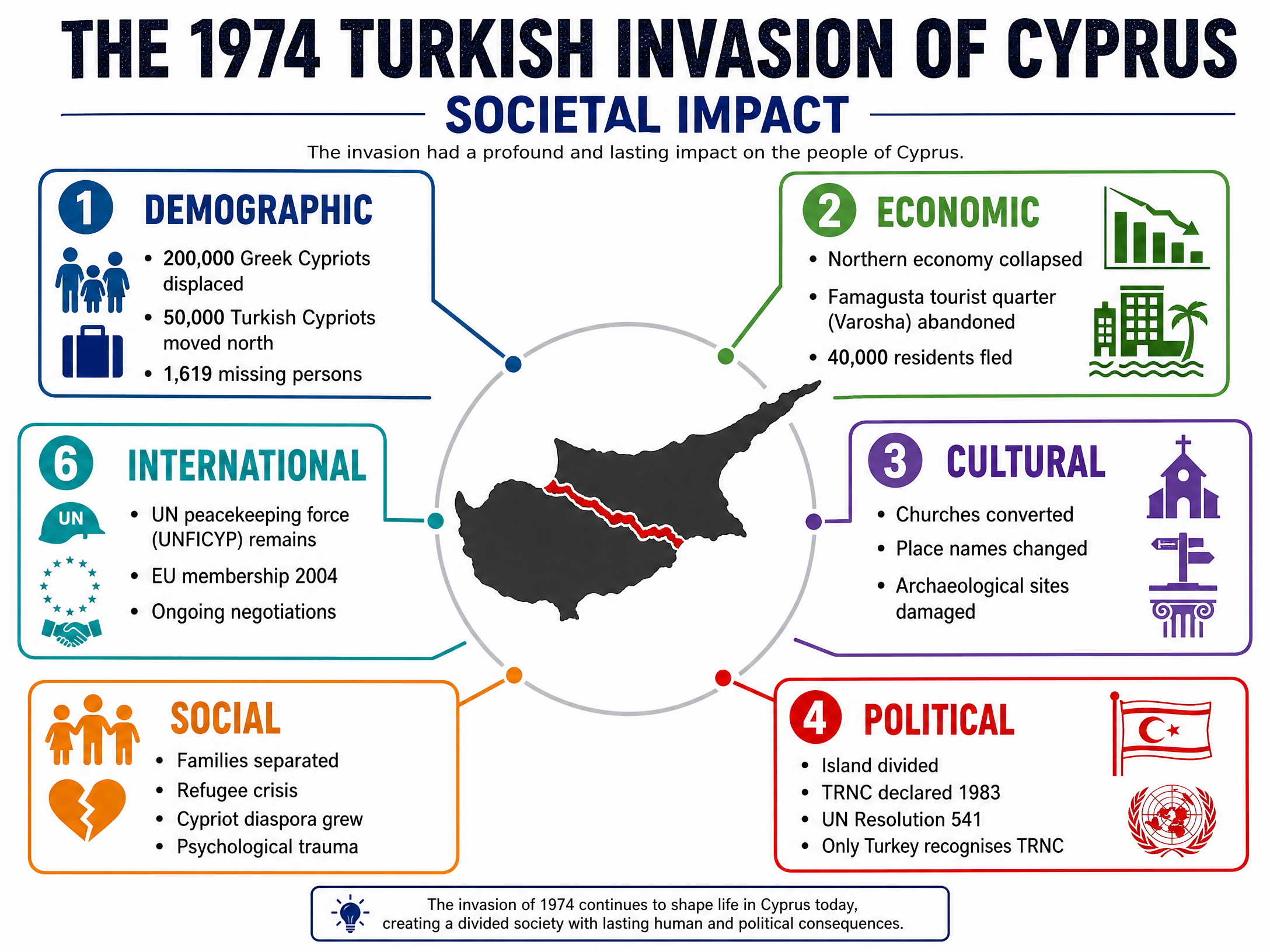
The period between 1974 and 1983 saw profound demographic and cultural changes:
- Refugee Crisis: Approximately 162,000 to 200,000 Greek Cypriots fled to the south, while around 50,000 Turkish Cypriots moved to the north.
- Missing Persons: 1,619 Greek Cypriots were reported missing (αγνοούμενοι), a trauma that still affects families today.
- Varosha: The thriving tourist district of Famagusta was abandoned by its 40,000 residents and remains a fenced-off "ghost town".
- Cultural Erasure: In the occupied north, Greek Orthodox churches were converted, place names were Turkified, and mainland Turkish settlers were brought in, altering the demographic balance.
Key Individuals
Archbishop Makarios III
Role: First President of the Republic of Cyprus (1960-1977).
Key Actions: Survived the 1974 coup, addressed the UN Security Council, and returned to Cyprus to lead the Greek Cypriot community until his death.
Impact: A symbol of the independent Republic of Cyprus and resistance against both the Greek junta and the Turkish invasion.
Rauf Denktaş
Role: Leader of the Turkish Cypriot community.
Key Actions: Led the Turkish Federated State of Cyprus (1975) and later declared the TRNC in 1983.
Impact: The primary architect of the separatist Turkish Cypriot political entity in the north.
Nikos Sampson
Role: Puppet President installed by the Greek junta.
Key Actions: Held power for only eight days following the 15 July coup.
Impact: His installation triggered the Turkish invasion; his rapid fall marked the failure of the Enosis movement.
Second-Order Concepts
Causation
The 1974 invasion was triggered by a short-term cause (the 15 July coup by the Greek junta), but was rooted in long-term intercommunal tensions, the constitutional breakdown of 1963-64, and Turkey's strategic interests in the eastern Mediterranean.
Consequence
The immediate consequence was death, destruction, and a massive refugee crisis. The long-term consequences include the permanent partition of the island, the creation of the TRNC, and the ongoing presence of UNFICYP.
Change & Continuity
The demographic makeup of the island changed completely, from intermingled communities to total ethnic segregation across the Green Line. However, the Republic of Cyprus continued to function as the sole internationally recognised government.
Significance
The Cyprus problem remains one of the longest-running unresolved conflicts on the UN agenda, affecting EU-Turkey relations and eastern Mediterranean stability.
Source Skills
When evaluating sources for this topic, examiners expect you to consider the provenance. A source from the Turkish Ministry of Foreign Affairs will justify the invasion as a "Peace Operation" to protect Turkish Cypriots. A source from the Republic of Cyprus will frame it as an illegal "Invasion and Occupation". You must critically analyse these differing perspectives and use authentic Greek-language sources (e.g., ERT Archive, gov.cy) in your research.
Visual Resources
3 diagrams and illustrations
Interactive Diagrams
1 interactive diagram to visualise key concepts
Conceptual Flow Outline
Flowchart showing the chain of cause and effect from 1974 to 1983.
Worked Examples
3 worked examples — open one to explore the question and available guidance.
Practice Questions
Test your understanding — click to reveal model answers
Εξηγήστε γιατί η Τουρκία εισέβαλε στην Κύπρο τον Ιούλιο του 1974. (Explain why Turkey invaded Cyprus in July 1974.)
Hint: Discuss both the immediate trigger (the coup) and the long-term strategic/ethnic concerns.
Ποιος ήταν ο ρόλος του Αρχιεπισκόπου Μακαρίου Γ' στα γεγονότα του 1974; (What was the role of Archbishop Makarios III in the events of 1974?)
Hint: Focus on his position before the coup, his escape, and his international appeal.
Περιγράψτε τον αντίκτυπο της εισβολής στην πόλη της Αμμοχώστου. (Describe the impact of the invasion on the city of Famagusta.)
Hint: Mention Varosha, the flight of residents, and its current status.
Πώς άλλαξε η δημογραφική σύνθεση της Κύπρου μεταξύ 1974 και 1983; (How did the demographic composition of Cyprus change between 1974 and 1983?)
Hint: Discuss refugees, segregation, and the arrival of settlers.
Σε ποιο βαθμό ήταν το πραξικόπημα της 15ης Ιουλίου η κύρια αιτία της διαίρεσης της Κύπρου; (To what extent was the July 15 coup the main cause of the division of Cyprus?)
Hint: Require a balanced argument: Yes, it was the trigger; No, Turkey had long-term plans and intercommunal violence existed prior.