AQA · A-Level · History
Course version: 7042 · Version from Sept 2017
How important were faith and ideas for Christians and Muslims?
Full specification wording
1A The Age of the Crusades, c1071–1204 – consequence in this period through the following key questions:: How important were faith and ideas for Christians and Muslims?
Faith and ideas were central to both Christian and Muslim societies during the Crusades, driving political actions and military campaigns.
Checked against the AQA 7042 specification (opens in a new tab) on .
- Point 3 of 6
- 4 key terms
Study notes
From the checked teaching notes for this specification point.
The idea
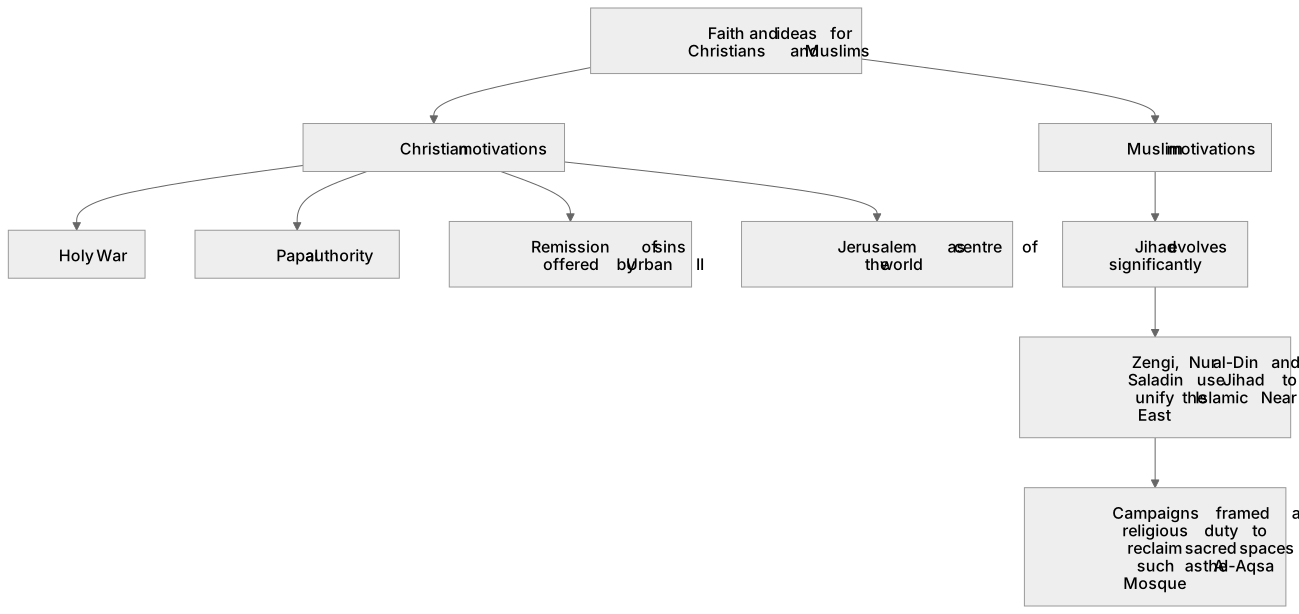
Faith and ideas were central to both Christian and Muslim societies during the Crusades, driving political actions and military campaigns. For Christians, the concept of Holy War, papal authority, and the promise of spiritual rewards (such as the remission of sins offered by Urban II) motivated thousands to take the cross. The idea of Jerusalem as the centre of the world was a powerful ideological draw. For Muslims, the concept of Jihad evolved significantly. Initially fragmented, leaders like Zengi, Nur al-Din, and Saladin increasingly utilised the ideology of Jihad to unify the Islamic Near East against the Frankish threat, framing their campaigns as a religious duty to reclaim sacred spaces like the Al-Aqsa Mosque.
What earns the marks
- Assess the role of papal ideology and the concept of penance in motivating Christian crusaders.
- Evaluate the development and political application of Jihad by Muslim leaders such as Nur al-Din and Saladin.
- Compare the religious significance of Jerusalem to both Christians and Muslims as a driver for conflict.
- Analyse how faith intersected with secular motivations, such as land acquisition or political consolidation, for both groups.
Common mistakes and how to put them right
Assuming all crusaders were motivated solely by religious zeal.
Put it right: Acknowledge the complex interplay of faith, economic hardship, and political ambition.
Treating the Muslim concept of Jihad as static throughout the period.
Put it right: Explain how Jihad was actively revived and weaponised by leaders like Zengi and Saladin over time.
Ignoring the role of ideas outside of direct warfare.
Put it right: Include the broader impact of religious ideas on societal structures, such as the formation of military orders.
Exam tips
- Use specific examples of religious propaganda, such as Urban II's sermon at Clermont or Saladin's use of poetry and sermons, to support your arguments.
- When evaluating 'importance', weigh faith and ideas against other factors like economic gain or political survival.
- Ensure your answer maintains a balanced focus on both Christian and Muslim perspectives as required by the question.
Try the lesson
The start of the 1A The Age of the Crusades, c1071–1204 – consequence in this period through the following key questions:: How important were faith and ideas for Christians and Muslims? lesson, made from checked teaching notes for this specification point.
Have a go first
Which of the following best describes the primary spiritual motivation for Western Christians participating in the First Crusade?
Listen
Faith and ideas were central to both Christian and Muslim societies during the Crusades, driving political actions and military campaigns. For Christians, the concept of Holy War, papal authority, and the promise of spiritual rewards (such as the remission of sins offered by Urban II) motivated thousands to take the cross. The idea of Jerusalem as the centre of the world was a powerful ideological draw. For Muslims, the concept of Jihad evolved significantly. Initially fragmented, leaders like Zengi, Nur al-Din, and Saladin increasingly utilised the ideology of Jihad to unify the Islamic Near East against the Frankish threat, framing their campaigns as a religious duty to reclaim sacred spaces like the Al-Aqsa Mosque. A strong answer earns marks for these points. Assess the role of papal ideology and the concept of penance in motivating Christian crusaders. Evaluate the development and political application of Jihad by Muslim leaders such as Nur al-Din and Saladin. Compare the religious significance of Jerusalem to both Christians and Muslims as a driver for conflict. Analyse how faith intersected with secular motivations, such as land acquisition or political consolidation, for both groups. A common slip: Assuming all crusaders were motivated solely by religious zeal. Instead, acknowledge the complex interplay of faith, economic hardship, and political ambition. Exam tip: Use specific examples of religious propaganda, such as Urban II's sermon at Clermont or Saladin's use of poetry and sermons, to support your arguments.
See it
Key words
Say what each word means before you turn the card.
Religious ideology and motivation
Try answering aloud or in your head before turning the card.
The evolution of Jihad
Try answering aloud or in your head before turning the card.
Papal authority and Holy War
Try answering aloud or in your head before turning the card.
Cultural and religious conflict
Try answering aloud or in your head before turning the card.
See every definition
- Religious ideology and motivation
- Faith and ideas were central to both Christian and Muslim societies during the Crusades, driving political actions and military campaigns.
- The evolution of Jihad
- For Muslims, the concept evolved significantly, with leaders increasingly utilising the ideology of Jihad to unify the Islamic Near East against the Frankish threat.
- Papal authority and Holy War
- For Christians, the concept of Holy War, papal authority, and the promise of spiritual rewards motivated thousands to take the cross.
- Cultural and religious conflict
- Religious significance of Jerusalem to both Christians and Muslims acted as a driver for conflict between the two faiths.
Label the diagram
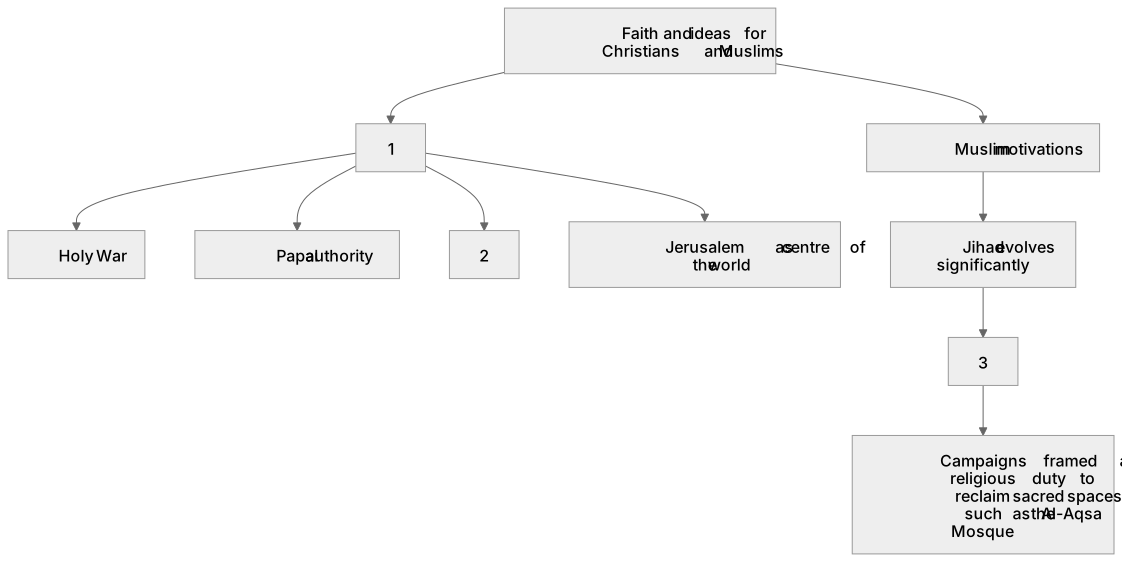
Some boxes have lost their names. Pick the right name for each number.
1Box 1
2Box 2
3Box 3
There is more to this lesson
The full lesson goes on to check your understanding and help you earn the marks. Create a free account to carry on, with your progress saved.
A week of Premium from your first lesson · Then the free plan continues · No card, no charge
Test your understanding of 1A The Age of the Crusades, c1071–1204 – consequence in this period through the following key questions:: How important were faith and ideas for Christians and Muslims?
Active recall beats re-reading. Take an instant quiz now to test what you’ve learned and lock it into long-term memory.
A week of Premium from your first lesson · Then the free plan continues · No card, no charge