AQA · A-Level · History
Course version: 7042 · Version from Sept 2017
What was the impact of the crusades on the Muslim Near East?
Full specification wording
1A The Age of the Crusades, c1071–1204 – consequence in this period through the following key questions:: What was the impact of the crusades on the Muslim Near East?
The Crusades profoundly impacted the Muslim Near East, acting as a catalyst for political unification and ideological revival.
Checked against the AQA 7042 specification (opens in a new tab) on .
- Point 4 of 6
- 4 key terms
Study notes
From the checked teaching notes for this specification point.
The idea
The Crusades profoundly impacted the Muslim Near East, acting as a catalyst for political unification and ideological revival. Initially, the First Crusade exploited existing Sunni-Shia divisions and the fragmentation of the Seljuk Empire, leading to the loss of key territories like Antioch and Jerusalem. However, the Frankish presence eventually stimulated a unified Muslim response. The necessity of countering the Crusader States allowed leaders like Zengi, Nur al-Din, and Saladin to consolidate power across Syria and Egypt. Culturally, the Crusades triggered a revival of Jihad, transforming it from a dormant concept into a powerful unifying ideology that fundamentally reshaped the political landscape of the Near East.
What earns the marks
- Analyse the initial political fragmentation of the Muslim Near East and how the Crusades exploited these divisions.
- Evaluate the role of the Crusades in stimulating the political unification of Syria and Egypt under leaders like Saladin.
- Assess the ideological impact, specifically the revival and weaponisation of Jihad in response to the Frankish presence.
- Examine the economic and territorial impacts on the Muslim Near East, including the loss and subsequent recapture of key trade routes and cities.
Common mistakes and how to put them right
Stating that the Muslim world united immediately against the First Crusade.
Put it right: Emphasise that the initial response was fractured and unification took decades.
Focusing solely on the military battles.
Put it right: Discuss the broader political, ideological, and economic impacts on the Muslim Near East.
Viewing the impact exclusively through a European lens.
Put it right: Centre the analysis on the internal dynamics, leadership changes, and societal shifts within the Muslim Near East.
Exam tips
- Trace the chronological shift from Muslim fragmentation in the late 11th century to unification by the late 12th century.
- Use the careers of specific leaders (Zengi, Nur al-Din, Saladin) to demonstrate how the Crusades impacted political consolidation.
- Distinguish between short-term impacts (territorial loss) and long-term impacts (ideological revival and unification).
Try the lesson
The start of the 1A The Age of the Crusades, c1071–1204 – consequence in this period through the following key questions:: What was the impact of the crusades on the Muslim Near East? lesson, made from checked teaching notes for this specification point.
Have a go first
What was the immediate political impact of the First Crusade on the Muslim Near East in the late 11th and early 12th centuries?
Listen
The Crusades profoundly impacted the Muslim Near East, acting as a catalyst for political unification and ideological revival. Initially, the First Crusade exploited existing Sunni-Shia divisions and the fragmentation of the Seljuk Empire, leading to the loss of key territories like Antioch and Jerusalem. However, the Frankish presence eventually stimulated a unified Muslim response. The necessity of countering the Crusader States allowed leaders like Zengi, Nur al-Din, and Saladin to consolidate power across Syria and Egypt. Culturally, the Crusades triggered a revival of Jihad, transforming it from a dormant concept into a powerful unifying ideology that fundamentally reshaped the political landscape of the Near East. A strong answer earns marks for these points. Analyse the initial political fragmentation of the Muslim Near East and how the Crusades exploited these divisions. Evaluate the role of the Crusades in stimulating the political unification of Syria and Egypt under leaders like Saladin. Assess the ideological impact, specifically the revival and weaponisation of Jihad in response to the Frankish presence. Examine the economic and territorial impacts on the Muslim Near East, including the loss and subsequent recapture of key trade routes and cities. A common slip: Stating that the Muslim world united immediately against the First Crusade. Instead, emphasise that the initial response was fractured and unification took decades. Exam tip: Trace the chronological shift from Muslim fragmentation in the late 11th century to unification by the late 12th century.
See it
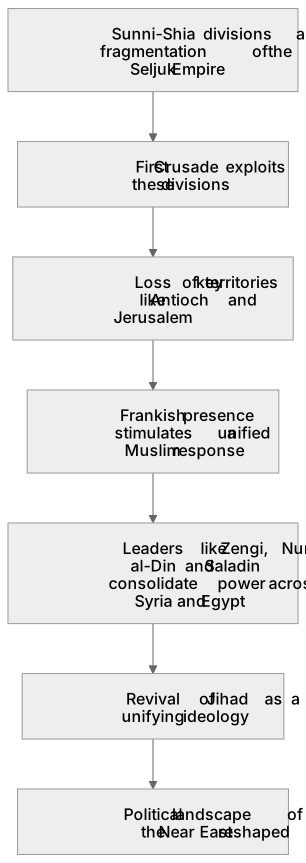
Put it in order
Put these steps in the order they happen.
- 1. Political landscape of the Near East reshaped
- 2. Revival of Jihad as a unifying ideology
- 3. Loss of key territories like Antioch and Jerusalem
- 4. Leaders like Zengi, Nur al-Din and Saladin consolidate power across Syria and Egypt
- 5. Sunni-Shia divisions and fragmentation of the Seljuk Empire
- 6. First Crusade exploits these divisions
- 7. Frankish presence stimulates a unified Muslim response
Key words
Say what each word means before you turn the card.
Political fragmentation and unification
Try answering aloud or in your head before turning the card.
The revival of Jihad
Try answering aloud or in your head before turning the card.
Leadership and power consolidation
Try answering aloud or in your head before turning the card.
Territorial and economic shifts
Try answering aloud or in your head before turning the card.
See every definition
- Political fragmentation and unification
- The Crusades initially exploited existing divisions but eventually stimulated a unified Muslim response across Syria and Egypt.
- The revival of Jihad
- The Crusades transformed this from a dormant concept into a powerful unifying ideology that fundamentally reshaped the political landscape.
- Leadership and power consolidation
- Countering the Crusader States allowed leaders to consolidate power across Syria and Egypt.
- Territorial and economic shifts
- The loss and subsequent recapture of key trade routes and cities formed part of the economic and territorial impacts.
Label the diagram
Some boxes have lost their names. Pick the right name for each number.
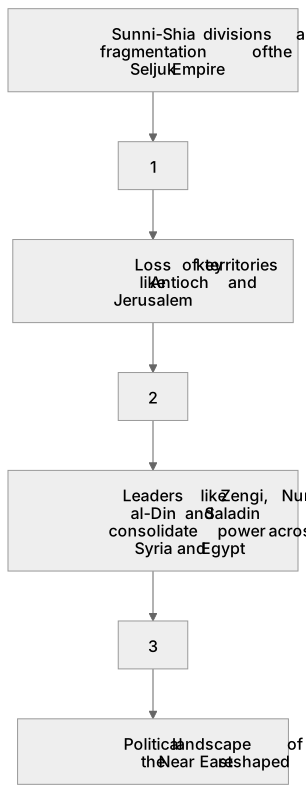
1Box 1
2Box 2
3Box 3
There is more to this lesson
The full lesson goes on to check your understanding and help you earn the marks. Create a free account to carry on, with your progress saved.
A week of Premium from your first lesson · Then the free plan continues · No card, no charge
Test your understanding of 1A The Age of the Crusades, c1071–1204 – consequence in this period through the following key questions:: What was the impact of the crusades on the Muslim Near East?
Active recall beats re-reading. Take an instant quiz now to test what you’ve learned and lock it into long-term memory.
A week of Premium from your first lesson · Then the free plan continues · No card, no charge