AQA · A-Level · History
Course version: 7042 · Version from Sept 2017
The impact of the Second Crusade on the Muslim Near East, the Byzantine…
Full specification wording
1A The Age of the Crusades, c1071–1204 – The foundation of new states and the Second Crusade, c1099–1149: The impact of the Second Crusade on the Muslim Near East, the Byzantine Empire, the Latin West and Outremer by 1149
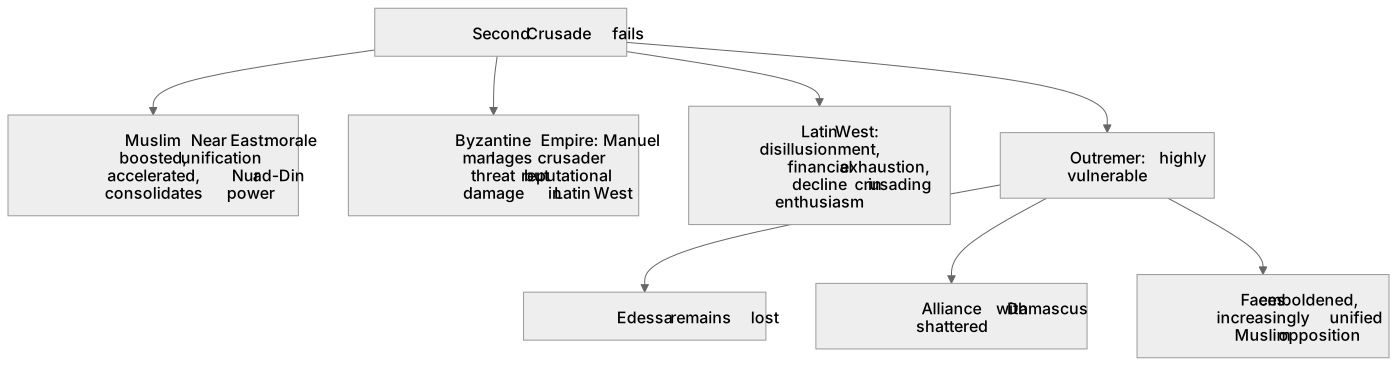
By 1149, the Second Crusade's failure profoundly impacted all regional powers.
Checked against the AQA 7042 specification (opens in a new tab) on .
- Point 6 of 6
- 4 key terms
Study notes
From the checked teaching notes for this specification point.
The idea
By 1149, the Second Crusade's failure profoundly impacted all regional powers. In the Muslim Near East, the crusaders' defeat boosted morale and accelerated unification, allowing Nur ad-Din to consolidate power. For the Byzantine Empire, Emperor Manuel I Comnenus successfully managed the crusader threat to his territory but suffered severe reputational damage in the Latin West, where he was scapegoated for the armies' defeats in Anatolia. In the Latin West, the humiliating collapse caused widespread disillusionment, financial exhaustion, and a decline in crusading enthusiasm. Meanwhile, Outremer was left highly vulnerable; Edessa remained lost, the vital alliance with Damascus was shattered, and the crusader states faced a newly emboldened and increasingly unified Muslim opposition.
What earns the marks
- Analyse how the crusade's failure facilitated Nur ad-Din's rise and the ideological strengthening of jihad in the Muslim Near East.
- Evaluate the diplomatic fallout between the Byzantine Empire and the Latin West, focusing on accusations of Byzantine treachery.
- Assess the psychological and financial impact on the Latin West, including the crisis of faith and criticism of Bernard of Clairvaux.
- Explain the strategic deterioration of Outremer's position by 1149, specifically the loss of the Damascene alliance.
Common mistakes and how to put them right
Assuming the Byzantine Empire was conquered or severely weakened.
Put it right: Manuel I actually navigated the crusade successfully, though diplomatic ties with the West worsened.
Stating that Saladin rose to power immediately after the Second Crusade.
Put it right: It was Nur ad-Din who capitalised on the victory in the immediate aftermath up to 1149.
Claiming Outremer gained territory.
Put it right: The crusader states gained nothing, failed to recover Edessa, and actively worsened their strategic borders.
Exam tips
- Structure answers thematically by region (Muslim Near East, Byzantium, Latin West, Outremer) to ensure comprehensive coverage of the specification.
- Highlight the contrast between the Latin West's search for scapegoats (blaming Byzantium) and the actual logistical reasons for failure.
- Emphasise the shift in the balance of power in the Levant, noting how the attack on Damascus pushed it into Nur ad-Din's sphere of influence.
Try the lesson
The start of the 1A The Age of the Crusades, c1071–1204 – The foundation of new states and the Second Crusade, c1099–1149: The impact of the Second Crusade on the Muslim Near East, the Byzantine Empire, the Latin West and Outremer by 1149 lesson, made from checked teaching notes for this specification point.
Have a go first
How did the failure of the Second Crusade at Damascus in 1148 immediately impact the political situation in the Muslim Near East?
Listen
By 1149, the Second Crusade's failure profoundly impacted all regional powers. In the Muslim Near East, the crusaders' defeat boosted morale and accelerated unification, allowing Nur ad-Din to consolidate power. For the Byzantine Empire, Emperor Manuel I Comnenus successfully managed the crusader threat to his territory but suffered severe reputational damage in the Latin West, where he was scapegoated for the armies' defeats in Anatolia. In the Latin West, the humiliating collapse caused widespread disillusionment, financial exhaustion, and a decline in crusading enthusiasm. Meanwhile, Outremer was left highly vulnerable; Edessa remained lost, the vital alliance with Damascus was shattered, and the crusader states faced a newly emboldened and increasingly unified Muslim opposition. A strong answer earns marks for these points. Analyse how the crusade's failure facilitated Nur ad-Din's rise and the ideological strengthening of jihad in the Muslim Near East. Evaluate the diplomatic fallout between the Byzantine Empire and the Latin West, focusing on accusations of Byzantine treachery. Assess the psychological and financial impact on the Latin West, including the crisis of faith and criticism of Bernard of Clairvaux. Explain the strategic deterioration of Outremer's position by 1149, specifically the loss of the Damascene alliance. Exam tip: Structure answers thematically by region (Muslim Near East, Byzantium, Latin West, Outremer) to ensure comprehensive coverage of the specification.
See it
Key words
Say what each word means before you turn the card.
Shifting balance of power
Try answering aloud or in your head before turning the card.
Diplomacy and alliances
Try answering aloud or in your head before turning the card.
Ideological shifts and morale
Try answering aloud or in your head before turning the card.
Consequences of military failure
Try answering aloud or in your head before turning the card.
See every definition
- Shifting balance of power
- The crusade's failure left Outremer vulnerable and faced with a newly emboldened and increasingly unified Muslim opposition, while Nur ad-Din consolidated power.
- Diplomacy and alliances
- The vital alliance with Damascus was shattered, and the Byzantine Empire suffered severe reputational damage in the Latin West, where Manuel I was scapegoated for defeats in Anatolia.
- Ideological shifts and morale
- In the Muslim Near East the crusaders' defeat boosted morale and accelerated unification, while in the Latin West the collapse caused widespread disillusionment and a decline in crusading enthusiasm.
- Consequences of military failure
- The humiliating collapse caused financial exhaustion in the Latin West, Edessa remained lost, and Outremer was left highly vulnerable.
Label the diagram
Some boxes have lost their names. Pick the right name for each number.
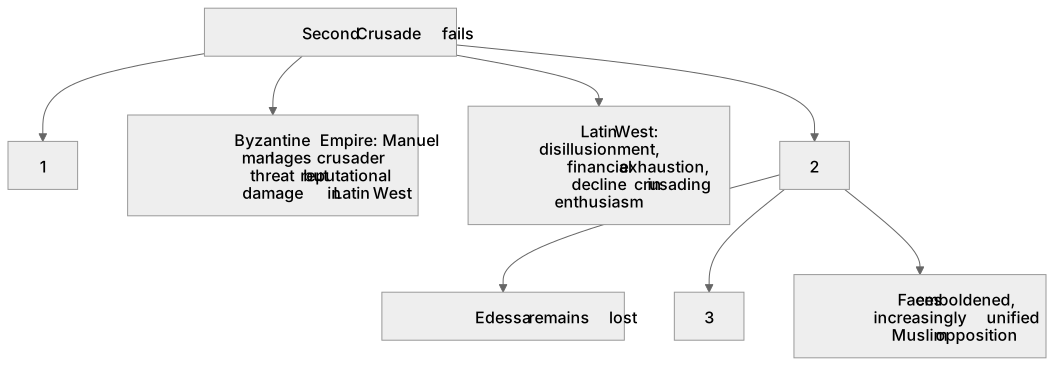
1Box 1
2Box 2
3Box 3
There is more to this lesson
The full lesson goes on to check your understanding and help you earn the marks. Create a free account to carry on, with your progress saved.
A week of Premium from your first lesson · Then the free plan continues · No card, no charge
Test your understanding of 1A The Age of the Crusades, c1071–1204 – The foundation of new states and the Second Crusade, c1099–1149: The impact of the Second Crusade on the Muslim Near East, the Byzantine Empire, the Latin West and Outremer by 1149
Active recall beats re-reading. Take an instant quiz now to test what you’ve learned and lock it into long-term memory.
A week of Premium from your first lesson · Then the free plan continues · No card, no charge